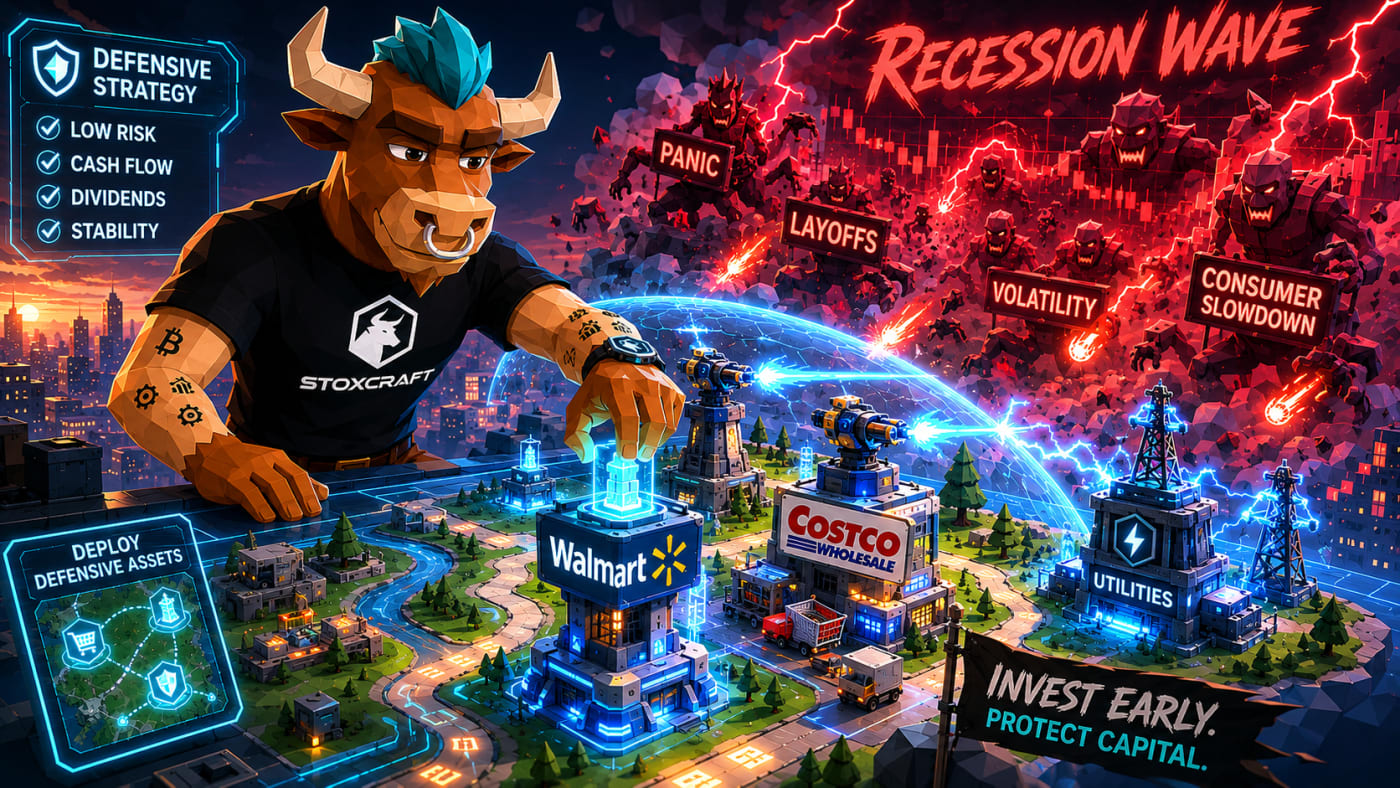
Recession odds are rising. J.P. Morgan places the probability of a U.S. recession in 2026 at 35%. Goldman Sachs puts it at 30%. The VIX sits at 18.43. The S&P 500 is down 1.24%. These are not panic signals. But they are exactly the kind of readings that historically precede a shift in what works.
History has a clear answer for which sectors to own. Consumer Defensive and Utilities held the line in 2008 and again in 2020. In 2026, those same sectors carry the lowest risk profiles across the Stoxcraft universe of 3,486 stocks across 156 industries.
Three names stand out as recession anchors based on both historical data and current ratings: Costco Wholesale (COST), Walmart (WMT), and Atmos Energy (ATO). All three earn 4-star overall ratings on Stoxcraft. Only 48 stocks across the entire Stoxcraft universe earn a 5-star rating. These three sit just below that elite threshold, placing them comfortably among the top-rated names in their sectors. Their edge is not just historical. Their fundamental profiles support it right now.














What the 2008 crash showed about sector resilience
The global financial crisis of 2008 to 2009 remains the clearest stress test in modern market history. The S&P 500 fell roughly 38% from peak to trough. That is more than a third of portfolio value erased in 17 months. Financials and real estate were at the center of the crisis and collapsed entirely. Many individual financial stocks lost between 88% and 99% of their value.
Not all sectors fell with the broad market, though. The divergence between defensive stocks and everything else was dramatic and consistent.
How consumer staples performed during the 2008 crisis
Consumer staples fell just 15% in 2008, against the S&P 500's 37% decline. A 22-percentage-point gap between a sector and the market index is not noise. It is the difference between recovering in one year and spending three or four years clawing back losses.
Only 10 stocks in the current S&P 500 posted positive returns from the October 2007 peak to the March 2009 trough. Nearly every one of them sold essential goods or offered low-cost alternatives to stretched consumers. Utilities, consumer staples, and healthcare have consistently outperformed most S&P 500 sectors when recession fears dominate. That pattern held in 2008 and in every major bear market that followed.
Why Consumer Defensive stocks recovered fastest after the 2008 crash
The businesses beneath consumer staples stocks never broke. People kept buying groceries, paying utility bills, and restocking household products. Revenue stayed relatively stable because demand was inelastic. That stability preserved cash flow, which allowed companies to keep paying dividends and investing through the downturn.
Financials and real estate needed years of recapitalization and regulatory repair before they stabilized. Consumer staples never needed any of that. The businesses just kept running.
What the 2020 crash confirmed about defensive sectors
March 2020 was a shock of a completely different nature. The S&P 500 dropped to 66% of its February 19 peak in under five weeks. Healthcare and consumer staples again outperformed. Consumer staples bottomed at 76% of their pre-crash level. Healthcare held at 72%. Energy collapsed to just 44%, crushed simultaneously by a demand shock and a global oil price war.
The evidence from 2020 reinforced the 2008 lesson with one additional insight. What sector you own during a recession matters more than how many individual stocks you hold. True diversification in a downturn means concentrating in sectors with inelastic demand, not spreading capital evenly across all 11 GICS sectors in equal measure.
Why the 2026 macro environment is worth taking seriously now
The current environment is not in freefall. But several indicators are flashing caution at the same time.
J.P. Morgan Global Research puts 2026 recession probability at 35%. Goldman Sachs is at 30%, raised from 25% earlier in the year. Moody's sits at 49%. Consumer sentiment fell to 49.8 in April 2026, below the 53-point level that historically marks recessionary territory. Year-ahead inflation expectations jumped to 4.7%. The S&P 500 is down 1.24% in recent sessions. The VIX sits at 18.43.
These readings are not signaling an immediate crash. They are signaling a risk environment where investors have historically rotated defensively before the worst of the damage arrived. Sector rotation into Consumer Defensive and Utilities tends to happen before the official recession signal, not after it.
Stoxcraft's analysis of why this selloff feels different and the five biggest forces shaping the stock market in 2026 provide deeper context on the current setup.
How Stoxcraft identifies the top-rated defensive names for 2026
The Stoxcraft system evaluates 3,486 stocks across 156 industries using fundamental strength, price performance, and risk. Its 5-star picks have returned 252% over five years, outperforming the S&P 500 by 174% over the same period. During periods of market stress, Consumer Defensive and Utilities stocks consistently show the lowest risk profiles in the entire universe. Three names currently represent the strongest overall profiles within those sectors, combining low risk with durable fundamentals.
How Costco and Walmart rank as Consumer Defensive anchors
Costco Wholesale (COST) earns a 4-star overall rating on Stoxcraft, placing it among the top-rated names in the Consumer Defensive sector. Its fundamental strength is driven primarily by an exceptional, recurring revenue model. Membership fee income does not fluctuate with consumer spending. The 92.3% member renewal rate in the U.S. and Canada as of fiscal 2025 is a revenue floor that holds regardless of what the economy does.
Costco's stock is up about 17% year to date in 2026, outperforming the S&P 500 by a meaningful margin. That relative strength in a shaky market reflects a business that attracts more value-seeking customers when conditions deteriorate, not fewer. Analyst consensus remains broadly positive, and the setup remains attractive for defensive-oriented investors. See the full profile at Costco on Stoxcraft.
Walmart (WMT) also earns a 4-star overall rating. It is the world's largest retailer, with stores within 10 miles of 90% of the U.S. population. In a recession, that reach becomes a direct competitive advantage. Consumers trade down from specialty retailers and premium brands to value chains. Walmart is the primary destination for that shift.
E-commerce grew 24% year over year in Walmart's fiscal Q4 2026, adding a durable digital layer on top of the already recession-resilient store network. WMT fell around 7% after its most recent earnings report. For investors building a defensive position, a dip in a fundamentally sound, large-cap name of this quality has historically been a favorable entry point. See the full profile at Walmart on Stoxcraft.
Why Atmos Energy stands out as a low-risk anchor in 2026
Atmos Energy (ATO) earns a 4-star overall rating with the most attractive risk profile among the three anchor names. Atmos is a regulated natural gas distributor operating across several Southern U.S. states. Its revenues are tied to regulatory rate frameworks, not to consumer confidence or GDP growth.
That structure creates one of the most predictable income streams in any sector. Regulated utilities do not outperform in bull markets. That is the known tradeoff. The payoff is that their revenue does not disappear in a downturn either. For investors building recession-resistant allocations, that stability is exactly what a rising-risk environment calls for.
The dividend yield Atmos Energy delivers adds a consistent income return even when price appreciation is limited. In 2008 and 2020, that income layer provided a meaningful cushion while price-focused portfolios were falling. See the full profile at Atmos Energy on Stoxcraft.
Utility names like Southern Company (SO) and Duke Energy (DUK) operate under the same regulated revenue model and follow similar risk and income patterns. See Southern Company on Stoxcraft and Duke Energy on Stoxcraft.
Other Consumer Defensive names to watch in the Stoxcraft universe
Beyond the three anchor names, several other Consumer Defensive and healthcare stocks combine strong current ratings with proven recession track records. Four names stand out.
- Procter & Gamble (PG) posted 7% net sales growth and 3% organic sales growth in fiscal Q3 2026. Volume growth alongside pricing is rare in the current environment. It signals a brand with enough strength to hold customers even when margins compress. See Procter & Gamble on Stoxcraft.
- PepsiCo (PEP) combines beverage and snack food revenues with global diversification. Demand for PepsiCo products holds steady through economic cycles. Consistent free cash flow supports ongoing dividend growth. See PepsiCo on Stoxcraft.
- Coca-Cola (KO) carries one of the deepest brand moats in global consumer goods. Earnings have held through every major recession in modern market history. See Coca-Cola on Stoxcraft.
- Johnson & Johnson (JNJ) raised its 2026 guidance and expanded its oncology diagnostics position this year. Healthcare demand does not follow the economic cycle. See Johnson & Johnson on Stoxcraft.
Three things to screen for when building a recession-focused allocation
Looking at the highest-rated names in Consumer Defensive and Utilities on Stoxcraft, three characteristics appear consistently at the top. These are the traits worth prioritizing when building a recession-positioning strategy.
- Strong, recurring cash flow. The top names generate predictable free cash flow from businesses with inelastic demand. Membership fees, regulated rate structures, and essential goods pricing create revenue floors that do not erode when growth slows.
- Low volatility relative to the broader market. In Consumer Defensive and Utilities, risk profiles cluster below the Stoxcraft universe median. That is structural. Lower volatility means a shallower drawdown during stress and a faster recovery after it ends.
- Dividend income as a return floor. In 2008 and 2020, dividends provided meaningful total returns when price appreciation disappeared. Companies that sustain and grow payouts through a downturn compound returns even in flat or falling markets.
If you are building a portfolio with recession resilience as the goal, the Stoxcraft guide on building your first investment portfolio covers the process from the ground up. For those weighing the timing question directly, the Stoxcraft guide on whether to invest now addresses it head-on.
Why acting before the recession signal beats waiting for it
Consumer staples are outperforming the S&P 500 for the first time since the 2022 bear market as investors rotate ahead of rising recession risk. This pattern has repeated before every major downturn. Capital shifts defensively before the official contraction arrives. By the time the data confirms a recession, the best entry points are already gone.
The historical record from 2008 and 2020 is consistent. Consumer Defensive and Utilities held the line when everything else fell. The specific stocks that held best were businesses with low-risk profiles, strong and durable cash flows, and essential-service demand that does not disappear in a downturn.
Those same characteristics define the top-rated names in these sectors on Stoxcraft today. COST, WMT, and ATO carry 4-star overall ratings for the same fundamental reasons that consumer defensive and utility stocks outperformed in both prior recessions. The fundamentals are strong. The risk profiles sit below the universe median. The income cushion from dividends adds downside protection that price-only plays cannot replicate.
This is not a call to abandon growth entirely. The buy-and-hold case for quality compounders over multi-year time horizons remains intact. What the data argues for is tilting toward resilience now, while the probability of a downturn is elevated and before the crowd makes the same move. The window for that positioning tends to be shorter than investors expect.