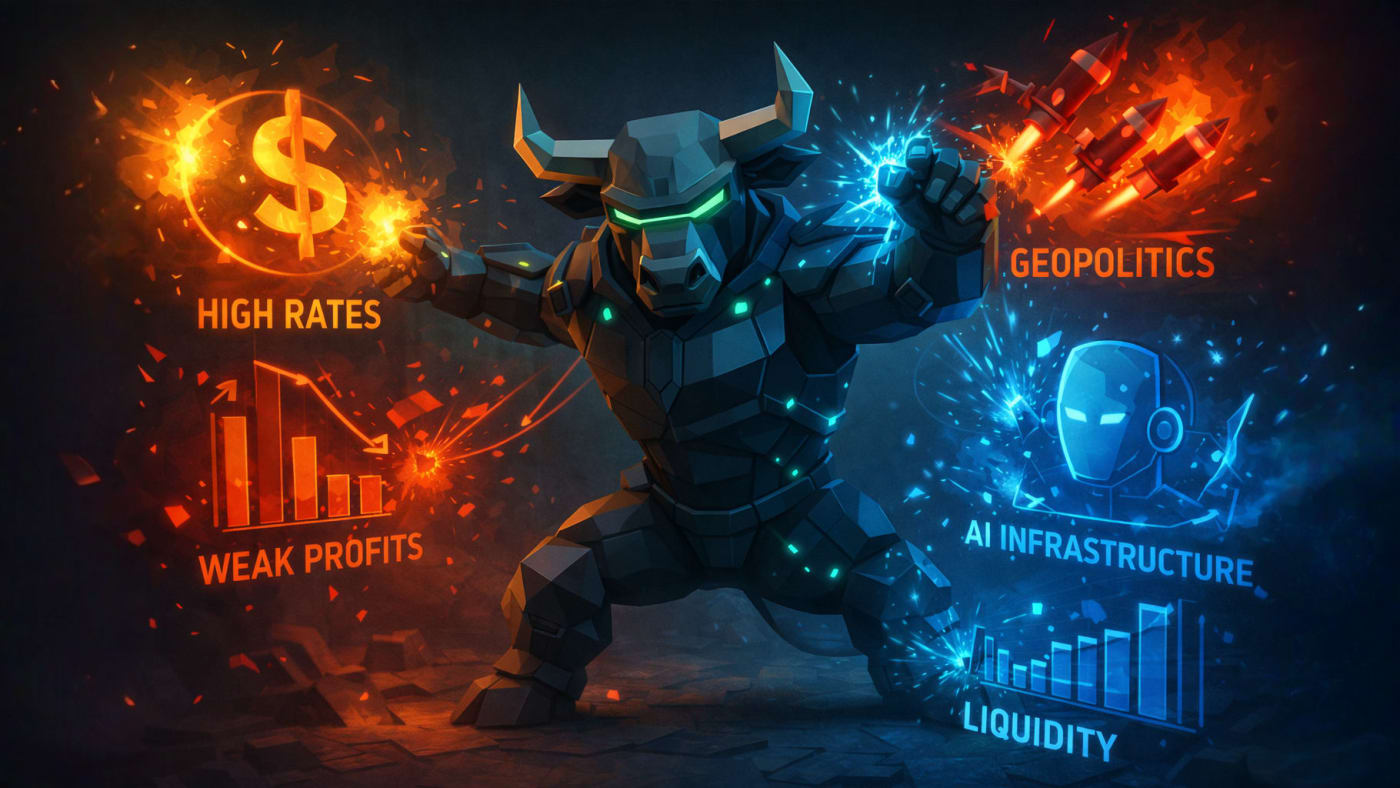
What really matters for markets in 2026
Markets don’t move because of one headline.
They move because a few big forces quietly decide where money feels safe and where it doesn’t.
By the time a trend shows up in your feed, markets have usually been reacting to it for months.
So instead of guessing the next headline, it’s worth looking at the patterns that actually matter heading into 2026. We’ve seen them before. Just never all at once.
Here are the five forces likely to shape how stocks behave next year and which parts of the market could feel the impact.
1. Interest rates won’t vanish. Even if cuts happen.
After more than a decade of free money, markets had to relearn an uncomfortable concept: capital has a price.
Between early 2022 and mid-2023, U.S. rates jumped from near zero to above 5% (Source: Discover.com) That single shift broke a lot of business models that only worked when borrowing felt like a cheat code.
We’ve been here before. In the mid-2000s, rates stayed above 4% for years. Stocks still went up, but only the ones that could survive without constant refinancing. Leverage-heavy stories didn’t age well.
For 2026, even if rate cuts arrive, this isn’t a return to the zero-rate era. Money won’t be free again. And markets know it.
That favors companies that don’t need financial gymnastics to stay alive.
Some stocks that stand to benefit from this trend include:
- JPMorgan Chase, benefiting from stable net interest margins
- Berkshire Hathaway, sitting on cash that finally earns real returns
- BlackRock, seeing flows into cash and fixed income products
- Visa, largely unaffected by rate drama thanks to its fee-based model
- Johnson & Johnson, boring in the best possible way with steady cash flows









2. Earnings quality matters more than earnings growth
In 2021, growth was enough. Sometimes just saying “growth” worked.
That stopped working fast.
During the 2023 and 2024 earnings seasons, markets repeatedly sent the same message: beating revenue estimates doesn’t matter if margins are falling or guidance sounds nervous.
This isn’t new either. After the dot-com era, investors stopped caring about promises and started caring about profits. History didn’t repeat. It rhymed.Heading into 2026, two companies can grow at the same pace. Only one will be rewarded. The one that turns growth into actual cash.
Companies aligned with this shift include:
- Microsoft, built on recurring revenue and operating leverage
- Apple, where pricing power does the heavy lifting
- Procter & Gamble, proof that boring can still outperform
- LVMH, using brand strength to defend margins
- UnitedHealth Group, predictable cash flows in an unpredictable world






3. AI shifts from hype to hard infrastructure
AI already had its main character moment.
Now comes the less glamorous part: power, cooling, hardware and grids. The stuff nobody flexes on social media, but everyone depends on.
We’ve seen this movie before. In the late 1990s, software stole the spotlight. In the early 2000s, infrastructure quietly became the real winner. The AI cycle is following the same script.
By 2024, global data center spending crossed $290 billion per year (Source: IOT Analytics). Power demand from AI workloads is climbing fast. That means real-world bottlenecks, not just cloud buzzwords.
By 2026, AI exposure won’t be limited to a handful of mega-cap names.
Companies positioned along this infrastructure layer include:
- NVIDIA, still the backbone of AI compute
- ASML, a quiet gatekeeper of advanced chip production
- Schneider Electric, benefiting from rising power demand
- Siemens, tied to automation and grid upgrades
- Vertiv, focused on cooling and power systems data centers can’t live without





4. Geopolitics becomes a permanent market variable
Geopolitics used to be an occasional shock. Now it’s background noise.
From supply chain chaos in 2020 to energy shocks after 2022, markets learned that politics doesn’t just move headlines. It moves earnings.
During the Cold War, markets didn’t collapse. They adapted. Certain industries benefited from long-term government spending while others lived with constant uncertainty.
That’s the setup heading into 2026.
Geopolitics doesn’t mean permanent fear. It means selective support and recurring volatility.
Stocks exposed to this shift include:
- Lockheed Martin, backed by long-term defense budgets
- Rheinmetall, riding Europe’s rearmament cycle
- Exxon Mobil, tied to global energy security
- NextEra Energy, benefiting from infrastructure investment
- Honeywell, spread across aerospace, safety and industrial systems







5. Liquidity quietly decides how far markets can run
Liquidity never trends on X. But it decides who survives the pullback.
In 2018, markets sold off hard even though the economy looked fine. Growth wasn’t the issue. Liquidity was. When money gets tighter, markets stop forgiving mistakes.
That dynamic hasn’t disappeared.
By 2026, rates may come down, but balance sheets remain bloated and government borrowing stays high. That creates a fragile setup where markets can look calm right until they aren’t.
Companies positioned to benefit from higher volatility include:
- S&P Global, as demand for market data increases
- CME Group, benefiting from higher trading activity
- Goldman Sachs, exposed to capital markets and volatility
- Blackstone, operating with long-term locked-up capital
- Moody’s, seeing more demand as refinancing pressure rises





What this means heading into 2026
There won’t be one story that explains markets in 2026.
Leadership will rotate. Volatility will show up without warning. Indexes might look fine while individual stocks quietly struggle.
None of these forces are new. We’ve seen all of them before. Just not stacked on top of each other like this. That’s the market setup investors are walking into next year.