Why cybersecurity has never mattered more
Everyone remembers the hacks that shattered the illusion of digital safety.
The PlayStation Network outage in 2011 that locked out 75 million gamers for 23 days.
The Ashley Madison leak that exposed millions of private affairs and triggered global scandal.
The Yahoo breach that quietly turned into the largest credential theft in internet history.
These were not just headlines. They were collective reminders that our digital lives rest on fragile foundations.
Today the stakes are far higher. AI accelerates attackers. Cloud systems run critical infrastructure. Hospitals, banks, airports and entire governments depend on networks that cannot fail. Global cybercrime damages are projected to reach 13.8 trillion dollars by 2028.
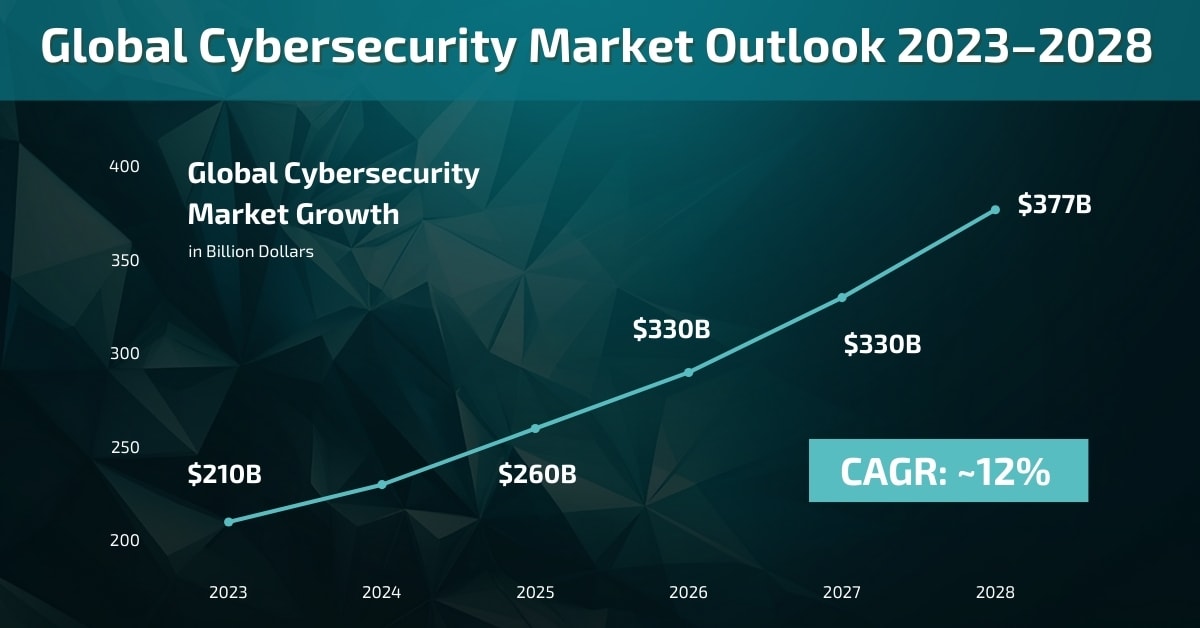
Cybersecurity is no longer a technical category. It is the safety net of the modern economy. Sectors with explosive growth like cybersecurity don’t just attract capital – they also amplify behavioral investing biases that quietly influence decision-making during hype cycles.
The cost of a breach keeps climbing
A data breach used to be an IT incident. Now it is a financial shock.
The average global breach costs 4.4 million dollars. In the United States the average rises above 10 million dollars. Multi cloud breaches reach 5.05 million dollars because they take longer to detect and contain.
Ransomware drives 75% of major incidents. Attackers encrypt systems, steal data or impersonate employees to bypass internal controls. AI is amplifying the threat. Around 30% of companies have already faced attacks on their AI systems and more than 60% report deepfake attempts used to manipulate identity verification.

The attack surface has expanded from servers to people to models to entire digital ecosystems.
The hacks that shaped modern cybersecurity
Before understanding the 2025 market, it helps to revisit the breaches that defined the industry’s mindset. These events were not random accidents. They became the blueprint for how organizations think about digital risk.
The PlayStation Network hack showed how quickly a global ecosystem collapses when core systems fail. The Ashley Madison leak demonstrated the devastating social and reputational fallout of sensitive data exposure. The Yahoo breach revealed how long attackers can remain inside a system undetected. Target and JP Morgan reminded the world that even multibillion dollar enterprises can crumble under the weight of a single weak entry point.
Across nearly all cases the pattern was the same. One reused password. One unpatched server. One missing authentication layer. Small oversights with massive consequences.
Top 10 most impactful cyberattacks of the modern era
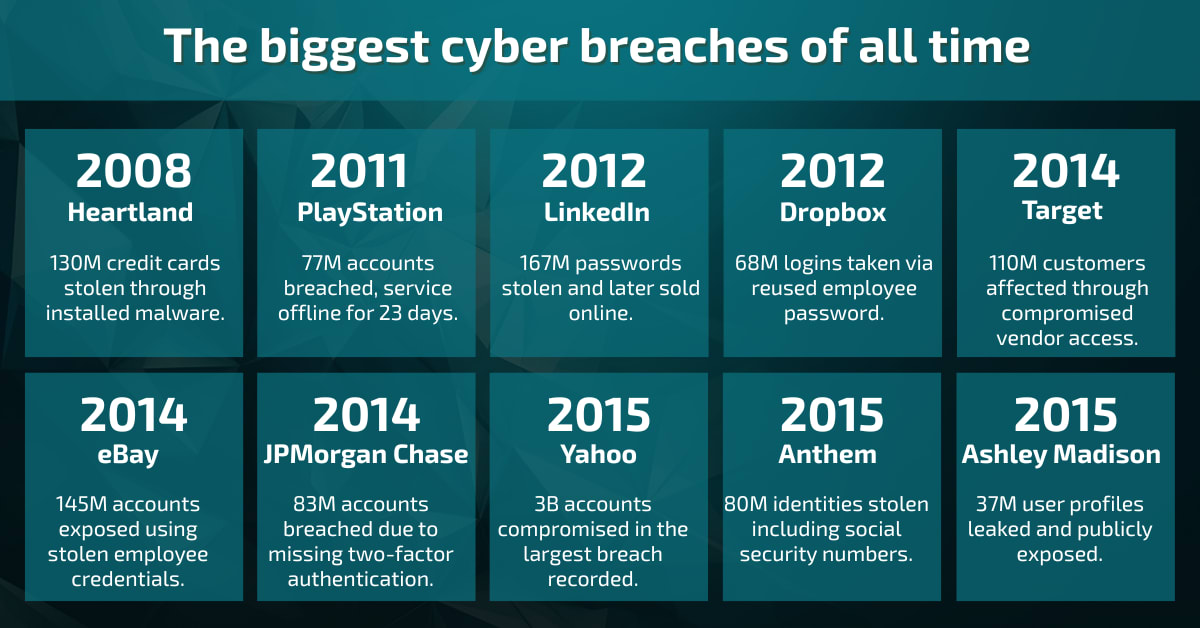
These attacks reshaped budgets, regulations and expectations. They taught organizations that the real danger is not the sophistication of the attacker but the simplicity of the vulnerability. That lesson still defines modern cybersecurity strategy.
A widening talent gap is transforming the industry
There are around 5.5 million cybersecurity professionals worldwide.
The industry needs nearly 4.8 million more.
This shortage is pushing organizations toward automation, managed security services and platform consolidation. Most budgets now focus on cloud protection, identity security, endpoint defense and data protection.
More than 90% of cybersecurity spending flows through partners. This reflects a structural shift from isolated tools to unified platforms that secure every major attack surface through a single architecture.
Enterprises no longer want dozens of disconnected products. They want one system that protects everything.
The rise of the security platform
This structural shift explains why companies like CrowdStrike, Palo Alto Networks, Zscaler, Fortinet and CyberArk are scaling faster than the broader market.
CrowdStrike is targeting 10 billion dollars in annual recurring revenue.
Zscaler operates one of the world’s largest Zero Trust clouds.
Palo Alto Networks is combining endpoint, cloud, identity and automation into a single expanding platform.
The market is moving toward one clear direction. Attackers use AI for rapid phishing, automated exploits and realistic deepfake impersonation. Defenders use AI for anomaly detection, log analysis and automated containment. Cybersecurity is becoming a competitive race between two learning systems.
This shift has created one of the strongest and most structurally resilient investment universes in technology. The sector offers a wide range of companies that benefit directly from rising security budgets, expanding attack surfaces and the transition from tools to unified platforms. Below is a small selection of stocks worth watching, each representing a different layer of modern digital defense.
Cybersecurity stocks to watch
CRWD
 228.10
+0.31%
8.3
Sell
Buy
© Stoxcraft
228.10
+0.31%
8.3
Sell
Buy
© Stoxcraft


 CrowdStrike Holdings, Inc.
FTNT
CrowdStrike Holdings, Inc.
FTNT
 171.50
+1.40%
4.8
Sell
Buy
© Stoxcraft
Fortinet, Inc.
ZS
171.50
+1.40%
4.8
Sell
Buy
© Stoxcraft
Fortinet, Inc.
ZS
 212.53
+2.48%
7.4
Sell
Buy
© Stoxcraft
Zscaler, Inc.
PANW
212.53
+2.48%
7.4
Sell
Buy
© Stoxcraft
Zscaler, Inc.
PANW
 346.95
+1.45%
5.9
Sell
Buy
© Stoxcraft
Palo Alto Networks, Inc.
346.95
+1.45%
5.9
Sell
Buy
© Stoxcraft
Palo Alto Networks, Inc.
CrowdStrike
A leader in cloud delivered endpoint and identity protection built on an AI driven architecture that scales across enterprises.
Palo Alto Networks
A dominant platform player focused on cloud, network and security automation with strong long term momentum.
Zscaler
The core of the Zero Trust movement, securing traffic between users, applications and devices without relying on traditional perimeter models.
Fortinet
Known for high performance security hardware and integrated software suites designed for networks from branch offices to global enterprises.
CyberArk
A specialist in identity security and privileged access protection, a crucial defense layer in preventing internal and external breaches.
The long game
Cybersecurity is not a trend. It is the foundation of digital trust.
Every cloud migration, every AI workload, every mobile identity and every connected device expands the attack surface. This is why budgets remain high. This is why they continue to grow even in economic downturns.
Cybersecurity is one of the few technology sectors where demand is driven not by excitement but by risk, and risk is scaling continuously.
For investors it is one of the most durable long term opportunities in the digital economy.
For companies it is a requirement for resilience.
For the modern world it is the seatbelt that keeps everything functioning.
And if you want to explore even more standout companies across the cybersecurity landscape, the Firewall Force Booster Pack offers a curated selection of stocks that represent the sector’s most dynamic and influential players.