What a K-shaped market means for stock investors
Not every market downturn looks the same. A crash hits everything. A correction pulls the broad index lower. A K-shaped market is different. It splits.
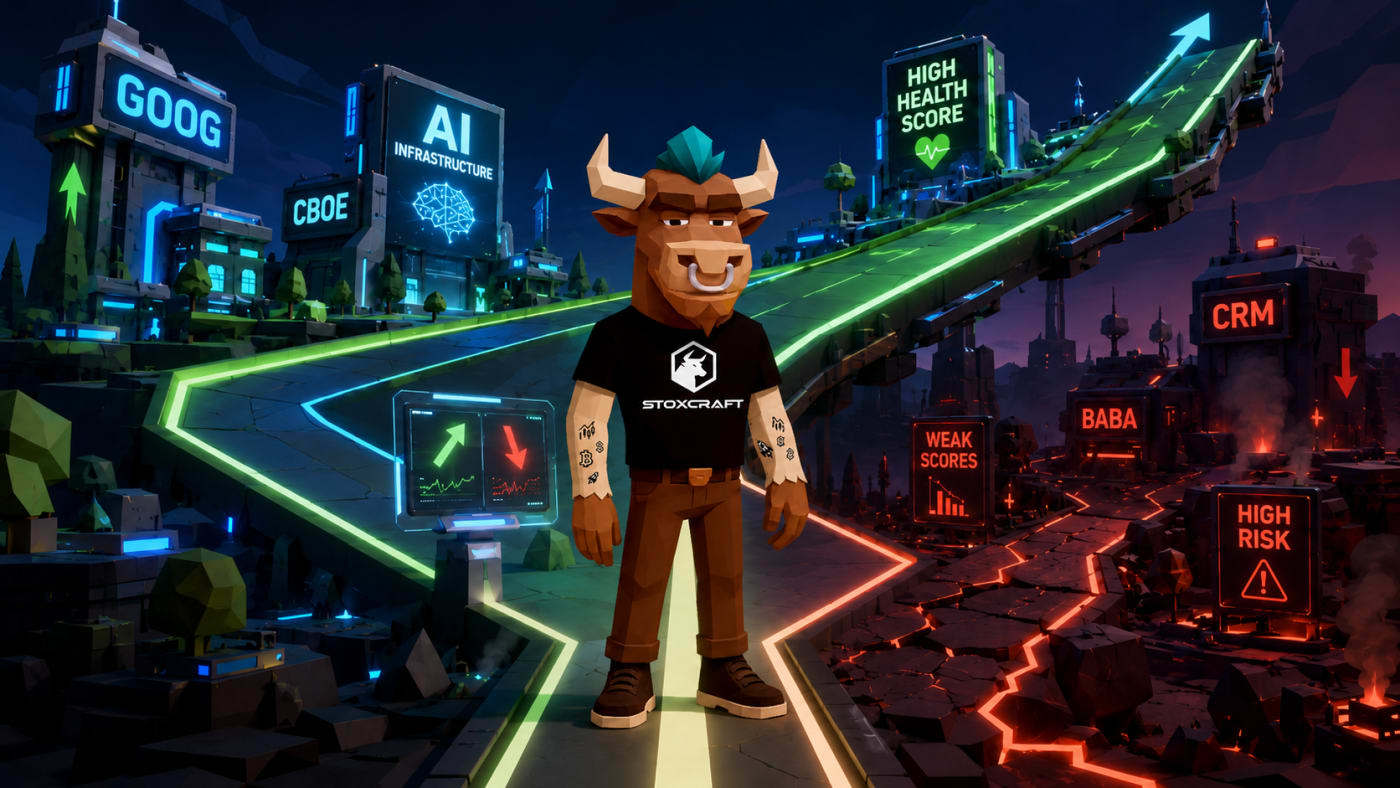
The letter K is not decoration. Picture the vertical stroke as time moving forward. Then two lines branch off. One arm climbs. The other drops. That is what a K-shaped market looks like in practice. One group of stocks keeps rising while another keeps falling, and both trends deepen over time.
This concept gained traction during the post-COVID recovery, when large businesses and high-income households bounced back while others stayed stuck. Economists call this a K-shaped economy, where the fortunes of two distinct groups diverge increasingly over time. In 2026, that same dynamic has moved directly into the stock market.
The data backs it up. The S&P 500 equal-weighted index rose 5.5% during the first 32 trading sessions of 2026 while its market-cap-weighted counterpart gained just 0.1%, representing the widest gap at this point in the year since the early 1990s.
That gap is a signal. It tells you that broad-market gains are concentrated in a small number of large winners. Everyone else is getting left behind.
The spread Stoxcraft data reveals across 3,486 stocks
Stoxcraft scores stocks across six dimensions using a proprietary formula applied to a live universe of 3,486 stocks across 156 industries. The overall rating is displayed publicly as a decimal. A score of 9.6 is exceptional. A score of 3.4 is weak. The gap between those two numbers tells the whole story about the 2026 market.
Two pairs of stocks illustrate the bifurcation clearly.
GOOG vs. CRM: the AI infrastructure divide
Alphabet (GOOG) sits at a Stoxcraft overall rating of 9.6. Salesforce (CRM) sits at 3.4. These are two of the most recognized names in enterprise technology, and the chasm between their scores reflects a real divergence in business trajectory.
Alphabet's score is driven by fundamentals that have held up as the company bets aggressively on AI. Alphabet's Q1 2026 revenue hit $109.9 billion, up 22% year over year, with Google Cloud growing 63% to $20 billion and net income jumping 81% year over year to $62.58 billion. That is not a company in distress.
Salesforce is a different picture. Salesforce stock slumped 35% year to date in 2026, with Bank of America reinstating coverage at underperform and setting a $160 price target, warning of structurally lower growth running at around 10% annually. The fear is not that Salesforce has bad products. The fear is that AI-native tools can replicate its core functionality at lower cost.
A 62-point gap in overall ratings between two enterprise tech names is significant. It reflects different momentum trajectories, different free cash flow profiles, and different positioning relative to the AI shift.
CBOE vs. BABA: rates, geography, and investor risk appetite
Cboe Global Markets (CBOE) holds a Stoxcraft overall rating of 8.7. Alibaba Group (BABA) sits at 4.7. These are global leaders in their categories, separated by a 40-point score spread.
CBOE benefits from elevated market volatility. When rates stay high and traders hedge more, CBOE's exchanges generate more volume and more fee income. Its Health Score reflects stable, recurring revenue rather than exposure to a single product cycle.
Alibaba faces a different set of pressures. Regulatory risk in China has not resolved. Geopolitical tension between the US and China creates persistent uncertainty around Chinese-listed stocks. While Alibaba's fundamentals are not broken, the drawdown from its 52-week high has damaged its Risk Score and pulled its overall rating down.
The point is not that BABA is a bad company. The point is that 2026 is punishing stocks with persistent external risk, even when the core business still functions.
Three forces driving the 2026 stock market bifurcation
The K-shape does not form by accident. Three forces are widening the split in 2026, and each one is measurable in Stoxcraft score data.
AI capital deployment as a separating mechanism
Stocks tied to AI infrastructure are pulling away from everything else. This is not only about owning AI stocks. It is about which companies are the infrastructure that AI runs on.
Nvidia (NVDA), Meta Platforms (META), and Amazon (AMZN) are deploying capital at a scale that locks in competitive position for years. The market-cap-weighted S&P 500 now trades at a nearly 30% premium to its equal-weighted version, up from approximately 13% before the pandemic, as index concentration has risen significantly faster than earnings contribution. That premium reflects investors pricing in a structural advantage for AI infrastructure leaders.
The stocks on the wrong side of AI capital are not necessarily weak businesses. But they are being repriced lower as investors question whether AI will erode their competitive position. Salesforce is the clearest case in the software space. Traditional CRM functionality is increasingly replicable by AI at lower cost. That fear is already in the stock price.












The interest rates environment and which stocks it rewards
Elevated rates create clear winners and losers, and that effect shows up in Stoxcraft score distributions across the universe.
The stocks that benefit from a higher-rate environment share certain characteristics:
- Strong pricing power that protects margins even as borrowing costs rise
- Revenue models that do not depend on cheap capital to grow
- Low debt loads relative to operating income
- High interest coverage ratios signaling financial resilience
CBOE fits that profile. Financial exchanges generate fee income regardless of rate direction. And when rates drive higher volatility and hedging activity, exchange volume rises with it.
The stocks that suffer in this environment are typically growth names with deferred profitability, high debt, or businesses that depend on enterprise customers cutting costs. When rates stay elevated, those customers reduce software contracts and defer IT budgets. That shows up in slowing revenue growth and weaker Health Scores.
Fundamentals as the deciding factor when markets split
During the 2021 zero-rate era, nearly any growth story could attract capital. Now, with rates still elevated and macro uncertainty persistent, the market is sorting stocks by actual financial quality.
Stoxcraft's Health Score captures this directly. It measures financial fundamentals relative to sector peers, covering profit margins, debt coverage, revenue growth, and free cash flow generation. In a bifurcated market, the Health Score becomes the clearest predictor of which arm of the K a stock belongs to.
The stocks in the upper arm of the K consistently share these score characteristics:
- High Health Scores reflecting strong fundamentals versus sector peers
- Moderate Risk Scores showing stability rather than extreme volatility
- Upward-trending Performance Scores reflecting multi-year momentum
- Positive TrendMeter readings backed by RSI and MACD confirmation
The stocks in the lower arm tend to have weak Health Scores, deteriorating Performance Scores, and Risk Scores elevated by large drawdowns from prior highs.
Which score signals place a stock on the upper K-curve
Identifying the upper K-curve is not about finding the most expensive or most hyped names. It is about finding stocks where multiple scoring dimensions align and point in the same direction simultaneously.
The Stoxcraft scoring system is built for exactly this kind of environment. The Stoxcraft Screener filters the full 3,486-stock universe by score dimensions to isolate names where Health, Performance, and Risk all point to strength at once.
In a bifurcated market, you want to filter for:
- Overall ratings above 7.0, placing a stock in the top tier of the universe
- Health Scores above 7.0, meaning fundamentals are in the top third relative to sector peers
- Risk Scores below 5.0, meaning the stock carries less risk than half the universe
- Positive TrendMeter direction, confirmed by RSI above 50 and MACD still pointing upward
Stocks passing all four filters are operating in the upper arm of the K. Strong business, manageable risk, technical confirmation.
Palantir Technologies (PLTR) is one name that has drawn attention in this environment. Its full scoring breakdown on Stoxcraft shows how its dimensions have shifted as defense and AI government spending accelerated through 2026.
The sector-rotation story of 2026 also runs through this analysis. Technology infrastructure is rotating up. Traditional software, legacy retail, and rate-sensitive sectors are rotating down. The full picture of what is driving the market in 2026 maps that rotation across sectors.
The lower K-curve: what stocks with falling scores share
The lower arm of the K is not one single story. It is a collection of different problems that share one outcome: falling scores and sustained price underperformance. Stoxcraft data from the bottom 30% of the universe reveals consistent patterns across these names.
Stocks in the lower arm tend to share these characteristics:
- Health Scores below 4.0, placing them in the bottom half of their sector peer group on fundamentals
- Risk Scores above 6.0, driven by elevated drawdown and above-average price volatility
- Declining or flat Performance Scores reflecting sustained underperformance versus the broader market
- Negative or sideways TrendMeter readings, with RSI stuck below 45
These are not always broken companies. Some have solid core businesses. But they are caught in a combination of external headwinds, high risk perception, and weak momentum that makes it difficult for prices to recover. The Stoxcraft news article on stocks with comeback potential in 2026 identifies which lower-tier names the data suggests may be mispriced.
What a bifurcated market means for how you screen
A K-shaped market rewards a different approach to stock selection than a broad bull run. When everything rises, sector selection is enough. When markets bifurcate, individual stock quality becomes the deciding factor and the margin for error shrinks.
Three practical shifts follow from the 2026 data:
- Score alignment over single-metric screening. A high Health Score alone does not guarantee upper-K placement. Look for alignment across Health, Performance, and Risk simultaneously.
- Risk Score as a triage tool. In a bifurcated market, a high Risk Score is a warning signal that a stock may be in the lower arm regardless of other metrics. Elevated drawdown from 52-week highs is a consistent lower-K marker.
- TrendMeter as a confirmation signal. Do not buy fundamentals against a deteriorating trend. Wait for TrendMeter to confirm that the market is agreeing with the fundamental thesis before taking a position.
The Stoxcraft Screener is the most direct way to apply all three filters to the full universe at once.
Where to position in a market that has already chosen sides
The 2026 K-shaped market has one defining characteristic: it rewards clarity. Stocks with strong, aligned scores stay in the upper arm. Stocks with weak or misaligned scores slide further down.
The data from 3,486 stocks is not ambiguous. The top decile is pulling away. The bottom 30% is losing ground. The three forces driving the split, AI capital, interest rates, and fundamental quality, are all measurable in real time through Stoxcraft's scoring system.
The Stoxcraft five-star picks, roughly 48 stocks out of the full universe, have historically reflected upper-arm characteristics. Those picks returned 252% over five years compared to 78% for the S&P 500. The methodology producing that track record is the same methodology now identifying which stocks belong to each arm of the split.
The question is not whether the market is splitting. The data settles that. The question is which side of the split your current holdings are on, and whether the scores confirm your thesis or contradict it.