A company announces a stock split. The share price drops. But the business did not change at all. No new products. No earnings beat. No news. Just math. So why do investors react so differently to a forward split versus a reverse split? Because the number tells only half the story. The other half is what the split signals about where the company is headed.
What a stock split is and how it works
A stock split is a corporate action that changes the number of shares outstanding and adjusts the price per share by the same factor. The total market capitalization stays identical. Think of it like cutting a pizza into more slices. The pizza does not get bigger. You just have more pieces.
Companies do this for different reasons, and those reasons reveal a lot about the business behind the action.
How a forward stock split works
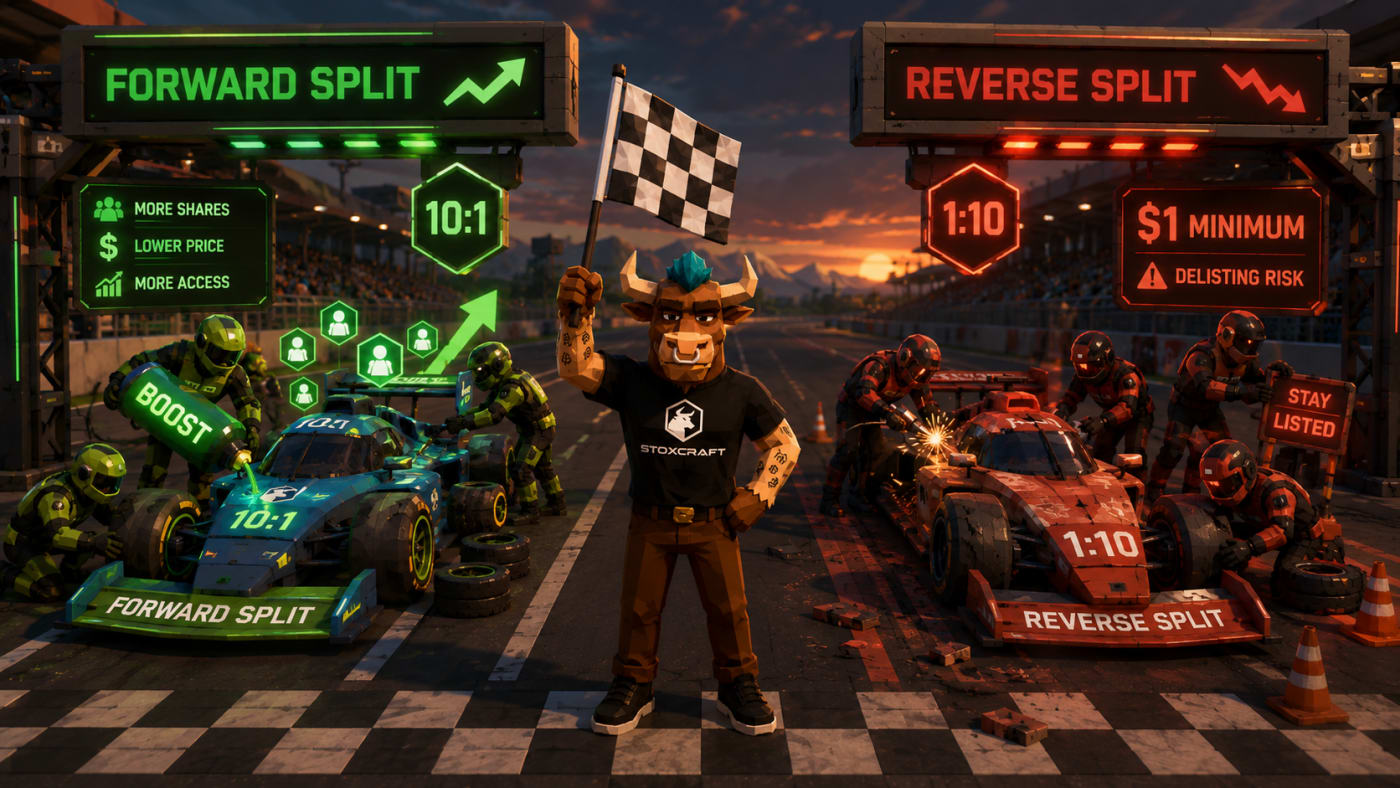
In a forward split, the company increases its share count and lowers the price per share. The most common ratios are 2-for-1, 3-for-1, and 10-for-1. If you own 100 shares at $500 each and the company does a 10-for-1 split, you now own 1,000 shares at $50 each. Your total holding is still worth $50,000. Nothing changed financially.
The reason companies do this is to lower the share price and make the stock more accessible. A $1,200 stock feels out of reach for many retail investors. A $120 stock feels much easier to buy. It is a psychological play as much as a practical one.
Nvidia (NVDA) executed a 10-for-1 forward split in June 2024. The company's share price dropped from over $1,200 to around $120 on a split-adjusted basis, making ownership far more accessible to retail investors and employees in equity programs. Nvidia had not changed its fundamentals. It had simply lowered the sticker price for new buyers.
How a reverse stock split works
A reverse split does the opposite. The company reduces its share count and raises the price per share. In a 1-for-10 reverse split, every 10 shares you own become 1 share. If you held 1,000 shares at $0.50 each, you now hold 100 shares at $5.00 each. Same total value. Same company. Very different vibe.
Reverse splits are almost always done for one reason: to avoid being kicked off a stock exchange. The NYSE and Nasdaq both require companies to maintain a minimum share price of $1.00. When a stock slips below that level for 30 consecutive trading days, the exchange sends a deficiency notice. A reverse split is the quickest fix.
Why forward splits attract attention and capital
When a high-growth company announces a forward split, the market usually pays attention. The move signals that the share price has risen far enough to be considered expensive for average investors. Only companies that have performed extremely well reach that point.
Bank of America research found that stocks completing forward splits delivered an average one-year return of 25% from the date of the split announcement. That figure reflects the strength of the underlying business, not the split itself, but the pattern is consistent.
In 2024, some of the most prominent companies in the market completed forward splits. More than a dozen high-profile companies, including Nvidia (NVDA), Walmart (WMT), and Broadcom (AVGO), announced or completed forward splits in 2024, with only one reverse split among them. Netflix (NFLX) followed with a 10-for-1 forward split in November 2025, bringing its share price from above $1,000 to just over $100. These were companies at the peak of their market cycles, not the bottom.
Why reverse splits are a warning sign investors should not ignore
Reverse splits carry a very different reputation. The mechanics are neutral. The context rarely is.
Most companies that do a reverse split are trying to stay listed on a major exchange. Their stock has fallen to near zero. The business is struggling. The reverse split buys them time, but it does not fix the underlying problem.
Research from NYU Stern School of Business and Emory University tracked over 1,600 reverse splits from 1962 to 2001. Stocks that completed reverse splits underperformed their peers by 15.6% in the first year, 36% in the second year, and 54% in the third year. Those numbers are hard to ignore.
When reverse splits become serial events
A company that does one reverse split and then stabilizes is one thing. A company that does multiple reverse splits over a few years is almost always in serious trouble.
LogicMark (LGMK), for example, executed three reverse splits between 2021 and 2024, with ratios of 1-for-10, 1-for-20, and then 1-for-25. An investor holding 5,000 shares before the first split ended up with just one share after all three. The stock declined nearly 99% across that period.
This pattern is common enough that regulators responded. In January 2025, the SEC approved new rules from both the NYSE and Nasdaq that restrict how often companies can use reverse splits to avoid delisting. Under the updated Nasdaq rules, any company that completes a reverse split and then falls below the $1 minimum bid price within one year faces an immediate delisting determination, with no compliance grace period.
What the 2023 and 2024 reverse split data shows
A record 495 reverse splits were enacted by listed companies in 2023, pushing regulators to act. In Q1 2025 alone, 93 reverse stock splits occurred, the highest quarterly total in over ten years, with most concentrated in small biotech stocks, followed by technology and energy companies.
These are not healthy companies making strategic moves. They are mostly small-cap and micro-cap stocks trying to survive. The volatility that follows a reverse split is often severe, as the reduced share count and thin trading volume create wide price swings.









The signals each split sends about a company's health
The split type tells you something the financial statements alone may not. Here is how to read each one.
Neither split guarantees what happens next. But across thousands of companies, the pattern is consistent: forward splits cluster around strength, and reverse splits cluster around distress.
How splits affect your position as a shareholder
Regardless of the split type, your proportional ownership in the company does not change. If you own 1% of a company before a split, you still own 1% after. The math always balances out.
What does change is the nominal price and the number of shares in your portfolio. That affects some practical things worth tracking.
What splits mean for stock indexing and index funds
If you own an index fund or ETF, stock splits happen quietly in the background. Index providers and fund managers rebalance to account for the new share count and adjusted price. You do not need to do anything. Your exposure to the underlying company stays the same.
However, when a company in an index completes a reverse split due to poor performance, it may eventually be removed from the index altogether. That triggers a rebalancing event and can affect the prices of remaining index components.
Splits in the context of broader market conditions
Forward stock splits tend to cluster in bull market environments. When equities are rising and investor confidence is high, more companies find their shares trading at elevated prices. The AI-driven surge in semiconductor and tech valuations in 2024 pushed prices into territory where splits became practical.
Reverse splits, by contrast, tend to spike during periods when market sentiment deteriorates. When broad indices are under pressure and speculative stocks fall hard, small-cap companies race to stay listed. The record 2023 reverse split numbers came after the 2022 rate-hiking cycle, which crushed high-multiple and unprofitable companies.
A forward split during a correction carries more weight than one in a raging bull market. A reverse split in a stable market is a louder warning than one during a broad crash.
What the stock price alone cannot tell you
Here is what most investors miss: price per share is almost meaningless without context. A $5 stock is not cheap. A $1,500 stock is not expensive. What matters is what you get per dollar invested, not the nominal share price.
A $5 stock that just did a 1-for-25 reverse split was $0.20 before the split. The company is the same. The problems are the same. The split just moved the decimal point.
A $150 stock that just did a 10-for-1 forward split was $1,500 before the split. The company is the same. The growth is the same. The split just lowered the sticker price for new buyers.
This is why evaluating the underlying business, not the post-split price, determines whether a position is worth holding. A split is a signal. It is not the verdict. For a framework to evaluate any stock before or after a split, read how to build your first investment portfolio the Stoxcraft way.
What forward and reverse splits mean for your investing decisions
Two stocks split. One deserves further research. The other deserves serious scrutiny. Here is how to approach each.
Avoiding common traps around corporate actions like these is one of the most valuable habits a new investor can build. The guide on 5 investing mistakes every beginner should avoid covers several patterns that apply directly here.
Splits, signals, and the business case behind each one
Stock splits are among the most misunderstood corporate actions in public markets. They generate headlines, move prices on announcement day, and trigger retail buying or selling based on the wrong reasons.
The split itself changes nothing. The share count adjusts. The price adjusts. The total market value stays the same. What the split reveals is why a company's leadership chose to act at this particular moment, and whether that decision reflects confidence or desperation.
Forward splits are the moves of companies that have earned a high price and want more investors to participate. Reverse splits are usually the moves of companies trying to buy time. There are exceptions in both directions. But the historical data is consistent. Read the context before you read the price.