Three companies made headlines with a stock split in 2026. That is usually where the coverage stops.
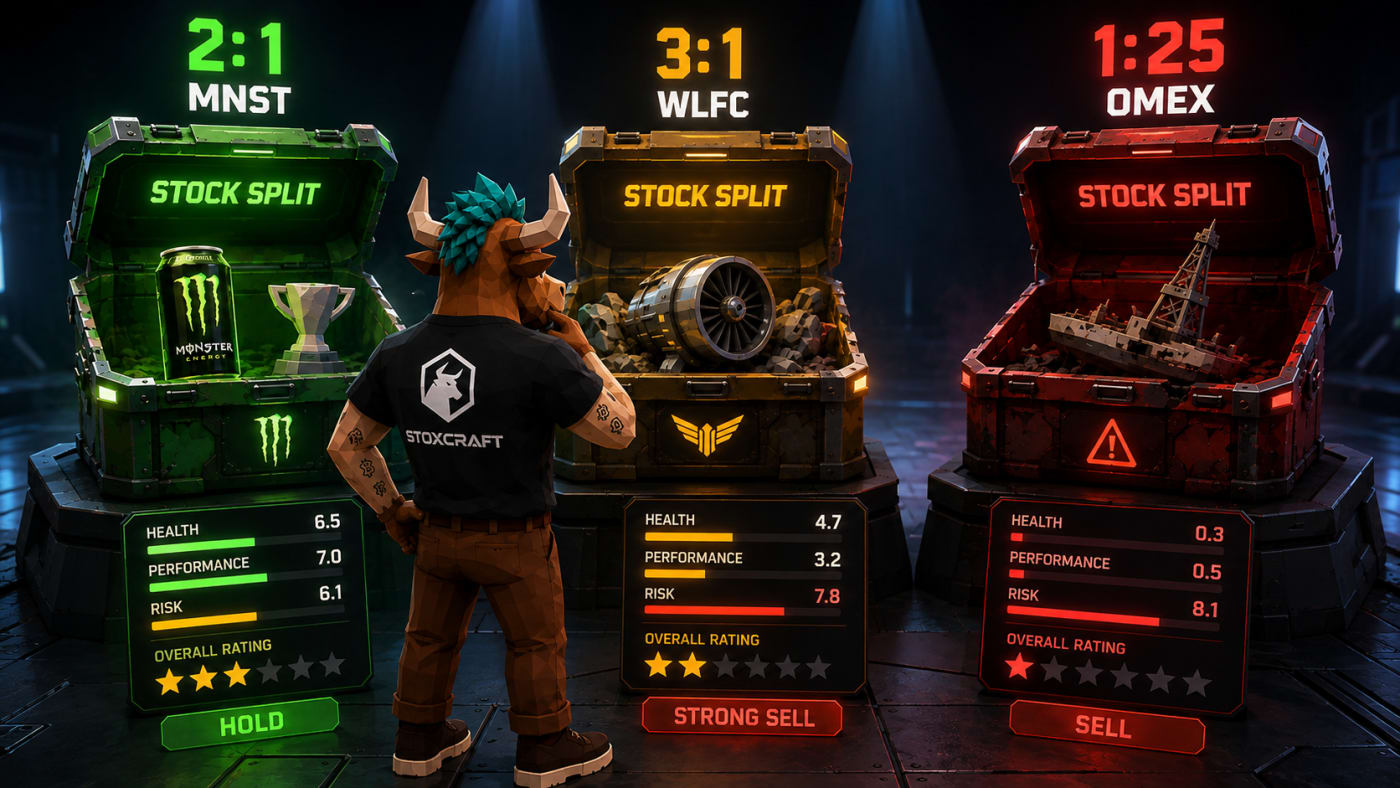
Recent stock splits get treated like an event on their own: announcement day, a stock pop, a wave of should-I-buy posts. Monster Beverage (MNST), Willis Lease Finance (WLFC), and Odyssey Marine Exploration (OMEX) all touched a stock split this year, and their current Stoxcraft scores tell three completely different stories.
None of that difference came from the split itself.
What a stock split does (quick recap)
A stock split changes the number of shares outstanding and adjusts the price per share by the same factor. A forward split multiplies shares and cuts the price. A reverse split shrinks the share count and raises the price. Either way, the company's total market value stays exactly the same. Nothing about the business changes on split day.
We covered the full mechanics in forward split vs reverse split. For a deeper primer, the Academy's how dividends, splits, and dilution affect ownership skill walks through the mechanics from the ground up. This piece goes further: three real 2026 splits, three real outcomes, and what the difference actually tells you.
Not all splits are equal: why the ratio and type matter
A 2-for-1 split and a 1-for-25 reverse split are not the same signal wearing different math. The ratio itself carries information, and so does the direction.
A 1-for-25 reverse split does not happen to a stock that is merely having a rough quarter. It happens to a stock that has fallen so far the exchange itself is asking questions. That context matters more than the headline number.








MNST: a 2-for-1 split, now trading well off its post-split high
Monster Beverage announced its 2-for-1 split on July 8, 2026, structured as a 100% stock dividend. Shareholders of record on July 24 received one extra share per share held, and the stock began trading split-adjusted on August 11. The announcement followed a strong quarter: record net sales of $2.54 billion, up 20.2% year over year, with adjusted EPS climbing 15.2%.
That is the kind of backdrop forward splits usually come from. But the current picture is more mixed than the announcement suggested. MNST now trades around $46.68, which is 53% below its 52-week high of $100.34. The Performance Score sits at 7.0, still solid, and the Health Score at 6.5 reflects a genuinely clean balance sheet with zero long-term debt. The Risk Score, though, has climbed to 6.1, an elevated reading, and the Overall Rating currently lands at 3.5 stars. The Buy Signal reads Hold, not the enthusiastic entry point the split headline implied.
The fundamentals held up. The stock did not wait around for them.
WLFC: a 3-for-1 split that coincided with a sharp pullback
Willis Lease Finance shareholders approved a 3-for-1 forward split on June 23, 2026, with split-adjusted trading beginning July 20. On paper, this looked like a classic strength split: the aircraft-engine lessor had returned 336.92% over five years heading into the vote.
The weeks since have not been kind. WLFC currently trades at $54.44, down 24.43% in the past month alone and 77.75% below its 52-week high of $244.62. The Buy Signal has flipped to Strong Sell. The Risk Score sits at 7.8, meaning elevated risk, and the Health Score of 4.7 puts it below the median of its own sector on fundamentals. RSI near 30 shows the stock is approaching oversold territory. The Overall Rating has slipped to 2.5 stars.
A five-year return chart made the split look like a reward for strength. A one-month chart tells a different story. Both are true at the same time, which is exactly why a split date is a bad place to freeze the analysis.
OMEX: a 1-for-25 reverse split that has not even happened yet
Odyssey Marine's case is the odd one out, and that is the point. Shareholders approved a reverse split in a range of 1-for-20 to 1-for-25 back on June 1, 2026, tied to a planned $1 billion all-stock merger with American Ocean Minerals. Odyssey intends to execute the 1-for-25 split before that deal closes, but as of the most recent SEC filings, the split itself is still pending.
The scores do not need the split to already be in place to make their point. OMEX carries a Health Score of just 0.3 and a Performance Score of 0.5, both near the bottom of the entire Stoxcraft universe. The Risk Score of 8.1 reflects genuinely elevated risk, not just sector-normal volatility. The Overall Rating sits at half a star, and the Buy Signal reads Sell. The stock is down 85.78% over five years.
A reverse split can slow a delisting clock. It cannot raise a Health Score of 0.3 on its own, and OMEX's numbers make that plain before the split has even been executed.
What these three splits actually teach investors
The split is the headline. It was never the whole story.
MNST proves that even a split coming off genuinely strong earnings does not guarantee the stock keeps climbing afterward. WLFC proves that a five-year track record and a current Strong Sell signal can belong to the same company in the same month. OMEX proves that a reverse split does not need to happen yet for the scores to already tell you what is going on underneath.
Before you act on any split, check the current Stoxcraft Screener for the stock's Health Score, Risk Score, and Performance Score. The ratio tells you what happened to the share count. The scores tell you what is actually happening to the company.