VOO is the most searched ETF on the internet. Every month, 3.6 million people type some version of "what is VOO" into a search engine. Most of what they find is wrong in the same two ways. The articles make VOO sound like a no-brainer shortcut to wealth. And they never explain the index it tracks, who dominates it, or why that matters.
What VOO actually is
VOO is the Vanguard S&P 500 ETF. An ETF, or exchange-traded fund, is a basket of stocks that trades on a stock exchange like a single share. VOO's job is to match the performance of the S&P 500 Index, which holds roughly 500 of the largest publicly traded companies in the United States. When the S&P 500 goes up, VOO goes up by nearly the same amount. When it falls, VOO falls with it.
Vanguard launched VOO in September 2010. Today, VOO is closing in on $1 trillion in assets under management, a milestone no ETF has ever reached. It became the world's largest ETF in early 2025 and has not looked back since. The fund charges an expense ratio of 0.03% per year. On a $10,000 investment, that is $3 in annual fees. It does not get cheaper than this for broad market exposure.
How the S&P 500 index is built
The S&P 500 is not a simple list of the 500 biggest companies. A committee at S&P Global selects which companies qualify based on size, liquidity, domicile, and financial health. To be included, a company must be a U.S. corporation, clear a market cap threshold, and report four consecutive quarters of positive earnings.
The index is weighted by market capitalisation. The bigger a company's market cap, the larger its share of the index. A company worth $3 trillion gets a much bigger slice than one worth $30 billion. That weighting system is what creates VOO's concentration problem.
What VOO actually holds right now
The fund holds 504 stocks, but the weighting is far from equal. Here are VOO's ten largest positions as of March 2026:
Those ten names alone make up 37.8% of the total fund. The remaining 494 stocks split the other 62.2%.















The concentration problem most VOO articles skip
This is where the polished explainers go quiet. VOO is marketed as broad diversification. You own 500 companies. You are spread across the entire US economy. Except that is not quite true, and the numbers show exactly why.
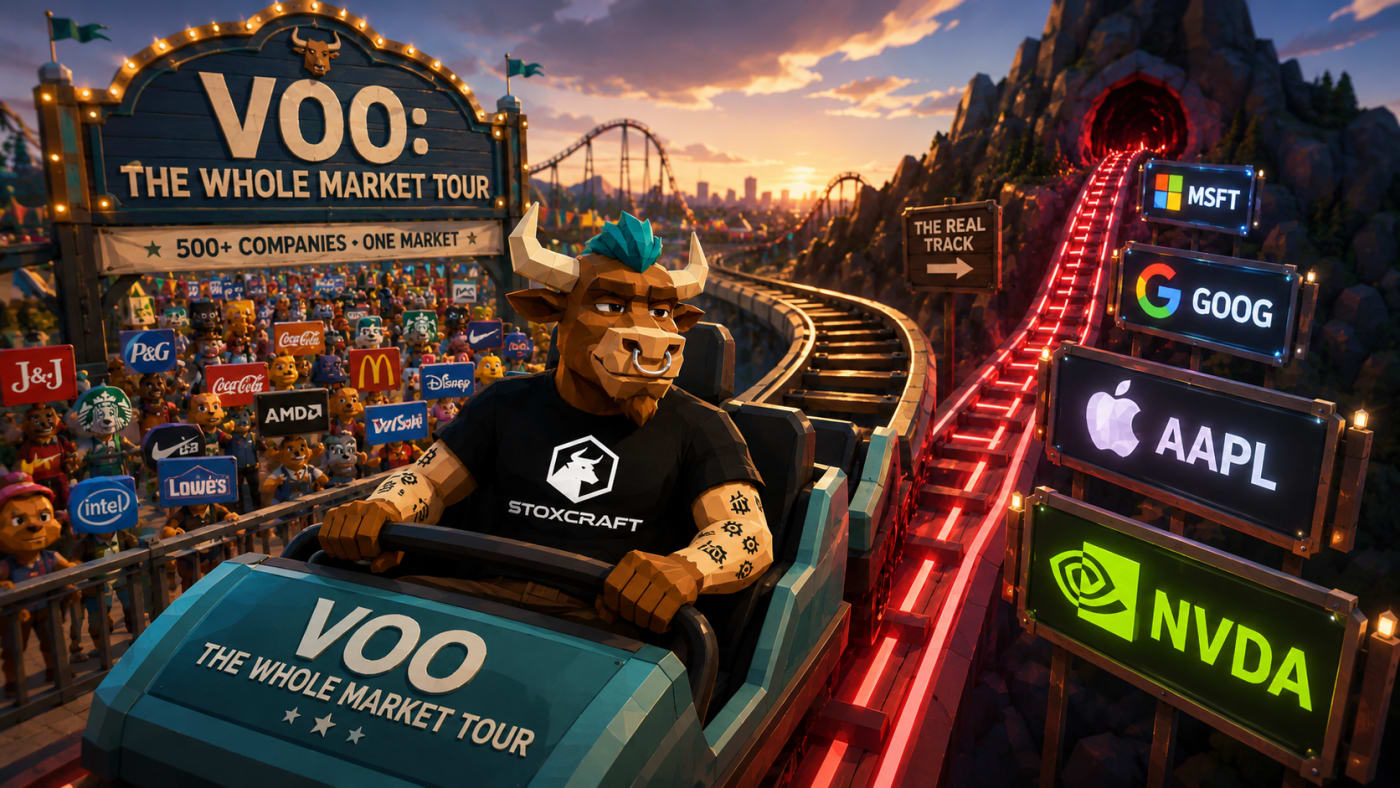
Nvidia, Microsoft, and Apple alone account for nearly 20% of the index. Technology stocks as a group now make up over a third of the S&P 500. Looking back 30 years, the top 10 stocks averaged roughly 25% of the index weight. The current level is close to 38%, which is unprecedented in the modern era of index investing.
Why concentration risk is real for VOO investors
With NVIDIA alone sitting near 8% of the index, one company can meaningfully move the entire fund. An earnings miss, a regulatory shock, or a shift in AI sentiment does not just hit a corner of your portfolio. It hits the whole thing.
In the most recent 28-session rally between late March and early May 2026, just 10 stocks drove 69% of the index's gains. Alphabet, NVIDIA, Amazon, Broadcom, and Microsoft led the charge. The other 490 stocks barely shifted the needle.
This does not make VOO a bad fund. It makes it a different fund than most people think they are buying. If you are comfortable with heavy exposure to AI-driven technology, VOO delivers. If you want true equal-weight diversification, you need a different product.
How tech dominance shapes VOO's sector breakdown
As of early 2026, four sectors dominate VOO's allocation. Together they account for roughly two thirds of the fund, leaving seven other sectors to share the remainder:
The remaining sectors, including energy, utilities, real estate, and basic materials, split the rest.
VOO vs SPY vs QQQ: the comparison most articles botch
These three ETFs are constantly lumped together. They are not the same product. The differences come down to which index they track, what they cost, and how much risk they carry.
VOO and the SPDR S&P 500 ETF Trust (SPY) both track the S&P 500. The primary difference is structure and cost. VOO charges 0.03%, compared with 0.09% for SPY and 0.18% for QQQ, making it the cheapest long-term option of the three. SPY launched in 1993 and uses an older unit investment trust structure that creates small dividend reinvestment inefficiencies. VOO uses a more modern open-end structure.
The Invesco QQQ Trust (QQQ) is a different product entirely. It tracks the Nasdaq-100 Index, not the S&P 500. The Nasdaq-100 holds 100 of the largest non-financial companies listed on the Nasdaq exchange. Technology dominates QQQ even more heavily than it does in VOO.
Here is how the three funds compare across the key variables:
One more point worth knowing: holding both QQQ and VOO adds almost no real diversification. The two funds have a correlation of around 0.94, meaning they move in near-lockstep. Owning both is essentially a double bet on the same large-cap tech positions.
The stocks inside VOO that Stoxcraft scores
The biggest names inside VOO are not anonymous index components. They are individual businesses with earnings, risks, and Stoxcraft scores you can assess right now. The top six holdings are all covered on Stoxcraft.
NVIDIA (NVDA) is VOO's single biggest holding at 7.6%. The AI infrastructure boom has made it the most valuable semiconductor company in history. Its valuation leaves little room for disappointment. The NVIDIA (NVDA) Stoxcard covers its financials in full.
Apple (AAPL) holds the second-largest position at 6.7%. Revenue growth has slowed and its valuation reflects substantial optimism about future earnings. The full breakdown is on the Apple (AAPL) Stoxcard.
Alphabet (GOOG) sits at 5.4% of the fund. Its advertising business generates substantial cash flow and its cloud segment has moved into meaningful profitability. See current metrics on the Alphabet (GOOG) Stoxcard.
Microsoft (MSFT) makes up 4.9% of VOO. Azure continues to grow and its AI product integrations keep it central to enterprise technology. The Microsoft (MSFT) Stoxcard has the full picture.
Amazon (AMZN) rounds out the top five at 3.6%. AWS dominates global cloud infrastructure and its advertising segment has become a major earnings contributor. See the Amazon (AMZN) Stoxcard for current scores.
Meta Platforms (META) holds a 2.2% position. Its advertising revenue and AI-powered engagement tools have driven significant margin expansion over the past two years. View the Meta Platforms (META) Stoxcard.
Why VOO's 0.03% fee compounds into a real advantage
The 0.03% expense ratio sounds trivial. Over 20 or 30 years, the difference between fee levels shapes your final portfolio value in a way most investors underestimate.
Consider $50,000 held for 30 years at a 10% average annual return before fees:
- At 0.03% (VOO): fees cost roughly $2,400 over the entire period
- At 0.09% (SPY): fees rise to roughly $7,100 over that same period
- At 0.18% (QQQ): fees climb to roughly $14,000 over the period
Every 20-year period in the S&P 500's history has ended in positive total returns. For buy-and-hold investors who plan to stay the course, keeping fees as low as possible is one of the few variables entirely within your control.
What VOO is not
VOO is not a shortcut to above-average returns. It tracks the market, so it will never beat the market. If the S&P 500 drops 30%, VOO drops 30%. There is no active management absorbing any of that fall.
VOO is also not a defensive play. Its heavy technology weighting makes it sensitive to interest rate movements, AI sentiment shifts, and the quarterly results of a handful of companies. During a sharp market correction, it falls quickly because its largest positions move first.
And VOO is not a substitute for stock-level research. The index does not screen for quality. Deteriorating companies remain in the index until their market cap forces them out. That is a structural limitation worth understanding before you put capital into it.
Who VOO is right for
VOO suits investors who want clear, low-cost exposure to US large-cap equities. It works best for a specific type of investor profile:
- Long-term investors with a 10-plus year horizon who do not want to pick individual stocks
- Investors who want one fund to anchor the core of a portfolio
- Anyone targeting the compound growth of US equities without paying for active management
VOO is a weaker fit for investors who want true sector diversification, lower tech concentration, or meaningful exposure to small and mid-cap companies. A total market fund or an equal-weight S&P 500 product would serve those goals better.
What VOO's record inflows reveal about retail investor behaviour
VOO has pulled in $60 billion in net inflows so far in 2026, putting it on track for a third consecutive year of more than $100 billion in new money. SPY has shed $7 billion over the same stretch. IVV has lost $3 billion. The gap keeps widening.
This dominance reflects a structural shift in how retail investors build portfolios. Passive indexing has won the cost argument by a wide margin. The debate now is not about whether to index. It is about what you are actually indexing into.
At current concentration levels, buying VOO is less like buying the US economy and more like buying its ten largest technology companies at a significant valuation premium. That premium may be justified. AI infrastructure spending is projected to run into the trillions over the next five years. The bull case is not hard to construct.
The risk is that the top 10 already price in a decade of that growth.
What every VOO explainer forgets to say
Most articles stop at "it tracks the S&P 500, it is cheap, buy it." That is fine as far as it goes. But it ignores the structural reality. VOO is increasingly a concentrated bet on a narrow set of AI-era technology giants, wrapped in a diversification narrative.
That is not a reason to avoid it. It is a reason to hold it with your eyes open.
If you want to understand the forces making VOO's top holding so dominant, the chip boom driving NVIDIA and the sector's biggest players covers the dynamics shaping the fund right now.