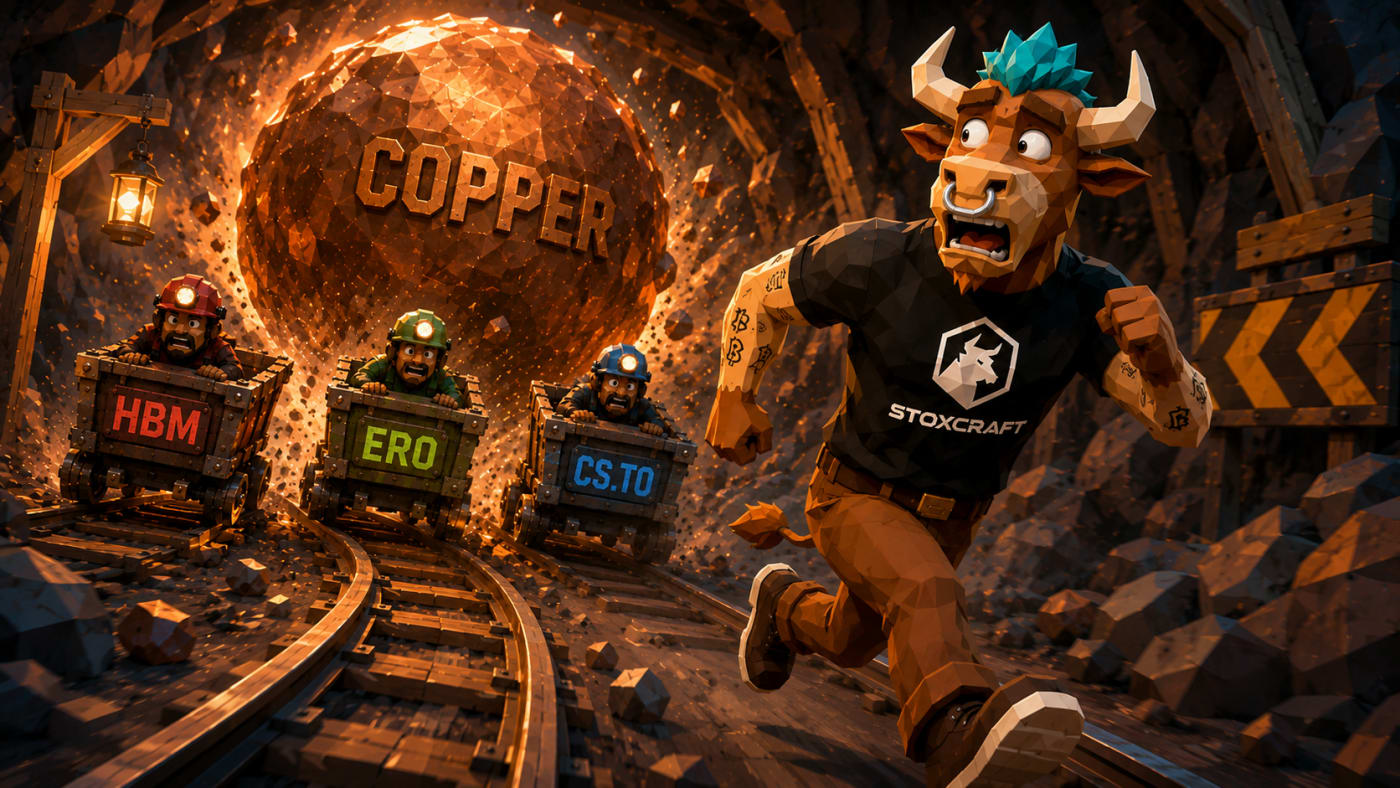
Hudbay Minerals (HBM), Ero Copper (ERO), and Capstone Copper (CS.TO) are all rallying at once. Their Performance Scores tell three different stories about how safe that rally actually is.
All three sit in the Copper industry, all three carry Strong Buy or Buy-leaning signals, and all three are up double digits over the past month. That's where the similarities stop.
Hudbay Minerals: the highest score, the highest risk
Hudbay Minerals (HBM)'s Performance Score of 9.7 is the highest of the three, and its shares are up 154% over the past year. But its Risk Score of 7.1 is also the highest of the group, and its Health Score of 4.5 sits in the middle of the pack rather than at the top.
Hudbay's own investor relations site details the Copper World project behind that growth story, a US development asset the company expects to sanction after securing a $600 million joint-venture investment from Mitsubishi.
Ero Copper: the healthiest balance sheet
Ero Copper (ERO) carries the most modest headline number of the three, a Performance Score of 8.3. Its Health Score of 5.5 is the strongest of the group, and its Risk Score of 6.8 sits between the other two rather than at either extreme.
Ero's own investor relations site lays out the Brazilian operations behind that steadier profile.
Capstone Copper: the calmest chart, the weakest health
Capstone Copper (CS.TO) posts the second-highest Performance Score at 9.3, and its Risk Score of 5.9 is now the lowest of the three, a shift from a few days ago when Ero held that edge. But its Health Score of 3.2 remains the weakest of the group by a wide margin.
Capstone's own investor relations site details the Pinto Valley and Mantoverde assets behind that number.



So which one has the cleanest case?
None of the three wins clean on all three metrics right now, and that's the more honest read than picking a single winner. Each name trades one strength for one weakness.
Hudbay's top Performance Score comes bundled with the group's highest risk. Capstone now carries the calmest Risk Score of the three, but its Health Score is also the weakest by a wide margin. Ero gives up the top spot on raw performance, but it's the only name whose Risk and Health Scores both sit in a reasonable range rather than one metric compensating hard for another.
The chart tells the same story with less arithmetic. Three copper miners, one commodity tailwind, three very different paths to get there.
What's actually driving the copper trade
None of this happens in isolation. Copper has been one of the stronger commodity stories of the year, and all three of these names are levered to the same underlying price. A rising tide can lift a weak balance sheet just as easily as a strong one, at least for a while.
That's exactly why the score gap matters here. When the commodity tailwind fades, the names with the cleaner risk and health profiles tend to hold up better than the ones whose performance depended more heavily on momentum.
Ero's numbers suggest the most balanced footing among the three, without leaning hard on any single strength to offset a single weakness. Hudbay and Capstone each carry one clear edge and one clear gap.
None of the three is a bad business. A weak Health Score in a capital-intensive, cyclical industry like mining isn't automatically disqualifying the way it might be for a software company burning cash with no clear path to profitability. Mines carry heavy fixed costs and long development timelines by nature, and Health Scores in this sector tend to run lower across the board than in most other industries.
What the gap does tell a reader is where to look first if the rally stalls. A pullback in copper prices would test all three balance sheets differently, given how far apart their Risk and Health Scores currently sit.
Anyone tracking the broader copper trade can filter the full Copper industry, not just these three names, on the Stoxcraft Screener by Performance, Risk, and Health Score.