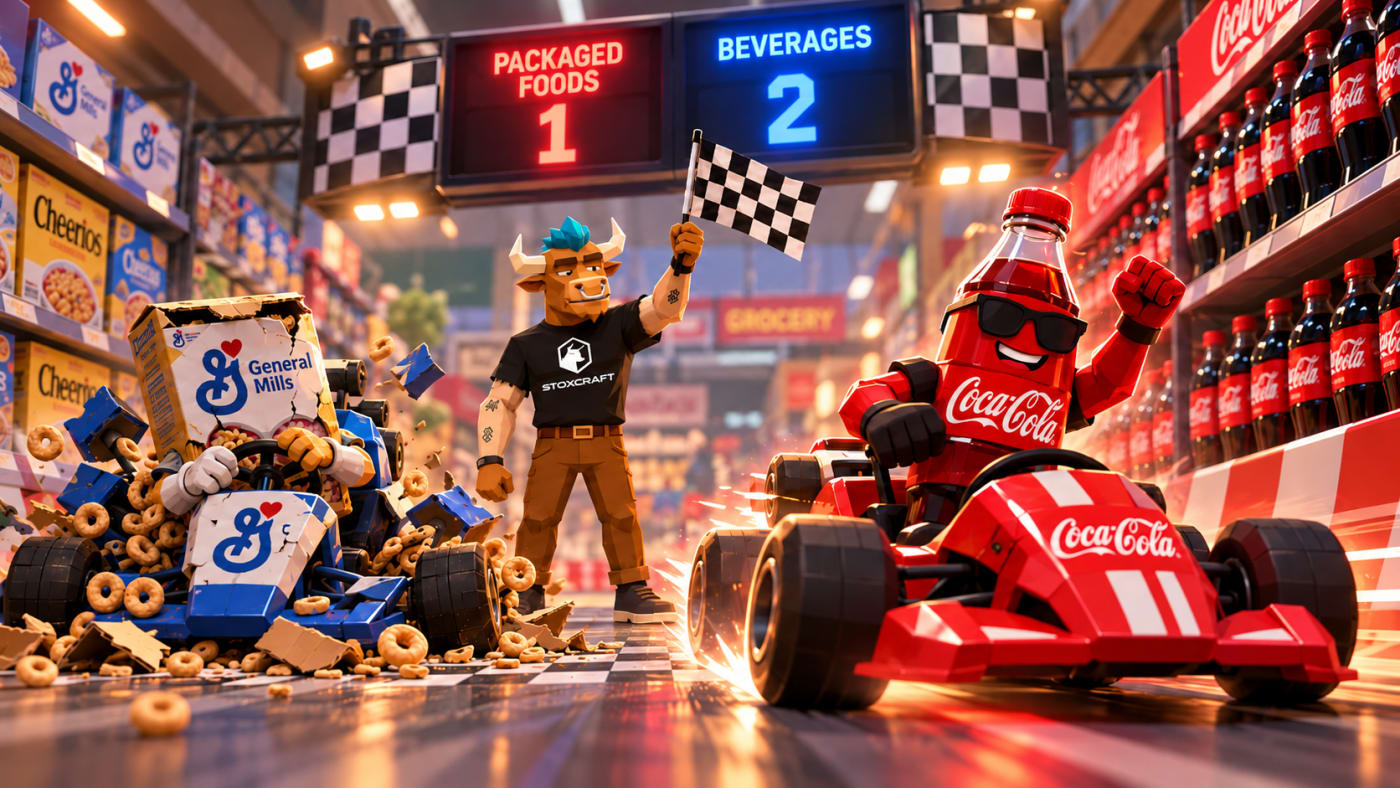
General Mills shares fell another 3.05% on September 10 after analysts flagged caution on the company's soft guidance, the latest in a string of downgrades that's pulled the stock down more than 20% this year. That's not the profile most people have in their head when General Mills, the maker of Cheerios and Betty Crocker, comes up as a steady packaged-foods holding.
Coca-Cola sells sugar water for a living, a business with none of General Mills' pantry-staple reputation. Checked metric by metric, the "steady household name" isn't the one actually holding up.
Here's the two flagship names side by side before the numbers start.




Three angles decide which side actually holds up: the true industry-wide average, each industry's strongest individual name, and who's actually delivering for investors right now.
Round 1: Who's actually healthier, industry-wide?
Beverages - Non-Alcoholic averages a 5.4 Health Score across all 14 scored stocks in the industry. Packaged Foods averages just 4.6 across all 43 scored stocks, despite housing some of the highest individual scores in Consumer Defensive.
The gap comes down to how widespread the pain is, not one or two bad apples. Of the 43 Packaged Foods stocks scored, nine sit below a 2.5 Health Score, including Conagra Brands (1.7), Utz Brands (1.2), and Kraft Heinz (2.4), all names fighting the same private-label and value-seeking shift that's now hitting General Mills.
Two of those names have a specific, well-documented reason behind the weak score, not just the industry-wide headwind. Kraft Heinz has paid down nearly $3 billion in debt this year, yet its shares remain 71% below their 10-year high, a legacy of the heavy debt load and repeated goodwill write-downs the company has carried since its 2015 merger. Utz Brands is carrying roughly $839 million in long-term debt and posted an $18.4 million net loss for the first half of 2026, leverage built up over a decade of debt-funded acquisitions, and the company has now agreed to be acquired and taken private.
Beverages has a much shorter list of weak names, and its bottom performers, Primo Brands (2.1) and Zevia (1.1), are smaller, less-followed companies rather than household brands.
That difference in how the weakness is distributed matters. A wide, industry-spanning problem is harder to dismiss as one company's execution mistake, and it's exactly the kind of pattern that shows up in Packaged Foods' lower average.
Round 2: Who's actually the strongest individual name?
The Marzetti Company (MZTI), the maker of Marzetti dressings and Sister Schubert's rolls, carries an 8.9 Health Score, the highest of any stock in either industry. Marzetti was known as Lancaster Colony until it renamed itself after its best-known brand and switched tickers. Coca-Cola (KO) sits at 6.6, Beverages' own strongest name.
Marzetti's score is backed by a balance sheet that's almost debt-free: $55.6 million in total debt against $998.5 million in shareholder equity, and an interest coverage ratio of 135.4, meaning its operating profit covers its interest payments more than 135 times over. Its Altman Z-Score sits at 10.33, far above the 3.0 threshold that marks the safe zone for bankruptcy risk, a reading that high is rare even among healthy companies. The company just declared its 63rd consecutive year of dividend increases, one of only 12 US companies with that long a streak, funded by that same debt-free balance sheet.
Coca-Cola backs its own score with a 28.56% net profit margin, meaning it keeps about $29 of every $100 in sales as profit, and a 40.74% return on equity. Real numbers, just not in Marzetti's league on this particular measure. Most readers have never heard of Marzetti by that corporate name, and it's still the single strongest name in this whole comparison, a reminder that an industry's true ceiling and its average don't always point to the same conclusion.
Round 3: Who's actually delivering right now?
General Mills (GIS), the recognized flagship most people would actually name first in Packaged Foods, carries a Health Score of just 3.7 and a Performance Score of 0.6, near the bottom of the platform. Coca-Cola's Performance Score sits at 7.0.
The numbers behind that gap are specific, not vague. General Mills has cut its full-year guidance multiple times since February, most recently trimming adjusted EPS expectations to a 16% to 20% decline, and reported a quarter where net earnings fell 52% year over year to $303 million. Management has said the company is deliberately sacrificing near-term margin, spending more on promotions and advertising, just to defend sales volume against private-label competition. Coca-Cola, over the same period, grew revenue to $47.94 billion from $45.75 billion three years ago and kept net income above $13 billion.
Here's the part that trips people up: General Mills' dividend yield has actually climbed to 6.74%, more than double Coca-Cola's 2.37%, even though General Mills is the one struggling. Dividend yield is just the annual dividend per share divided by the stock price, nothing more. General Mills is still paying the same $2.40 a share it was paying before, that hasn't changed, but the stock has fallen from roughly $46 at the start of 2026 to around $36 now. Divide the same $2.40 by a smaller price and the percentage goes up, even though nothing about the payout itself got better. That's why a rising yield on a falling stock is often a warning sign rather than a bargain, the yield is telling you the price dropped, not that the dividend improved. Coca-Cola's lower 2.37% yield sits on top of a stock that's actually gone up, the opposite story.
Final score: Beverages 2, Packaged Foods 1
Beverages takes the overall win because it's stronger on the full industry average and at the level most people actually recognize. Packaged Foods' one win is real, Marzetti has the strongest balance sheet of any stock in either industry, but that strength doesn't belong to the brand most people would think of first, and General Mills, the one they would, has spent this year cutting guidance and shedding value.
One more number worth a look: General Mills' P/E ratio is currently negative, meaning the company posted a net loss rather than a profit over the trailing year, so there's no meaningful earnings multiple to quote. Coca-Cola trades at a P/E of 22.92, meaning investors are paying about $22.92 for every $1 of its annual earnings, a real number attached to a real profit.
Here's the full scorecard, both flagship names side by side:
None of that is a buy signal, and a high yield isn't automatically a good one, sometimes it's just a stock that's fallen faster than the dividend has been cut. It's a scorecard, not a crystal ball. Curious how other consumer-staples names stack up. Stoxcraft's screener lets you filter by Health Score and Performance Score yourself.