Growth vs value stocks is the oldest fight in investing. One side bets on what a company becomes. The other bets on what it is worth today. The growth investing vs value investing debate never really ends. It is not about which is right. It is about which fits the moment and your goals.
Quick note before we dig in. This is education, not a buy or sell call. Names and numbers here are examples only.
What growth investing is
Growth investing rests on one belief. Some companies will grow revenue and earnings faster than the market. That future growth is worth paying extra for today.
Growth stocks usually live in tech, biotech, or software. They pour cash back into expansion. Many pay no dividends. Some are not even profitable yet. What they have is a believable story about where revenue is heading.









How growth investors screen for stocks
Growth investors do not care how cheap a stock looks. They care about the rate of change. Here are the signals they hunt for:
Then comes the price tag. The P/E ratio shows how much you pay per dollar of earnings. On growth stocks it runs hot. A P/E of 40 or 60 is normal. Investors accept that because they are buying future profit.
When growth investing outperforms
Growth wins in cheap-money, expanding economies. When rates sit near zero, future cash flows get discounted less. That inflates the value of growth today. The 2010s were the perfect example.
Over the past decade, the Vanguard Growth ETF (VUG) returned 15.6% a year. The Vanguard Value ETF (VTV) returned 10.8%. That gap compounds into a huge lead.
Then the math flips. The reason is simple. Growth stocks lead when interest rates fall and the economy expands, and they suffer when both reverse.
What value investing is
Value investing asks a different question. What is this business really worth? And is the market getting it wrong?
Value stocks trade below their true worth. That worth comes from assets, earnings power, and cash flow. Say a stock trades at $40. Your analysis says it is worth $70. That $30 gap is the opportunity.
Benjamin Graham called this gap the margin of safety. He was Warren Buffett's mentor and the father of value investing. You buy a dollar for 60 cents. If you are wrong, the discount still cushions the fall.
How value investors screen for stocks
Value investors run the opposite screen. They want proof, not promise. Their checklist looks like this:
Value stocks cluster in mature industries. Think banks, energy, industrials, and staples. Many are blue chip stocks with long records and steady cash.
When value investing outperforms
Value shines when rates rise and markets fall. Scared investors run to hard assets, stable earnings, and yield. Defensive stocks and value names hold up better in a sell-off.
Look at 2022. The Vanguard Growth ETF (VUG) dropped 33%. The Vanguard Value ETF (VTV) fell just 2%. That 31-point gap shows how rate risk flows through a portfolio. In a brutal bear market, value did its job.
Zoom out and the long record favors value. Since 1927, value beat growth by about 4.4% a year in the US. The last decade broke that pattern. But one decade does not erase a century.
The key differences between growth stocks and value stocks
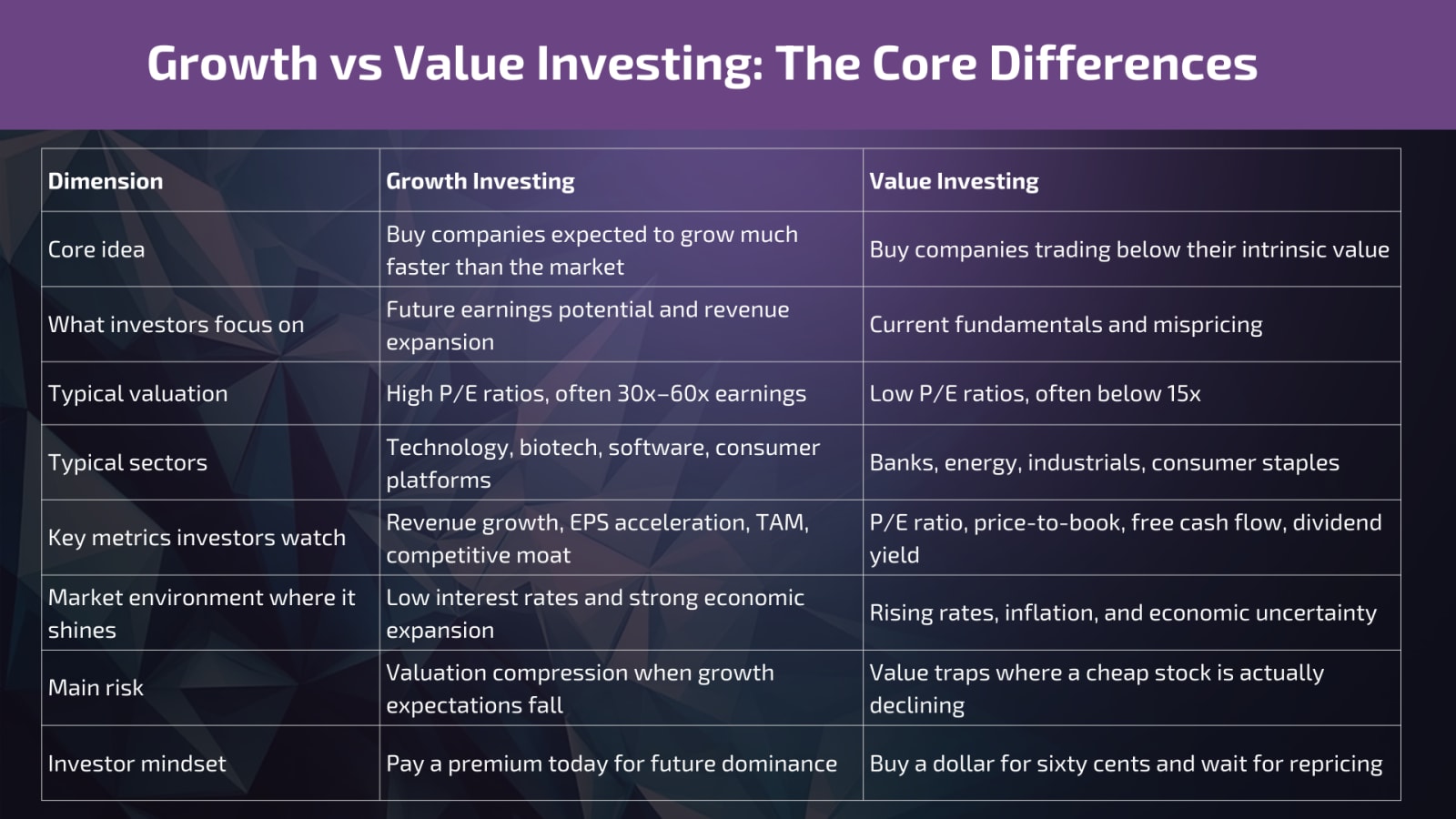
These two styles split on every major point. It helps to line them up side by side. No table needed, just the contrasts worth knowing.
What defines the growth stock profile
Growth investing is about buying future earnings. Valuations run high, often 30 to 60 times earnings. Dividends are rare because profits get reinvested. The home turf is tech, biotech, and software. It thrives in low-rate bull runs. Its big risk is valuation collapse when the mood shifts.
What defines the value stock profile
Value investing is about buying a discount. Valuations stay low, usually under 15 times earnings. Dividends are common because cash flow is real now. The home turf is finance, energy, and industrials. It thrives when rates climb or growth slows. Its big risk is the value trap.
Why value traps fool value investors
A value trap looks cheap for a reason. The market has spotted a real problem. The business is in decline, not on sale. Telling a bargain from a slow death is the hardest skill in value investing.
How interest rates drive the growth vs value rotation
Interest rates are the biggest outside force here. The mechanism is simple once you see it.
Why growth stocks fall when rates rise
Growth stocks get most of their value from earnings far in the future. Discount those future earnings at a higher rate. Their value today drops. That is exactly why growth got crushed in 2022. The Federal Reserve hiked hard and fast.
Why value stocks shrug off higher rates
Value stocks lean on what they earn right now. Many pay dividends and post strong current profits. Their worth sits in today, not a decade out.
Banks even gain from higher rates. Their net interest margin widens. Energy firms gain from inflation. The rate story is real. But it plays out stock by stock, so blanket rotations often overshoot.
Growth stocks vs value stocks: who has won over time
Everyone wants the simple answer. The honest one is that it depends on your time frame.
Over the last decade, growth won big. The AI boom, mega-cap tech, and near-zero rates all pushed the same way. In 2024, US large caps returned about 25%. Tech led again, up over 34%. Growth beat value for a second straight year.
Zoom out and the story flips. From 1927 through the mid-2010s, value won most long stretches. The recent decade is the outlier, not the rule.
Neither style wins forever. Growth owns expansions. Value owns recoveries and tight-money periods. Pick one and ignore the other, and you leave money on the table half the time.
GARP: the strategy that refuses to pick a side
The smartest answer to the debate is to refuse it. That answer is Growth at a Reasonable Price, or GARP. Peter Lynch made it famous at Fidelity's Magellan Fund. He averaged 29% a year for 13 years.
GARP wants strong earnings growth at a price that still makes sense. Its key tool is the PEG ratio. That is the P/E divided by the expected growth rate. A PEG under 1 hints that growth is not fully priced in.
Warren Buffett's career shows the shift. He started as a pure Graham deep-value guy. Over time, nudged by Charlie Munger, he paid fair prices for great businesses. His stake in Apple (AAPL) is the clearest modern proof.
Here is how a few names map onto the spectrum:
GARP is not about lowering your standards. It is about refusing to pay any price for a good story.
How to choose between growth and value for your portfolio
No style is right for everyone. Your call comes down to three things: your time horizon, your risk tolerance, and the market cycle.
A 25-year-old has 40 years to compound. They can ride the swings of a growth-heavy portfolio. Someone five years from retirement cannot stomach a 33% drop in one year. That person leans on value's stability and dividend income.
The cycle matters as much as your age. Falling rates and expansion favor growth. Rising inflation and tight policy favor value. Sector rotation often signals the shift before the returns show up.
Diversification across both styles smooths the ride. Most big institutions hold growth and value together. Timing the cycle perfectly is too hard to bank on.
You can sort growth and value names yourself with the Stoxcraft Screener. It covers 3,487 stocks across 156 industries.
Want a practical starting point? The Stoxcraft guide to building your first investment portfolio walks through it. The breakdown of the top five investor biases shows what pushes people to pick the wrong style at the worst time.
What the data says about blending growth and value
The case for holding both is in the numbers, not just theory.
Over the past 10 years, the Vanguard Growth ETF beat its value twin in eight of them. The one miss was 2022, when value absorbed the damage. That is the whole argument for owning both. One style covers what the other cannot. In fact, a balanced portfolio often holds both growth and value on purpose. Each does its job in a different climate.
The buy and hold logic fits here too. Chasing last year's winner usually backfires. Compound growth rewards patience far more than style-hopping.
Where growth stocks and value stocks stand now
Growth valuations look stretched by history. Heading into 2026, the S&P 500 Pure Growth Index sat well above its 15-year average P/E. That is not a sell signal. It just means less room for error. One big earnings miss and valuations drop fast.
Value looks cheaper by comparison. The S&P 500 Pure Value Index sat near or below its long-run average. The market has priced in almost no optimism. That is often when value delivers.
Rotation picked up through 2024 and 2025. Some of the biggest growth winners became the biggest laggards. That kind of shift tends to signal a broadening market. For more on what is driving it, the Stoxcraft piece on the five biggest forces shaping the stock market is useful context.
Growth and value are tools, not teams
The sharpest investors do not pick a team and stay loyal forever. They learn what each style is built to do. Then they read the conditions and build for both.
Growth rewards vision in expansions. Value rewards cold discipline when the crowd panics. GARP rewards both, as long as you respect price.
Neither camp owns good outcomes. Know both frameworks, and you can shift as the cycle turns. That beats locking into one playbook that only works half the time.