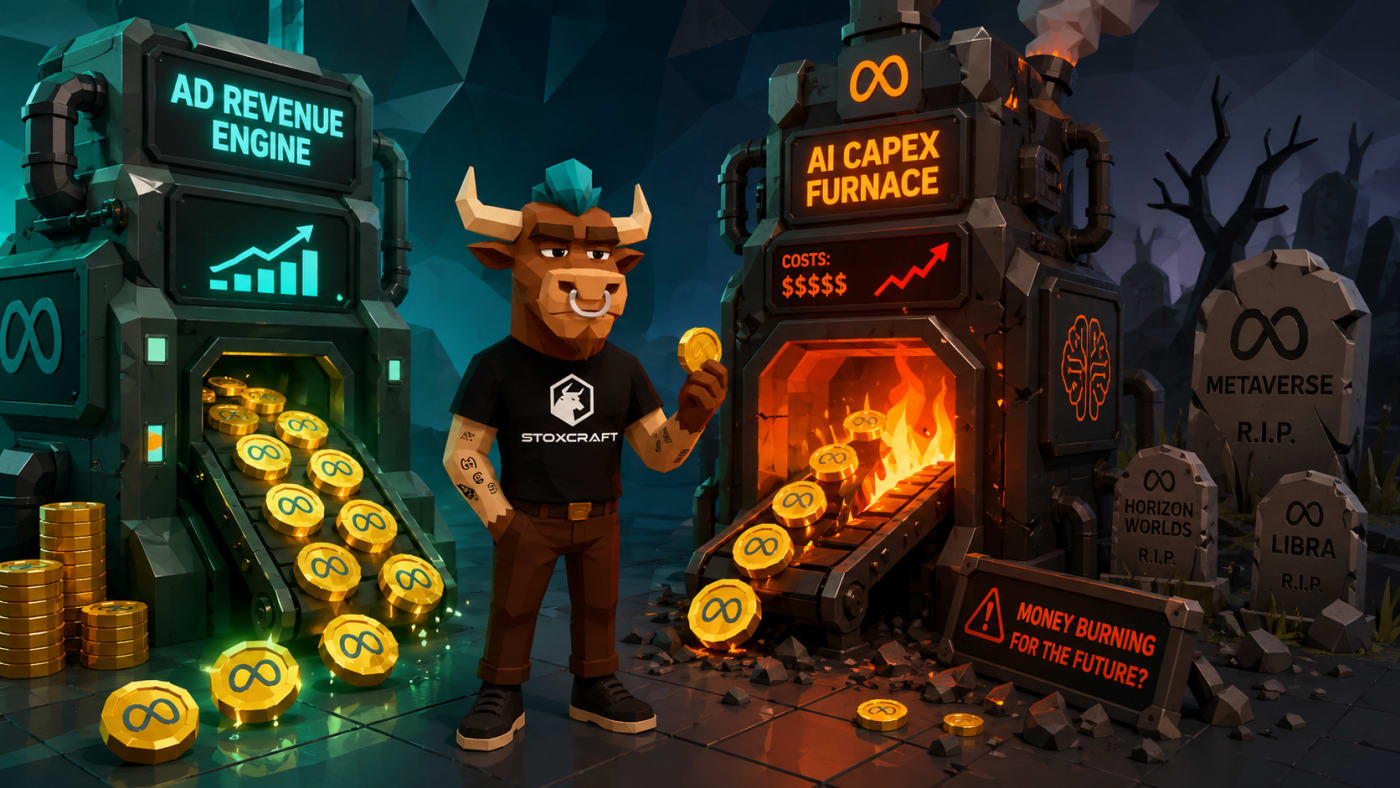
Meta (META) is one of the highest-rated Communication Services stocks on Stoxcraft, carrying an overall rating of 7.3 out of 10 and placing it in the top 30% of all roughly 3,900 stocks tracked globally. Today it faces its biggest test yet. Wall Street expects $6.71 EPS on $55.5B in Q1 2026 revenue, up 31% year-over-year. The print itself matters less than what Meta says next: can the advertising business keep funding a $125B annual infrastructure build?




How META's financial health compares ahead of Q1 2026
Meta earns a Health Score of 7.8 out of 10, placing it in the top 25% of all stocks in the Stoxcraft universe and comfortably above the Communication Services sector median. Two factors push it ahead of nearly every peer: exceptional cash generation and balance sheet discipline that most online advertising platforms never reach.
Cash generation as META's fundamental edge
Free cash flow per share is among the strongest in the online advertising industry. In Q4 2025, expenses jumped 40% year-over-year and the ad business absorbed it without breaking the cash profile. That level of conversion is what puts META in the global top quartile and makes the 2026 capex commitment look manageable rather than reckless.
The capex pressure and what it means for the balance sheet
The near-term risk is compression, not collapse. Meta committed $115-135B in 2026 capex, nearly double the $72.2B spent in 2025. At the midpoint, analyst models see free cash flow shrinking 30-40% before recovering in 2027. That elevated pressure is reflected in the Risk Score of 6.2, which sits above the sector average but well short of levels that signal structural danger. Reality Labs cut its budget 30% in 2026, redirecting capital to AI infrastructure. Today's operating margin line is the key number to watch.
How META has outperformed the Communication Services benchmark
META's Performance Score of 7.4 places it ahead of more than 70% of all stocks in the Stoxcraft universe on a relative return basis. Across every time horizon measured, from one month to five years, META has outperformed both the S&P 500 and the Communication Services sector average.
The strongest contribution comes from the 1-to-3-year window, where Meta's AI-enhanced targeting drove compounding advantage over peers. Alphabet (GOOG) is the closest fundamental comparable in large-cap internet, but META's return edge is concentrated precisely in the period the ad targeting improvements started paying off.
What the trend and entry signals mean for META right now
Two technical signals are pointing in slightly different directions today. Here's what each one means in practical terms before the earnings print.
The trend signal: META's momentum is recovering
The TrendMeter reads 6.7 out of 10, an uptrend. Momentum stabilized after the early 2026 pullback on capex headlines. Short and mid-term indicators are pointing positive. It's not an aggressive signal, but the direction is clearly recovering.
The entry signal: how attractive META looks at current prices
The BuyMeter reads 5.5 out of 10, a Buy. That's not a forced entry. But the stock hasn't been bid back to levels that make the trade feel crowded. There's measurable upside from current prices to the 52-week high, and analyst consensus leans constructive. A clean Q1 beat with stable guidance would push both signals meaningfully higher within the week.
META's overall rating and which tech stocks to watch alongside it
Meta's overall rating of 7.3 out of 10 reflects a fundamentally strong business navigating a deliberate compression phase. The quality is real. The risk is managed. The thesis holds as long as revenue growth continues to outpace expense growth. Today's earnings print either confirms that sentence or complicates it.
Two names worth monitoring alongside META for the same AI infrastructure trade are Nvidia (NVDA) and Alphabet (GOOG), both carrying strong overall ratings on Stoxcraft and exposed to the same capex cycle reshaping Big Tech this year. Track META's live scores at the Stoxcraft META page. For the sector forces driving this trade, Stoxcraft's analysis of AI in global markets gives broader context before the earnings call.



Disclaimer: This article is for informational purposes only and does not constitute financial advice, investment advice, or a recommendation to buy or sell any security. Stoxcraft scores are quantitative indicators, not investment recommendations. Investing involves risk, including the possible loss of principal. Always conduct your own research and consult a qualified financial professional before making investment decisions.