Stoxcraft tracks 3,486 stocks across 156 industries globally. Only 50 earn a 5-star rating. That's fewer than 1 in every 70 stocks. ASML Holding (ASML), Taiwan Semiconductor Manufacturing (TSM), and Applied Materials (AMAT) are all on that list. Their 5-star picks have returned 250% over five years. That compares to the S&P 500's 79% over the same period. These three are core to that track record.





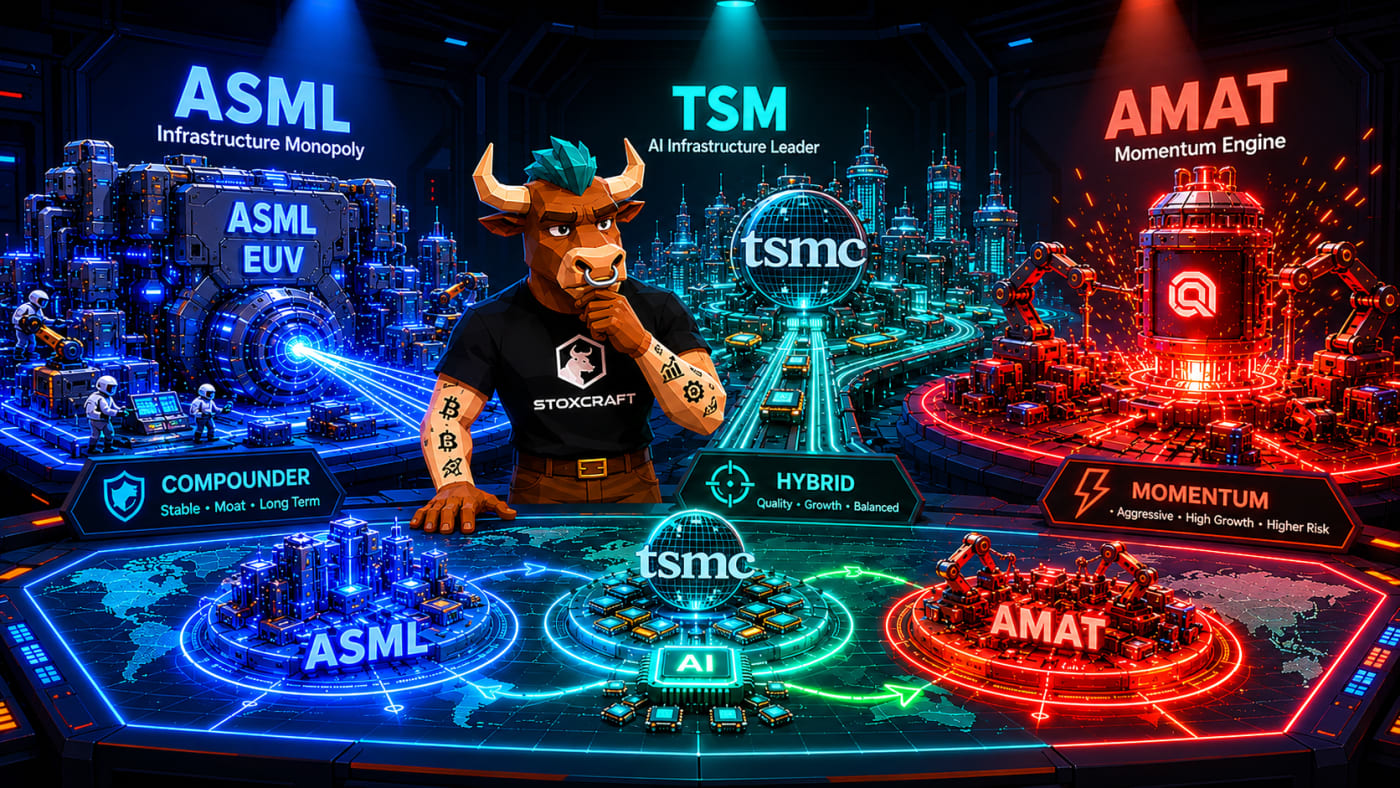
But getting to the same rating from different directions changes everything about how you use them. ASML is a quality compounder. TSM is a quality-momentum hybrid. AMAT is a momentum play with strong fundamentals underneath. Each one fits a different investor in the current AI-capex cycle.
Here's what the data shows for each one.
ASML: the quality compounder case
ASML doesn't manufacture chips. It builds the machines chipmakers need to fabricate their most advanced processors. No other company on Earth produces extreme ultraviolet lithography systems at commercial scale. That structural monopoly is the foundation of ASML's entire investment case. It shapes the fundamentals, the performance, and the risk profile.
What ASML's financial health reveals about its semiconductor equipment moat
ASML earns a Health Score of 8.6 out of 10. That places it among the top 10% of semiconductor equipment companies in the Stoxcraft database. The score is primarily driven by exceptional free cash flow generation. Operating margins here consistently exceed what most peers can match.
The Q1 2026 numbers back this up. ASML reported €8.8 billion in revenue with a gross margin of 53%. It raised its full-year 2026 revenue guidance to €36 billion to €40 billion. It increased its annual dividend by 17% to €7.50 per share. This is the profile of a business that compounds steadily without needing to sprint.
One constraint worth noting: ASML trades at a premium valuation versus peers. Its price-to-earnings ratio sits well above the semiconductor equipment sector median. The fundamentals justify a premium. Whether the current premium is excessive depends on your time horizon.
How ASML's price performance holds up across market cycles
ASML's Performance Score of 8.6 is well above the median across all 3,486 tracked stocks in the Stoxcraft universe. Long-term outperformance drives the score more than recent months do. Over three and five years, ASML has consistently beaten its sector benchmarks. Shorter windows are more moderate.
That's the classic compounder pattern. Slow, steady, multi-year gains. The stock doesn't chase momentum. It builds returns quietly through fundamentals.
The technical trend is currently climbing. All major short-term indicators are pointing upward, but the signal is steady rather than aggressive. Entry conditions are reasonable. Analyst consensus supports the stock at current levels. For patient investors, ASML fits a long-term buy-and-hold strategy. It's the quality compounder of the semiconductor equipment world.
TSM: quality and momentum in the same stock
Taiwan Semiconductor earns a 5-star overall rating, with the strongest composite profile of the three. Within Stoxcraft's 50 top-rated stocks globally, very few names bring what TSM brings. Both the fundamental case and the momentum case are firing at the same time. That combination is rare.
TSM's financial health and what record profits reveal about fab infrastructure
TSM's Health Score is 8.6. Within the semiconductor manufacturing sector, that places it among the strongest foundry businesses in the Stoxcraft database. The score is driven by extraordinary profitability and pricing power. Few companies in any industry can match these margins.
Revenue climbed 40.6% year-over-year to $35.9 billion in Q1 2026, and net income surged 58.3%. Gross margin reached 66.2%. AI and high-performance computing now account for 61% of TSM's total revenue. Advanced chip nodes at 7nm and below represent 74% of wafer revenue.
TSMC is infrastructure. Every major AI chip from Nvidia (NVDA) and Apple runs through its fabs. Customers are booking production slots months in advance. Capacity at the most advanced nodes is effectively sold out. That pricing power shows up directly in the margin profile.
TSM's business doesn't depend on one product cycle. It depends on the continued advancement of semiconductor technology globally. That's a structural tailwind, not a cyclical one.
How TSM's price performance compares to the S&P 500 and semiconductor peers
TSM's Performance Score of 9.7 places it in the top 3% of all 3,486 stocks tracked globally. To reach that level, a stock must outperform benchmarks across all time horizons. TSM does exactly that.
Compared to the S&P 500, the outperformance gap is significant. Compared to the broader semiconductor sector, TSM leads. Short-term momentum is strong. The stock is trading near its 52-week high. All major technical indicators are aligned bullishly.
TSM's trend signal currently sits between climbing and surging. That's unusual for a company of this size. The long-term fundamental case and the short-term technical case are both pointing the same way. That's what makes TSM the hybrid.
The entry signal reflects strong analyst consensus. Positioning is favorable but not extreme. Elite fundamentals and a favorable entry signal make TSM the most balanced choice of the three for new positions.
AMAT: the highest momentum, and the highest risk
Applied Materials is the most interesting of the three to unpack. Its Health Score of 8.8 is the highest of the group. Its Performance Score of 9.8 is also the highest. And its risk profile is the most elevated of the three. All of that is true at the same time.
AMAT's fundamental health ranking among semiconductor equipment peers
AMAT's Health Score of 8.8 puts it in the top 5% of semiconductor equipment companies across the Stoxcraft database. Among direct peers in the equipment sector, very few stocks score higher. The score reflects strong earnings quality and high cash conversion. AMAT also just posted its highest gross margin in over 25 years.
Q2 FY2026 was a record quarter. Revenue reached $7.91 billion, up 11% year-over-year. AMAT's CEO raised the semiconductor equipment growth outlook to above 30% for calendar 2026. The company's growth is broad-based across three key areas:
- Leading-edge logic demand driven by the global AI infrastructure buildout
- DRAM revenue growing 18% year-over-year as AI memory requirements expand
- Advanced packaging revenues forecast to grow over 50% in calendar 2026
That breadth is what separates AMAT from a one-product momentum story. The fundamentals are genuinely strong across multiple growth vectors.
AMAT's momentum-driven performance and the risk that comes with it
AMAT's Performance Score of 9.8 is essentially at the ceiling of the Stoxcraft database. Across all 3,486 tracked stocks, fewer than 1% score higher. The short-term technical signal is equally aggressive. AMAT's trend is currently surging, the highest possible reading, with all major indicators aligned bullishly.
That momentum comes at a cost. AMAT's Risk Score of 6.0 is above average. The score measures volatility, drawdown, and market sensitivity. A reading above 5.0 means the stock carries more risk than the median across all tracked names. For the risk score, higher always means more risk.
Applied Materials shares surged to a record after the company delivered a surprisingly upbeat sales forecast, signaling that demand for AI and memory semiconductors is fueling equipment purchases. That kind of momentum-driven reaction is part of what drives the elevated risk score. When the narrative is this strong, the stock moves sharply in both directions.
The current entry signal for AMAT is favorable. Analyst consensus is firmly bullish. RSI sits in a healthy zone rather than overbought territory. But investors should be clear about what they're buying. AMAT is a momentum play with genuine fundamentals underneath. Gains can accelerate quickly. So can pullbacks when sentiment shifts.
Which of ASML, TSM, and AMAT fits your portfolio in the AI-capex cycle
All three stocks earn a 5-star rating. All three are among the 50 top-rated picks from a universe of 3,486 stocks. But they're built for different investors in the current AI chip buildout.
ASML is for the patient, quality-first investor. The EUV monopoly is structural. The fundamentals compound steadily. The trend is climbing, not surging. This is a long-term position, not a trade.
TSM is for the investor who wants quality and momentum together. Health and performance are both elite. The trend is building toward surging territory. The risk profile is more moderate than AMAT's. That balance makes TSM the most versatile pick for long-term AI infrastructure exposure.
AMAT is for the investor who can tolerate volatility and wants the highest concentration of momentum. The performance and trend readings are the most aggressive in this group. The fundamentals are strong. But the risk profile is elevated, and pullbacks tend to be sharp.
Holding all three gives you diversification across the full chip supply chain. ASML brings equipment monopoly. TSM brings fabrication infrastructure. AMAT brings broad equipment momentum. For more context on how the AI-capex cycle is reshaping this sector, see our chip boom analysis.