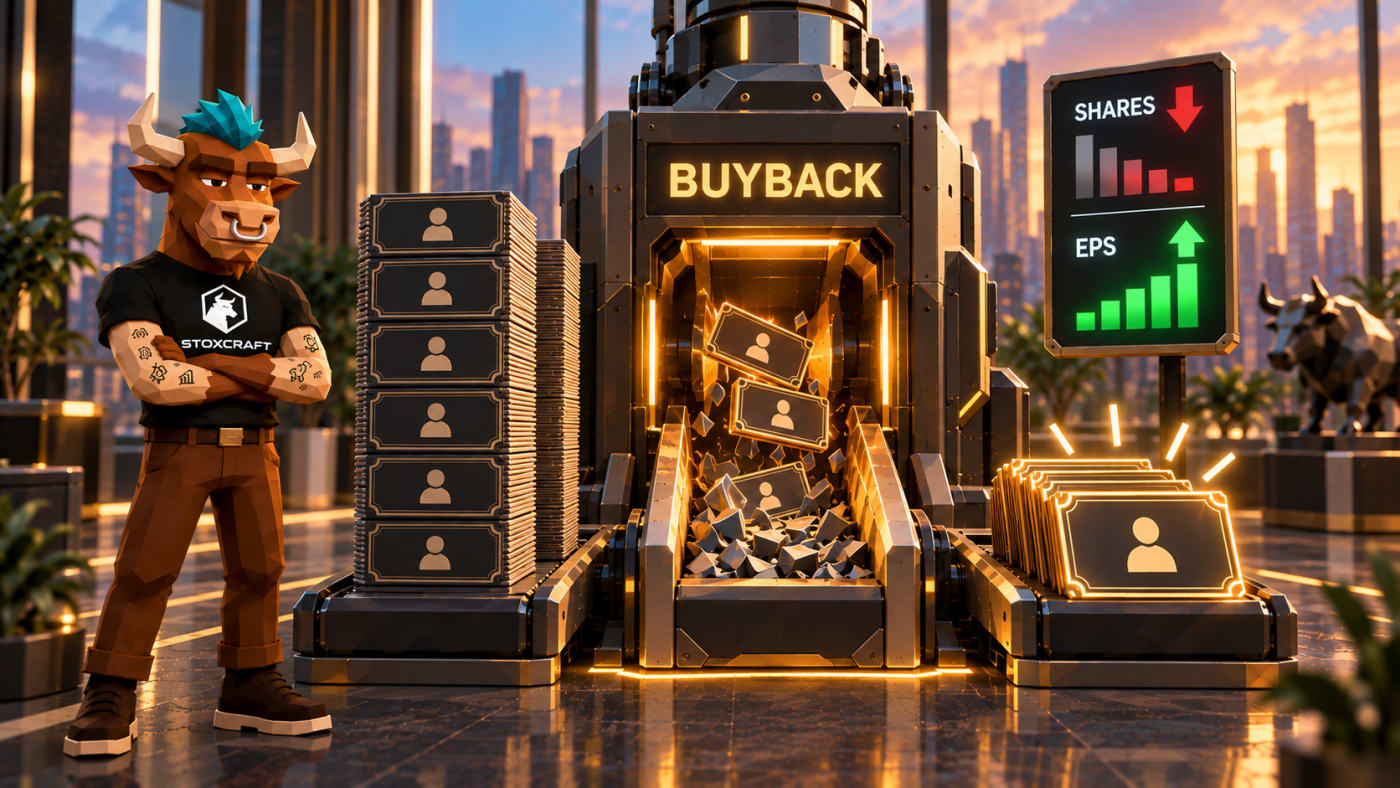
A stock buyback is when a company uses its own cash to purchase shares of its own stock, then retires them. Fewer shares outstanding, same company. That single move quietly reshapes everything from earnings per share to who actually controls the vote.
Corporate America is not shy about it. S&P 500 companies spent a record over 1 trillion dollars on buybacks in the twelve months through September 2025. That is more than the market caps of most countries' entire stock exchanges. Here is what a buyback actually does, why companies keep reaching for it, and how to tell if it is helping you or just padding a headline.
What a stock buyback is and how it works
When a company announces a buyback, its board authorizes a dollar amount, say 20 billion dollars, to spend repurchasing shares on the open market. The company then buys stock the same way any investor would, just at a much bigger size, and retires the shares instead of holding them.
Where the cash for a buyback comes from
Buybacks get funded out of free cash flow, the money left over after a company covers operations and reinvestment. A business generating strong free cash flow has options: pay down debt, invest in growth, hand cash to shareholders through dividends, or buy back stock. Buybacks are the flexible option on that list, and that flexibility is the whole point.
What actually happens to your shares
Retiring shares shrinks the total share count. Since earnings per share is net income divided by shares outstanding, a smaller denominator pushes EPS higher even if profit stays completely flat. That is not an accounting trick. It is real math, and it is exactly why buybacks move stock prices.
Why companies choose buybacks over dividends
Dividends are a promise. Cut one and the stock gets punished hard, since investors read a dividend cut as a signal something is seriously wrong. A buyback carries no such promise. A company can run a 20 billion dollar program one year and quietly do nothing the next, with far less market drama.
That flexibility explains most of the corporate playbook here:
- No recurring commitment, so a slow quarter does not force an awkward announcement
- More tax-efficient for many shareholders than a cash dividend, since a buyback is not taxed until you actually sell
- A built-in signal that management thinks the stock is undervalued at current prices
- A direct lever on EPS and other per-share metrics that Wall Street watches closely
One more twist worth knowing: since 2023, the US has charged a 1% excise tax on net buybacks, meaning companies pay a small toll for choosing this route over dividends. It barely dents the math. The tax trimmed S&P 500 operating earnings by less than half a percentage point in 2025, nowhere near enough to change management's calculus.
Apple has leaned on this harder than almost anyone. The board authorized a 110 billion dollar buyback program, a 22% jump from the year before, and followed it with another 100 billion dollar authorization in May 2025. Apple, Alphabet, and Nvidia alone announced close to 430 billion dollars in combined buybacks in 2025.
How to tell if a buyback actually helps shareholders
Here is the hot take: a buyback is not automatically good news. It is only good news if the company is buying its own stock for less than it is worth. Buy back shares at an inflated price and management just set fire to shareholder cash for a one-time EPS bump.
That last point matters more than it gets credit for. A buyback funded by genuine free cash flow, alongside continued investment in the business, is a sign of a company with more cash than it knows what to do with. A buyback funded by new debt while cash flow from operations is shrinking is a very different story wearing the same headline.



Companies like Apple (AAPL), Microsoft (MSFT), and Nvidia (NVDA) run some of the largest buyback programs in the market, and each is worth checking on its own terms rather than assuming size alone means a good deal for shareholders. Nvidia's 60 billion dollar authorization, for instance, came while the company was still pouring record sums into AI infrastructure, a very different setup than a mature company with nowhere left to reinvest.
The buyback headline is not the shareholder story
A stock buyback shrinks the share count, lifts EPS, and signals confidence from the boardroom. None of that guarantees the stock was a good buy at the price management paid for it. The trillion-dollar headline tells you corporate America is flush with cash. It does not tell you whether that cash was well spent.
Treat every buyback announcement as a starting question, not a final answer. The size of the number matters far less than the price paid, the funding source, and what got sacrificed to make room for it. A disciplined buyback compounds shareholder value quietly for years. A careless one just burns cash at the top of a cycle and calls it capital return.
Before you treat a buyback announcement as a reason to buy, check the price it was bought at, where the cash came from, and whether the share count is actually falling once dividend and stock-grant dilution are accounted for. The buyback is the headline. Your own math is the story that actually matters.