Everyone throws the term blue chip stock around. Most people cannot tell you what actually earns that label.
There is no official rulebook. No regulator hands out the title. It is a reputation, built over decades, and confirmed one earnings report at a time.
This guide breaks down what is a blue chip stock, shows real examples, and compares blue chips to growth stocks. We will also cover how Stoxcraft's stock screener helps you spot one fast.
What makes a stock a blue chip stock
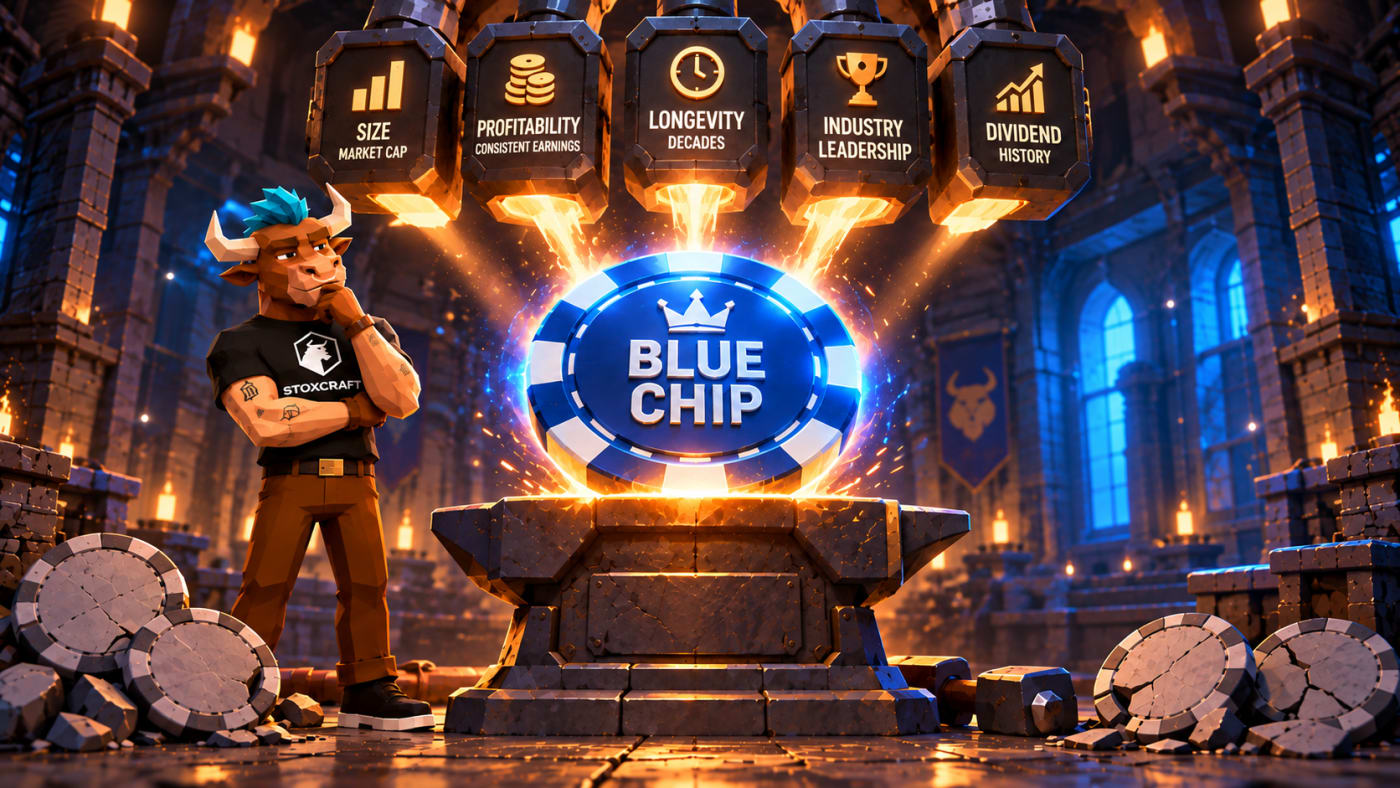
A blue chip stock is shares in a large, financially sound company with a long track record. Think decades, not years.
There is no single agency that stamps this label onto a company. Analysts and investors just tend to agree on the same set of traits.
Five things every real blue chip has in common:
- A market capitalization usually above $10 billion
- Decades of continuous operation through multiple downturns
- Consistent profits, not just one strong year
- A leading position in its industry
- Often a long history of paying and raising a dividend
That last point matters, but it is not a hard rule. Some blue chips reinvest almost everything instead of paying shareholders. The size and staying power still count more than the payout.
Market capitalization alone will not tell you the whole story either. A company can be huge and still fragile. That is why the other traits matter just as much as the size.
Index membership is a useful shortcut, but not a perfect one. Being included in the S&P 500 or the Nasdaq 100 signals scale. It does not guarantee dividend history or low volatility on its own.
Liquidity is the trait people forget. A true blue chip trades in huge daily volume. You can buy or sell a large position without moving the price much, which matters more than it sounds once you are managing real money.
None of this is exclusive to old, slow-moving industries either. A handful of technology names have grown large and stable enough to earn the same label, even without a long dividend history yet. Size and staying power can arrive faster than they used to.
Think you can already tell a real blue chip from a good story? Try it below before you keep reading.
Real examples of blue chip stocks in 2026
The clearest place to find blue chips is the Dow Jones Industrial Average, which has tracked over 30 of the market's most recognized names since 1896.
Apple (AAPL) and Coca-Cola (KO) sit at opposite ends of the blue chip spectrum. Apple builds phones and chips. Coca-Cola sells syrup and fizzy water. Both have decades of dominance and both show up on nearly every blue chip list ever written.
Size alone can be staggering. Apple and Microsoft are both within reach of a $4 trillion valuation, with Apple near $3.85 trillion and Microsoft near $3.55 trillion.
Other familiar blue chip names include Microsoft (MSFT) and Johnson & Johnson (JNJ). Procter & Gamble (PG) belongs on that list too. Each one dominates a different corner of the economy, from software to healthcare to household goods.
None of these companies are flashy anymore. Their stock charts do not spike overnight. That is the whole point. Boring, in this corner of the market, is a feature, not a flaw.



Blue chip stocks vs growth stocks
Growth stocks chase upside. They plow profits back into expansion and often skip dividends completely.
Blue chips already won that fight. They are not trying to become the next big thing. They are the current big thing, and they intend to stay that way.
- Growth stocks can double fast, and crash just as fast
- Blue chips move slower, in both directions
- Growth stocks rarely pay a dividend, blue chips often do
- Blue chips carry a track record, growth stocks carry a story
This is not really an either-or decision. Many investors hold both, using diversification to balance a portfolio's growth engine against its ballast. If you are still building that first portfolio, our guide on building your first investment portfolio walks through exactly how to split the two.
The trade-off is real. A portfolio stacked with only blue chips will likely lag a hot bull market. A portfolio stacked with only growth names will likely fall harder in a downturn. Neither extreme protects you from every outcome.
How to spot a blue chip stock using Stoxcraft's scoring
Reading annual reports for every candidate is not realistic. That is what scoring exists to fix.
A strong fundamental profile, consistent cash generation, and manageable debt are the fingerprints of a real blue chip. Stoxcraft's fundamental scoring surfaces exactly that, sector by sector, so a bank and a software company are never judged by the same yardstick.
Volatility is the other half of the picture. A blue chip should hold up when markets get rough, not just when they are calm. Screening for low downside exposure alongside strong fundamentals is a fast way to separate real blue chips from companies just borrowing the reputation.
Watch the trend too. A blue chip does not need to be exciting, but a stock stuck in a long downtrend is telling you something the balance sheet will not. Pair the fundamentals with the price action before you commit any money.
Stoxcraft's take on this is simple. A big name is not proof. A decade of proof is proof.
Run any candidate through the stock screener before you buy the story instead of the numbers. Filter for a large market cap, a stable trend, and a healthy balance sheet, and the noise falls away fast.
A blue chip label is a starting point, not a guarantee
Blue chip status is earned, not permanent. General Electric wore the label for a century before losing it. Nothing on this list is exempt from that risk.
The label still means something. It points you toward companies that survived recessions, price wars, and management turnover without falling apart.
Use it as a filter, not a finish line. Check the fundamentals, check the price, and decide for yourself if today is the right entry point.
Markets change faster than reputations do. A company can keep its blue chip label on paper for years after the fundamentals start slipping. That gap is exactly why a quick check before buying still pays off, no matter how familiar the name looks.