
What a moving average is
A moving average is a line drawn on a price chart. It calculates the average closing price over a set number of days. Each day, the oldest price drops off and the newest one enters. The line rolls forward.
That is the whole concept. No prediction engine. No signal generator. Just math applied to past prices.
There are two common types:
- Simple moving average (SMA): Every day in the period is weighted equally.
- Exponential moving average (EMA): Recent days are weighted more heavily.
Both types lag behind price. The EMA lags a little less. But neither one leads. If you are new to chart reading, what is technical analysis is a solid place to build your foundation first.
The 50-day and 200-day moving averages
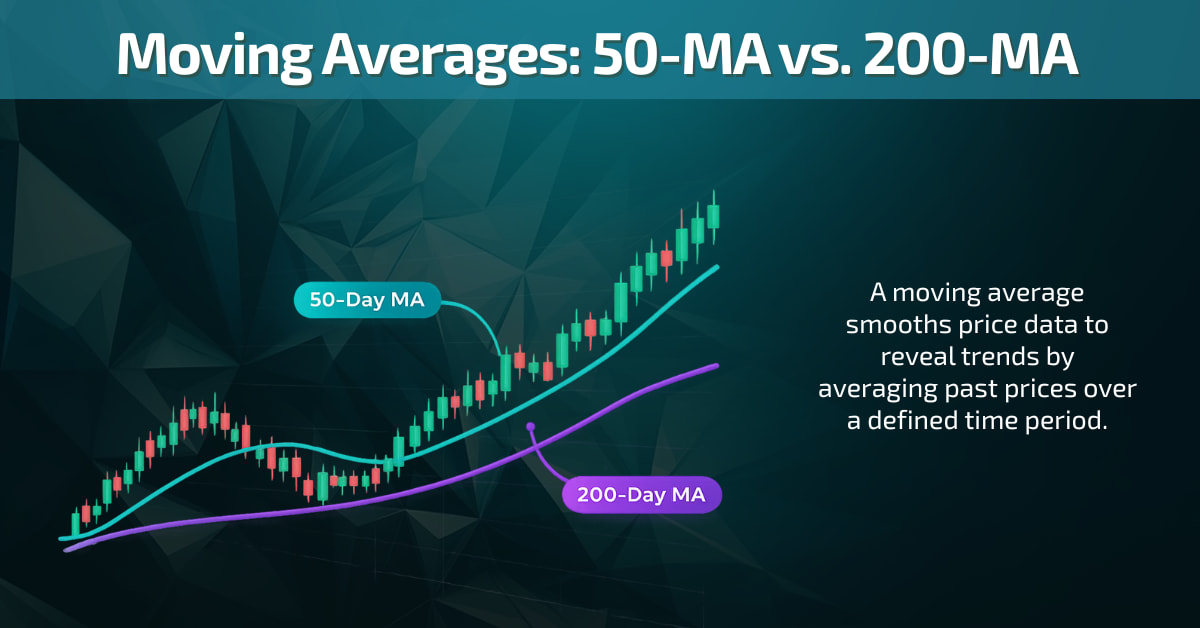
The two most closely watched moving averages are the 50-day and the 200-day. Institutions, funds, and retail traders all track the same lines. That shared attention is exactly what makes both lines meaningful.
What the 50-day moving average confirms
The 50-day MA covers roughly 10 weeks of trading. It reflects medium-term price behaviour. When a stock stays above it, buyers have been in control for about two months. When it drops below, sellers are gaining ground.
Traders use the 50-day as a test of near-term trend health. A bounce off the 50-day on rising volume adds real weight to a bullish read. A breakdown through it on heavy selling is a warning worth taking seriously.
What the 200-day moving average confirms
The 200-day MA covers roughly 40 weeks. It captures long-term price behaviour. This is the line that separates a bull market from a bear market for many analysts.
Stocks above the 200-day are generally in an established uptrend. Stocks below it are in a downtrend. Fund managers watch this line closely. When major indices break below the 200-day, institutional selling tends to accelerate.
If you want to practice reading these lines on real charts, how to read a price chart covers the fundamentals.
Moving average crossovers: golden cross and death cross
Crossovers happen when the 50-day and 200-day moving averages intersect. These events attract wide media attention. They also get misread constantly.
The golden cross: how the signal works and what it lags
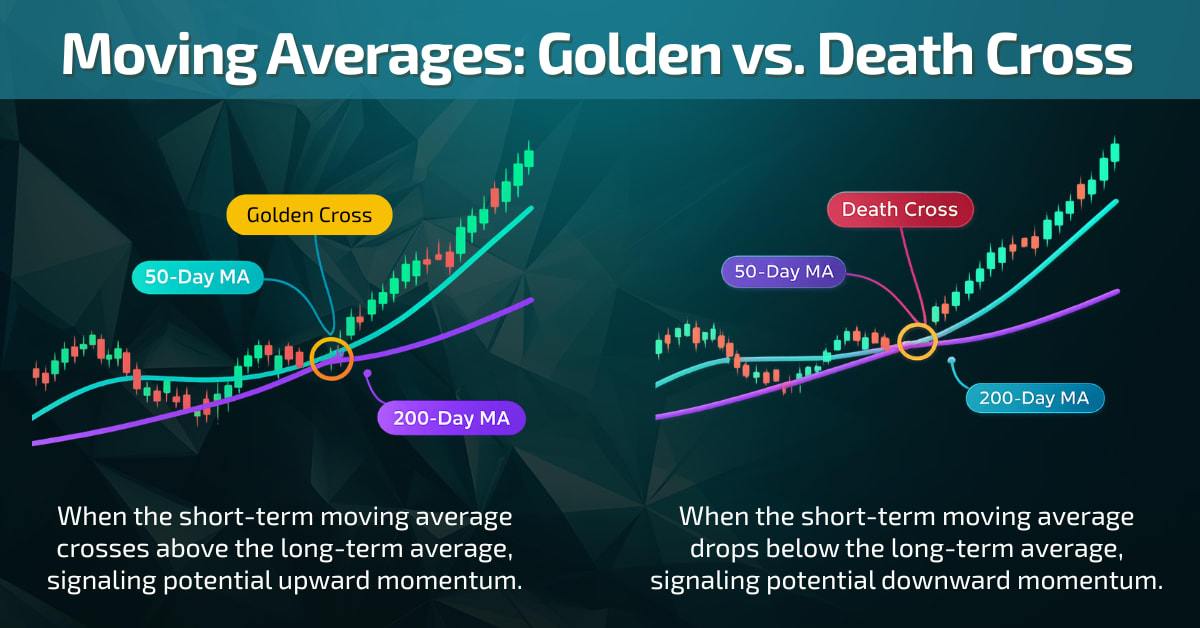
A golden cross forms when the 50-day MA crosses above the 200-day MA. Short-term momentum has built faster than the long-term average. This is widely treated as a bullish signal.
The key word is treated. A golden cross confirms an uptrend that has been in place long enough to shift the averages. By the time the lines cross, the move is often already underway. The S&P 500 has finished higher 88% of the time in the year following a golden cross, dating back to 1975, with an average return of 12.29% in that period. Strong historical odds. Not a guarantee.
Nvidia (NVDA) formed a golden cross in early 2023. The stock had already begun its AI-driven run before the lines met. Traders who waited for the cross still captured gains. But the move was confirmatory, not predictive.






The death cross: how the signal works and what it confirms late
A death cross forms when the 50-day MA crosses below the 200-day MA. Short-term momentum has weakened against the long-term average. It is widely interpreted as a bearish signal.
Context matters here. In 54% of historical death crosses on the S&P 500, the market's worst decline had already occurred before the signal formed, according to a Reuters analysis of LSEG data covering 50 years. The cross confirmed the damage. It did not cause it.
Tesla (TSLA) formed a death cross in early 2022. The stock had already been falling hard before the lines intersected. The cross confirmed a downtrend in progress. It did not start one. For a deeper look at how these signals are constructed, the moving averages explained guide goes further.
Why moving averages are lagging indicators
This is the part most people skip, and it is the most important part.
Moving averages are built from past prices. Every single calculation is historical. There is no forward-looking component. When the 50-day turns up, it means prices have been rising for a while. When it turns down, prices have been falling. The line does not know what happens next.
That lag is a feature, not a flaw. It filters out daily noise. It shows the trend after the chaos settles. But it also means crossover signals arrive late by design.
Treat them as early warnings and you will be caught off guard repeatedly. Use them to confirm what price and volume already show. That is the correct interpretation. The limitations of technical analysis guide covers this in full.
How volume confirms or invalidates a moving average crossover
A crossover that forms on low volume is a weak signal. One backed by surging volume carries real weight.
Volume tells you whether meaningful capital is moving behind the price action. When the 50-day crosses the 200-day on heavy volume, large participants are likely involved. When the cross happens on thin volume, it may reflect drift rather than conviction.
Three things to check when a crossover forms:
- Is volume above its 20-day average on the crossover day?
- Has volume been building over the previous several sessions?
- Is price closing near the high of the day, or near the low?
All three pointing in the same direction as the crossover is a meaningful setup. If volume is thin and price closes weak, treat the signal as noise. The volume: what it tells you guide walks through exactly how to read it.
How price structure determines a crossover signal's reliability
Price structure is the shape of the trend before the crossover forms. A golden cross forming in a stock that has been making higher highs and higher lows is a very different signal from one in a choppy sideways market.
When price structure adds weight to a golden cross
A clean uptrend with clear support levels and rising volume gives a golden cross more credibility. Price and the moving average are telling the same story. That alignment is what conviction looks like.
When Nvidia (NVDA) formed its 2023 golden cross, the stock had already established a series of higher highs with expanding volume. The moving average caught up to what price structure was already confirming. That is the setup that holds.
When price structure undermines a death cross
A death cross that forms after a sharp, fast sell-off can signal exhaustion rather than more selling. The stock has already dropped hard. The 50-day is catching up to what already happened. A recovery can follow.
This is where mechanical reliance on moving averages hurts traders. Context determines meaning. A death cross near all-time highs is not the same signal as one forming after a 40% collapse.
Resistance levels near the crossover also change the signal's value. A golden cross that forms directly below heavy resistance has limited upside until price clears that level.
Three moving average habits that generate bad signals
Most moving average mistakes trace back to a small number of repeated errors. Each one is avoidable. Here is exactly where traders go wrong.
Treating every crossover as a trade entry
Crossovers in sideways markets produce whipsaw trades. The lines cross. You act. Price reverses. This repeats. The fix is simple: only act on crossovers in clearly trending markets. A flat 200-day MA is a red flag that no real trend is established.
Ignoring the slope of the moving averages
The direction the lines are pointing matters as much as where price sits relative to them. A rising 200-day paired with a golden cross is far stronger than a flat or declining one. Slope confirms commitment to the trend direction.
Always check whether both the 50-day and 200-day are angled in the direction of the trade. A crossover with contrary-sloping averages is often a false start, not a new trend.
Using moving averages without a confirming indicator
Moving averages in isolation miss crucial context. The MACD (moving average convergence divergence) builds directly on moving averages and adds momentum context. Both tools together give you more than either one alone.
Combining moving averages with volume and at least one momentum indicator is the minimum viable approach for reliable signals. Build a complete technical toolkit at the Stoxcraft Chart and Technical Analysis Academy.
What moving averages can and cannot tell you about direction
Moving averages are among the most widely used tools in markets. They are also among the most misapplied.
The 50-day tells you what price has done over 10 weeks. The 200-day tells you what it has done over 40 weeks. The golden cross tells you short-term momentum overtook the long-term average. The death cross says the opposite. None of that is forward-looking.
Combine these lines with volume, price structure, and a clear trend. Use them to confirm what you already see in the chart. That is how they do the job they were built for.
Disclaimer: This article is for educational purposes only and does not constitute financial or investment advice. Always conduct your own research before making any investment decision.