Most bankruptcy filings do not come out of nowhere. The warning signs are in the numbers, hiding in plain sight on financial statements that most people never read. The Altman Z-Score was built to read those numbers for you.
In 1968, NYU Professor Edward Altman analyzed dozens of bankrupt companies and compared them to healthy ones. He discovered that five financial ratios, properly weighted, could predict financial distress years in advance. Over 57 years later, this formula is still one of the most widely used tools in finance.












How the Altman Z-Score formula works
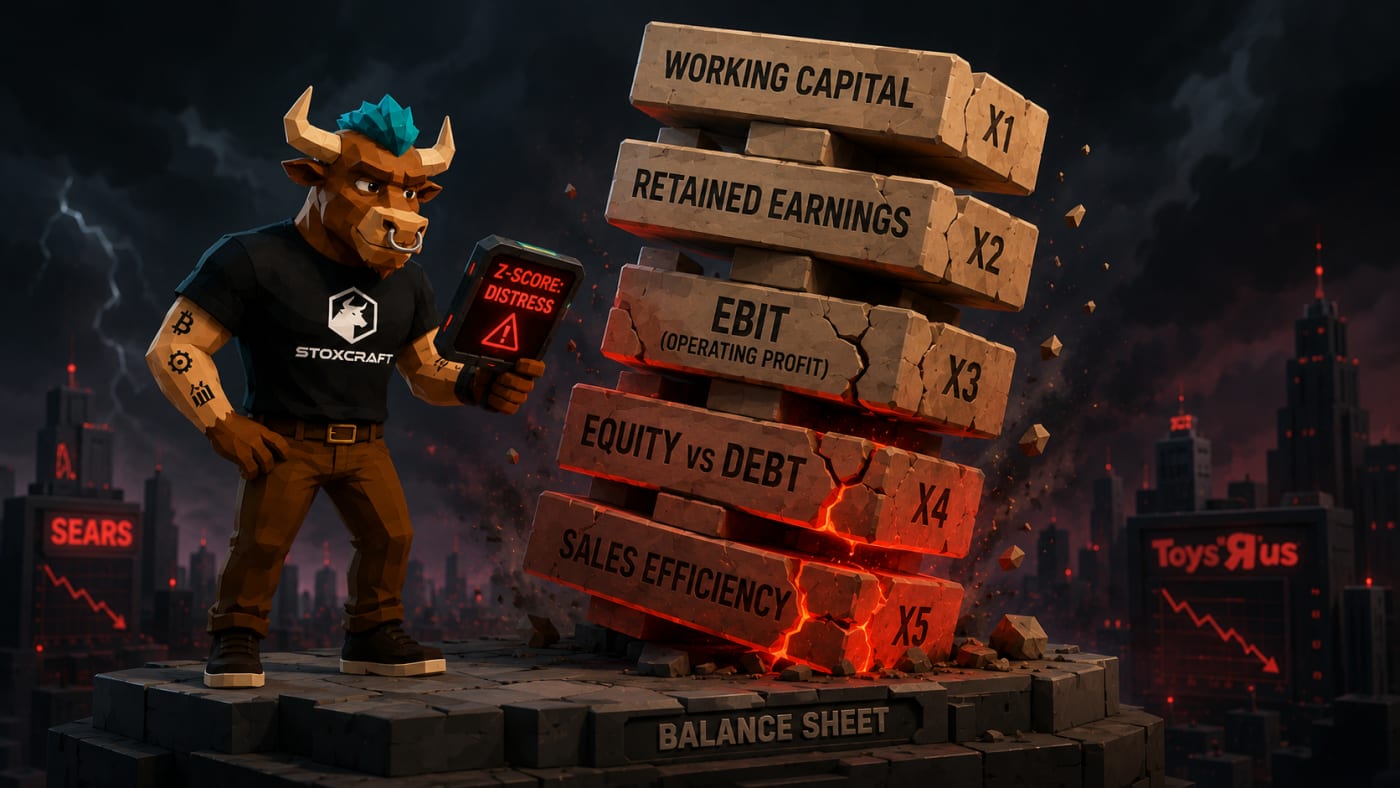
The Z-Score does not rely on a single ratio. It pulls five numbers from a company's financial statements, weights each based on its predictive power, and combines them into one output. Each variable captures a different dimension of financial health.
Here is what each variable measures:
- X1 (working capital / total assets): Measures short-term liquidity. Negative working capital is a serious early warning.
- X2 (retained earnings / total assets): Captures how much profit a company has reinvested over its lifetime versus how much it has borrowed to survive.
- X3 (EBIT / total assets): Shows how efficiently a company turns its assets into operating profit before interest and taxes.
- X4 (market value of equity / total liabilities): Compares the market's view of the company against its total debt load.
- X5 (sales / total assets): Measures how effectively assets generate revenue.
The weights are not arbitrary. Altman derived them through statistical analysis of real bankrupt and solvent firms. X3 carries the heaviest weight at 3.3 because operating profitability is the strongest single predictor of failure.
How to read a Z-Score result
Once you have a number, the zones work like this:
- Above 2.99: Safe zone. Low near-term bankruptcy risk.
- Between 1.81 and 2.99: Grey zone. Not in crisis, but close enough that one bad quarter can change the picture.
- Below 1.81: Distress zone. Significant probability of bankruptcy within two years.
The grey zone is where most of the risk hides. A company sitting between 1.81 and 2.99 is not yet collapsing, but it is close enough that one macro shock or one bad credit decision can push it over.
The Z-Score's accuracy record and its real-world proof
Numbers on paper only matter if the model actually works. The Z-Score has been tested against decades of real failures, and its track record is hard to dismiss.
How accurately the Z-Score predicts bankruptcy
That is not a perfect model. But for a five-variable formula built in 1968, that durability is remarkable. No proprietary algorithm, no machine learning layer, no subscription data feed required.
How the Z-Score flagged Sears and Toys R Us years before filing
The formula's strongest advertisement is its historical track record on names that everyone recognizes.
Between 2012 and 2017, the Z-Scores for Toys R Us failed to climb out of the distress zone, except briefly in 2013. Sears Holdings filed for bankruptcy in 2018 after five consecutive years of decreasing Z-Scores, all in the distress zone. Both companies collapsed in 2018. The Z-Score had been flashing red for years. Investors watching headlines missed it. Investors watching the formula did not.
Lehman Brothers showed a sharply declining Z-Score in the quarters before its September 2008 collapse. General Motors fell into distress territory years before its bankruptcy filing as operating losses mounted and liabilities exceeded assets. The pattern is consistent: the distress zone is a structural reading of a company spending more than it earns, borrowing more than it can repay, and generating too little from the assets it holds.
The five components explained
Each of the five Z-Score inputs tells a specific part of the financial story. Understanding them individually makes it easier to spot where a company is most exposed.
X1: working capital relative to total assets
Working capital is current assets minus current liabilities. When this ratio is negative, a company owes more in the short term than it has on hand. That is not always fatal. But combined with other weak inputs, it compresses the Z-Score fast. A company with negative working capital and rising debt is running out of runway.
X2: retained earnings relative to total assets
This ratio reflects accumulated profitability over a company's lifetime. A young business with negative retained earnings is not automatically in trouble. But a mature company with years of accumulated losses has spent decades consuming more capital than it generates. When X2 is low or negative in an established business, growth is being funded by debt, not profit. That is a structural warning.
X3: EBIT relative to total assets
EBIT, or earnings before interest and taxes, divided by total assets is the heaviest-weighted component of the formula at 3.3. A company can survive weak liquidity for a while. It cannot survive years of generating no operating profit. When X3 is near zero or negative, the business is not covering its cost structure through operations. Everything else is borrowed time.
X4: market value of equity relative to total liabilities
This is the one component that uses market data instead of accounting data. It asks how much investors think the company is worth compared to what it owes. When a stock collapses while debt stays fixed, X4 drops fast. A falling market cap against stable or rising liabilities is one of the earliest market signals of distress. This is also why Z-Scores tend to deteriorate before a bankruptcy announcement. The stock market prices in trouble before accountants report it.
X5: revenue relative to total assets
Asset efficiency. If a company holds a massive balance sheet but generates thin revenue relative to it, X5 is low. Capital-light businesses score well here. Asset-heavy businesses with declining sales score poorly. In retail and manufacturing, a falling X5 often signals that growth has stalled while the asset base stayed large.
What the Z-Score does not capture
No formula covers everything. The Z-Score has well-documented limits that matter in practice.
The original model was designed for U.S. public manufacturing companies. It is not recommended for financial companies because of the opacity of bank balance sheets and the heavy use of off-balance-sheet items. Beyond that:
- Accounting choices can distort individual inputs. Reported retained earnings can be adjusted without a real change in financial position.
- The model is backward-looking. It uses the most recent financial statements, which may lag rapid deterioration.
- It ignores qualitative factors: management changes, regulatory risk, litigation exposure, or competitive disruption.
Use the Z-Score as a filter, not a verdict. A low score is a reason to dig deeper, not automatically a reason to sell.
Why bankruptcy risk is worth tracking right now
The backdrop for financial distress is not abstract. 694 companies filed for bankruptcy protection in 2024, the most active year since 2010. That number was not driven by a recession. Markets were broadly positive. Elevated interest rates and the leverage built up during the low-rate era started catching companies out. Some of those failures carried investment-grade ratings before they fell. The Z-Score was already telling a different story.
For investors using Stoxcraft, the health score incorporates the Altman Z-Score as a direct data point alongside other fundamental metrics. You can read how Stoxcraft builds its full scoring system to see how the Z-Score fits into the broader picture.
Z-Score readings across the Stoxcraft universe
Looking at specific stocks in the Stoxcraft database shows how the Z-Score translates into real investment context. Not every company in the distress zone will fail. But where multiple inputs weaken simultaneously, the signal gets harder to ignore.
Pfizer (PFE) is a useful current example. Its Altman Z-Score has hovered near 2, placing it in the grey zone. The reading reflects the debt load from its Covexa acquisition, a post-COVID revenue reset, and significant near-term debt repayments. A score at that level does not mean bankruptcy is imminent. It means the model is asking a question that management must answer clearly.
On the stronger end of the Stoxcraft universe, companies like Microsoft (MSFT) and Mastercard (MA) run Z-Scores well above 3.0. Strong retained earnings, minimal net debt, and high asset efficiency push their scores deep into the safe zone. The Z-Score confirms what the cash flow data already shows: businesses generating more than they consume.
Stocks like Dow (DOW), Alcoa (AA), and Mosaic (MOS) operate in capital-intensive sectors where revenue cycles with commodity prices. When asset values compress and revenue drops, X5 and X4 weaken at the same time. That is when the grey zone becomes worth watching closely. You can screen for these signals directly using the Stoxcraft screener.
The Z-Score's place in a 2026 investing toolkit
The formula has survived 57 years because it measures things that do not change: whether a company earns more than it spends, whether it has more assets than debts, and whether revenue is growing in proportion to its balance sheet.
Financial distress does not always show up in price first. It shows up in the numbers. The Z-Score is a systematic way to read those numbers before the headline appears. With over 23,000 U.S. businesses filing for bankruptcy in 2024 alone, having a model that flags structural deterioration one to two years early is not optional research. It is basic financial homework.
The Stoxcraft health score builds on this foundation. Alongside the Piotroski F-Score, operating free cash flow, and sector-relative leverage ratios, the Z-Score functions as one layer in a multi-factor view of financial quality. No formula predicts the future with certainty. But a 57-year track record of catching structural deterioration before it becomes front-page news earns its place in any serious investor's toolkit.