Both SentinelOne and CrowdStrike sell the same pitch: AI-driven cybersecurity is the future, and both companies claim they're the ones building it. If you've been holding either stock waiting for that story to translate into actual returns, only one of them has anything to show for it right now.
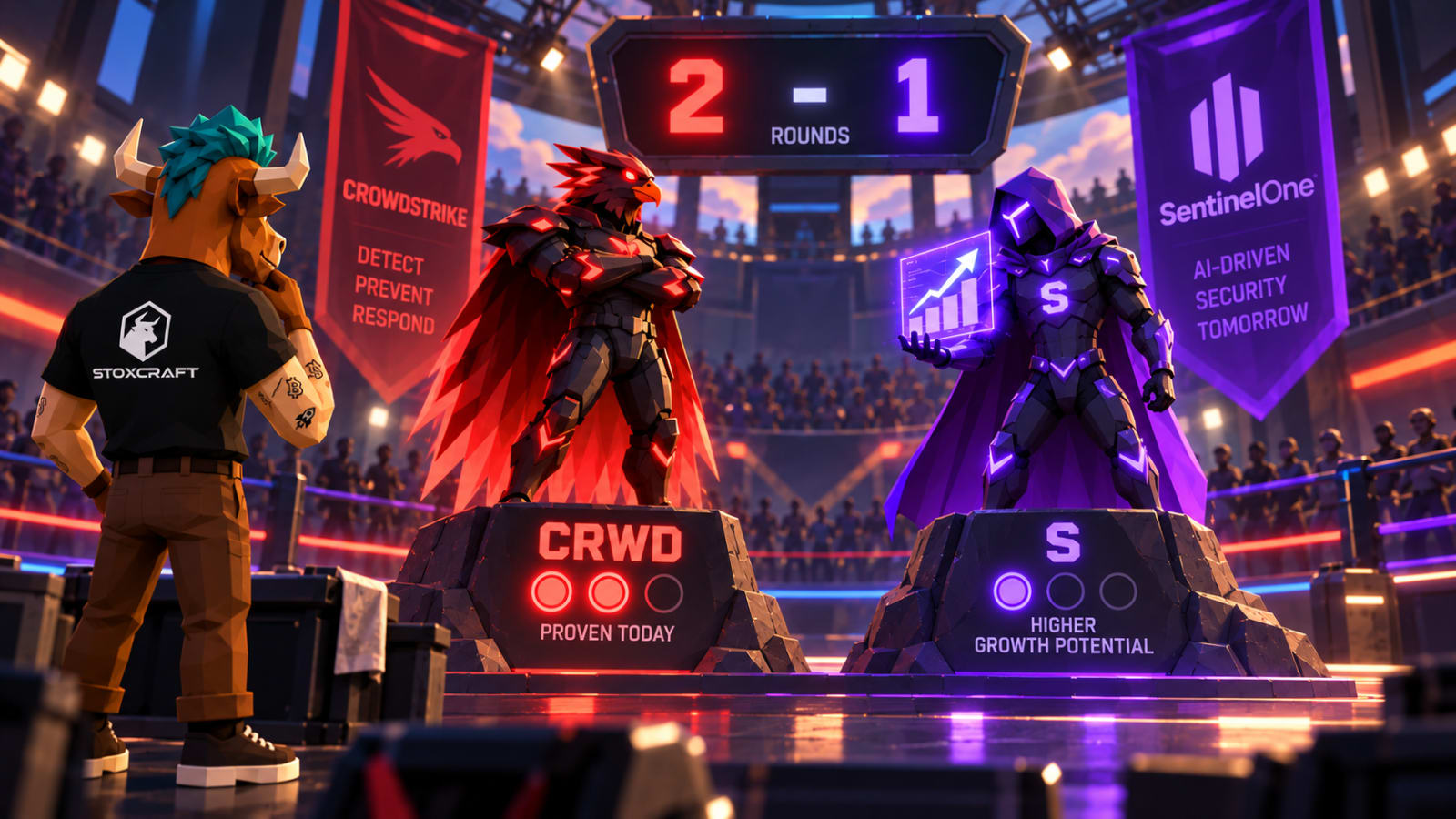
Here's the scoreboard, both names side by side:





Both stocks get compared across three angles that matter if you're deciding where to put money: raw performance, the risk that comes with it, and the underlying business growth behind the price. Here's how they stack up.
Round 1: Who's actually performing?
Start with the number that decides most of this fight. A Performance Score of 5.0 marks the average across the roughly 3,900 stocks Stoxcraft tracks. CrowdStrike's Performance Score sits at 9.4, among the strongest in the entire database.
The why matters more than the number itself. CrowdStrike's latest earnings report showed revenue up 26% year over year, its best quarter on record, with new subscription business jumping more than 50%. Management raised its full-year forecast on the back of it, and CEO George Kurtz has pointed to a simple driver: companies now need to secure their AI systems before they can even deploy them, and that's turned CrowdStrike's product into something closer to a requirement than a nice-to-have. That's a real business trend, not a one-quarter fluke, though a Performance Score this high also means the bar for the next earnings report just got a lot higher.
SentinelOne's Performance Score sits at 2.5, meaning the opposite. Its business hasn't stalled, revenue is still growing over 20% a year, but SentinelOne has cut its own guidance more than once over the past two years, and each cut chipped away at investor confidence. The company is smaller and growing off a lower base than CrowdStrike, which makes each disappointing quarter look worse by comparison, even when the underlying growth rate isn't actually far off.
Round 2: The return gap
The raw returns confirm the score isn't a fluke, but they also show what you're signing up for if you buy in now. Here's how the actual numbers stack up:
- Performance Score: S 2.5 vs. CRWD 9.4. S sits well below the market average of 5.0, CRWD ranks among the top performers.
- 1-Year Return: S +11.04% vs. CRWD +96.63%. CRWD has nearly doubled in a year, S delivers a noticeable but far smaller recovery.
- Risk Score: S 5.9 vs. CRWD 8.2. CRWD carries noticeably more risk for its higher return, S is moving more moderately.
- Revenue Growth (5Y/Share): S 6.01x vs. CRWD 3.74x. S is growing faster off a smaller base, CRWD grows slower but from a far higher level.
- Overall Rating: S ★ vs. CRWD ★★★. S lands in the lower star range, CRWD in the solid upper-middle.
CrowdStrike's one-year return of 96.63% isn't spread evenly across the year. A big chunk of it landed in a single trading session after that earnings beat, when the stock jumped roughly 20% in one day. That's the upside of the AI-security story working out. It's also exactly why CrowdStrike's Risk Score sits at 8.2: a stock that can jump 20% on one earnings call can also drop hard if the next one disappoints, and the current share price already assumes the growth keeps coming.
SentinelOne's one-year return of 11.04% looks unremarkable next to that, but its Risk Score of 5.9 reflects a business that hasn't been swinging on single earnings days the same way. The trade-off is obvious: less upside, but also less of your money riding on one report going perfectly.
Round 3: The growth twist
Here's the twist. Zoom past the price chart and into the actual business, and SentinelOne pulls ahead on one number: SentinelOne's revenue per share has grown 6.01x over five years, against CrowdStrike's revenue per share growth of 3.74x. That's SentinelOne compounding fast off a smaller base, real evidence the underlying business isn't the reason the stock has lagged. Much of that growth traces back to its Singularity platform picking up new enterprise customers and expanding within existing accounts, the same kind of demand signal that's driving CrowdStrike's rally, just not yet reflected in SentinelOne's share price the way it is in CrowdStrike's. CrowdStrike's slower 3.74x simply reflects a company that's already much bigger, where multiplying six-fold would take a far larger amount of new revenue.
That kind of growth doesn't happen by accident. SentinelOne has spent the past two years pushing its AI-driven Singularity platform deeper into enterprise accounts, and revenue per share compounding this fast, even during a stretch of guidance cuts, suggests the product is landing with customers well before the headline numbers catch up. If that trend holds, the gap between what the business is doing and what the stock price reflects becomes the whole argument for holding on.
Final score: CrowdStrike 2, SentinelOne 1
CrowdStrike takes the overall win because it delivered proof right now: a record quarter, raised guidance, and a demand story analysts can point to in plain terms. SentinelOne's case is more of a "give it more time" argument, its growth engine is intact, but it needs a few clean quarters in a row to earn back the confidence CrowdStrike already has.
Numbers on a page are one thing. Watching both stocks actually move is another.
So where does that leave you? CrowdStrike's Performance Score and its one-year return of 96.63% make the strongest case for a business that's proving its story in real time, but that same story is now baked into the price, so any slowdown carries more downside than it used to. SentinelOne's revenue-per-share growth of 6.01x suggests the underlying business is quietly outgrowing what the stock price reflects, but the company still needs to string together clean quarters to prove the recent guidance cuts are behind it. Neither of those reads is a signal to buy either stock. It's a scorecard, not a recommendation, and which side of it matters more depends on whether you'd rather pay for proof already delivered or bet on a turnaround still in progress.
One more number worth checking before you close the tab: analysts still see room in both. SentinelOne's analyst price target of $22.89 implies about 15.6% upside from its current price of $19.81. CrowdStrike's analyst price target of $231.58 implies roughly 10.9% upside from its current price of $208.86, a smaller gap that suggests analysts see the stock as closer to fairly valued after its run.