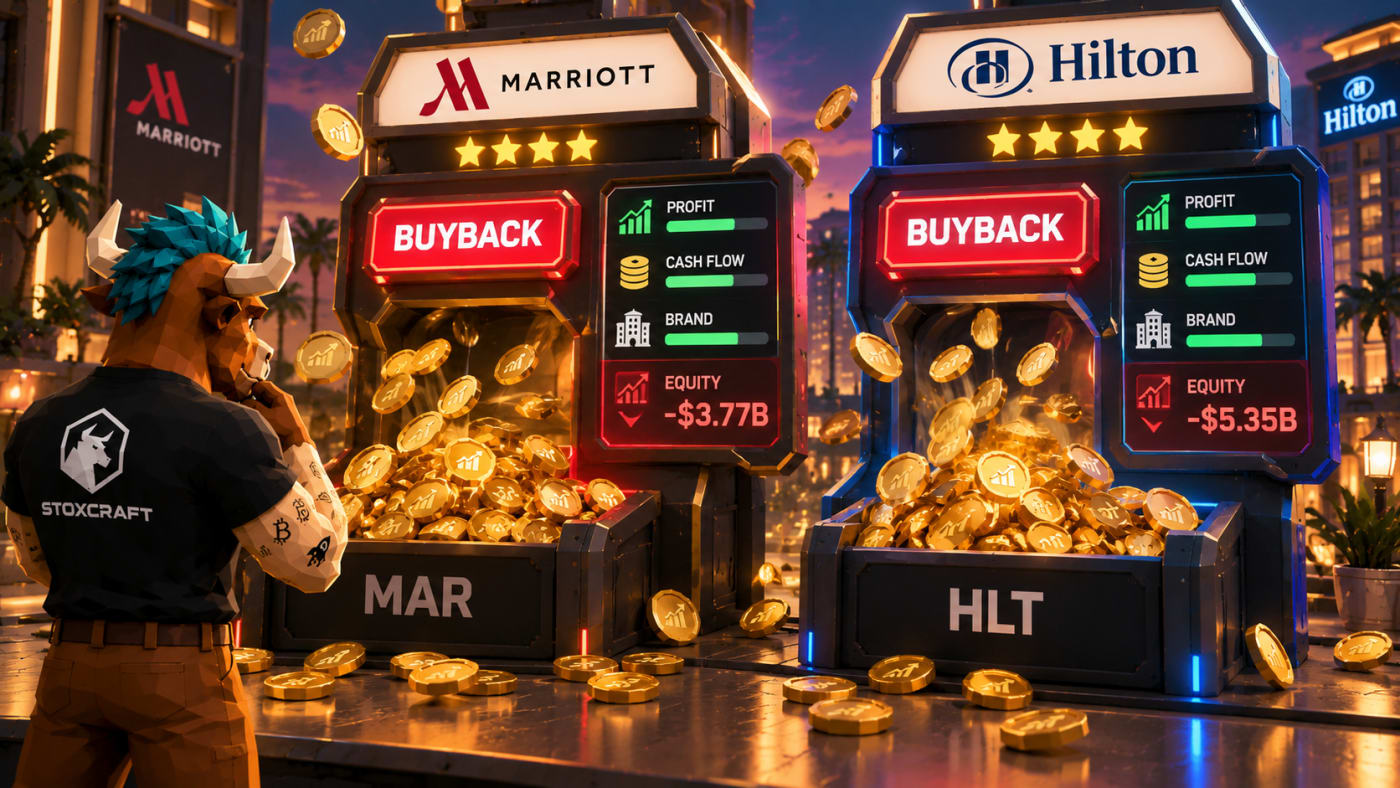
Marriott's total equity is negative $3.77 billion. Hilton's is negative $5.35 billion. Neither company is in trouble. Both have just bought back so much stock that their balance sheets show a negative number where equity used to be.
That's not a typo, and it isn't unique to one of them. It's what years of aggressive buybacks look like once retained earnings and paid-in capital get outrun by the cash sent back to shareholders. The real question isn't whether either company is at risk. It's whose buyback binge actually went further, and what that means for each stock's setup right now.
Two hotel giants, two negative balance sheets
Marriott International (MAR) and Hilton Worldwide (HLT) run the same playbook. Franchise the brand, let owners fund the real estate, and funnel the resulting free cash flow straight back into buybacks instead of building up a balance sheet. Neither company owns much of its own hotel portfolio anymore. That's exactly why this works, and exactly why both balance sheets look unusual next to a typical industrial or retail name.





Hilton's total equity sits at negative $5.35 billion. Marriott's is negative $3.77 billion, less negative, but still deep in the red. Both numbers show up as negative Return on Equity too, since ROE divides profit by an equity base that's below zero: Marriott's ROE reads -69.0%, Hilton's -27.0%. A negative ROE next to real, positive net income is the tell that the equity side is the odd number here, not the earnings side.
The two companies don't get there identically. Marriott's Net Profit Margin runs 9.7%, Hilton's 12.6%, meaning Hilton keeps more of every revenue dollar even as its equity hole runs deeper. Marriott, meanwhile, trades at the cheaper multiple of the two: a P/E of 32.6 against Hilton's 46.5. One company converts revenue into profit more efficiently. The other prices its shares more conservatively. Neither number cancels the other out.
Debt tells a related story. Marriott carries $17.08 billion in total debt, Hilton $15.67 billion, both companies leaning on debt rather than equity to fund operations. That's another footprint of the same buyback-heavy capital structure showing up on both balance sheets.
Add up the equity hole and the debt load, and both stat sheets look like they should be flashing red. Neither is. Marriott and Hilton both still carry a 4-star Overall Rating, a tier only a minority of the roughly 3,900 stocks in the Stoxcraft universe ever reach, and the same tier as some of the cleanest balance sheets on the platform. That's not a data error. It's a sign that the numbers driving the rating aren't the ones that just got the spotlight.
A negative stat that isn't a broken build
Picture a stock's score profile as an RPG character sheet. Health Score, Performance Score, and Risk Score are the stats that actually decide how the character performs in a fight. Overall Rating is the summary card at the top. Total equity isn't one of those combat stats. It's more like a hidden inventory value that happens to read negative right now, sitting off to the side of the build that actually wins the fight.
That's why the equity and debt numbers from the last section don't drag either rating down. A build only breaks when the stats that matter for the fight go negative too: revenue drying up, margins compressing, cash flow turning red. None of that happened here.
Marriott booked $2.6 billion in net income last year. Hilton booked $1.46 billion. Both still generate more cash than they spend.
The equity line went negative because the buyback button got mashed for years straight, not because the character ran out of health.
Compare that to an actual bag-holder setup: a company where revenue is falling, margins are compressing, and the balance sheet is bleeding because the business itself is losing the fight. That's a broken build, and the rating would show it.
Negative equity from buybacks is closer to a character that dumped every stat point into offense and skipped a defensive stat nobody's testing in this particular boss fight. It looks alarming on the sheet.
It doesn't actually cost the run, and it's a known pattern across the whole franchise-hotel genre, not a Marriott or Hilton-specific glitch.
Not everyone's cheering the buyback binge
The Stoxcraft scores treat this as a non-issue, and on the numbers, that holds up. Not everyone watching corporate America's buyback habit agrees the practice is this harmless, though, and the pushback is worth putting next to the scorecard rather than ignoring.
BlackRock CEO Larry Fink has spent years warning corporate boards against exactly this pattern, cautioning that chasing shareholder payouts through buybacks can come at the expense of the innovation, workforce, and capital spending a business needs for the long run. The debate his warning kicked off is still being argued in corporate governance research today, with critics on one side and defenders of the practice on the other.
Economist William Lazonick has made the sharpest version of that case. His widely cited "Profits Without Prosperity" research links heavy buyback spending across the S&P 500 to weaker reinvestment and slower wage growth, a critique covered by outlets including the Wall Street Journal as part of the broader scrutiny buybacks now face. Applied to hotel operators, the version of that question is simple: does capital that goes toward buybacks instead of property upgrades or new construction eventually show up as a competitive gap against rivals still investing in their footprint?
Defenders of the practice push back hard on that framing. Harvard Business Review research examining a decade of S&P 500 payouts found aggregate investment levels running near their highest point in years, even as buyback volume climbed, undercutting the idea that repurchases are starving these companies of growth capital.
Whether that finding holds specifically for asset-light hotel franchisors like Marriott and Hilton isn't something either side has settled. It's a real open question sitting underneath both stocks, not a solved one.
That's the backdrop for the split here. For the cheaper multiple and a smaller equity hole, Marriott is the more conservative pick between the two. Its P/E of 32.6 leaves less priced-in optimism to defend if travel demand softens further. For the stronger margin and a business that turns more of each revenue dollar into profit, Hilton makes the stronger case, even with the richer 46.5 P/E and the deeper equity gap.
Both stocks currently carry a Sell signal from the Stoxcraft model, so neither name is flashing green on timing right now regardless of which side of this comparison, or which side of the buyback debate, a reader leans toward. Buyback volume for both companies is disclosed each quarter. Marriott's repurchase activity is verifiable in its latest 10-Q on SEC EDGAR, as is Hilton's equivalent quarterly filing. This is a read on the compared metrics, not investment advice.