Smart investing starts with good data. Stoxcraft scores are analytical tools, not buy or sell recommendations. This article is for informational purposes only. Make sure any investment decision fits your own situation, and when in doubt, talk to a financial advisor.
The semiconductor supercycle: inside the trillion dollar chip race
The semiconductor market isn't slowing down. It's compounding.
Global chip revenues are on pace to hit $630 billion this year and could pass $1.2 trillion within the next decade, according to WSTS. That's not a niche corner of the market. Semiconductor stocks now sit at the core of the global economy.
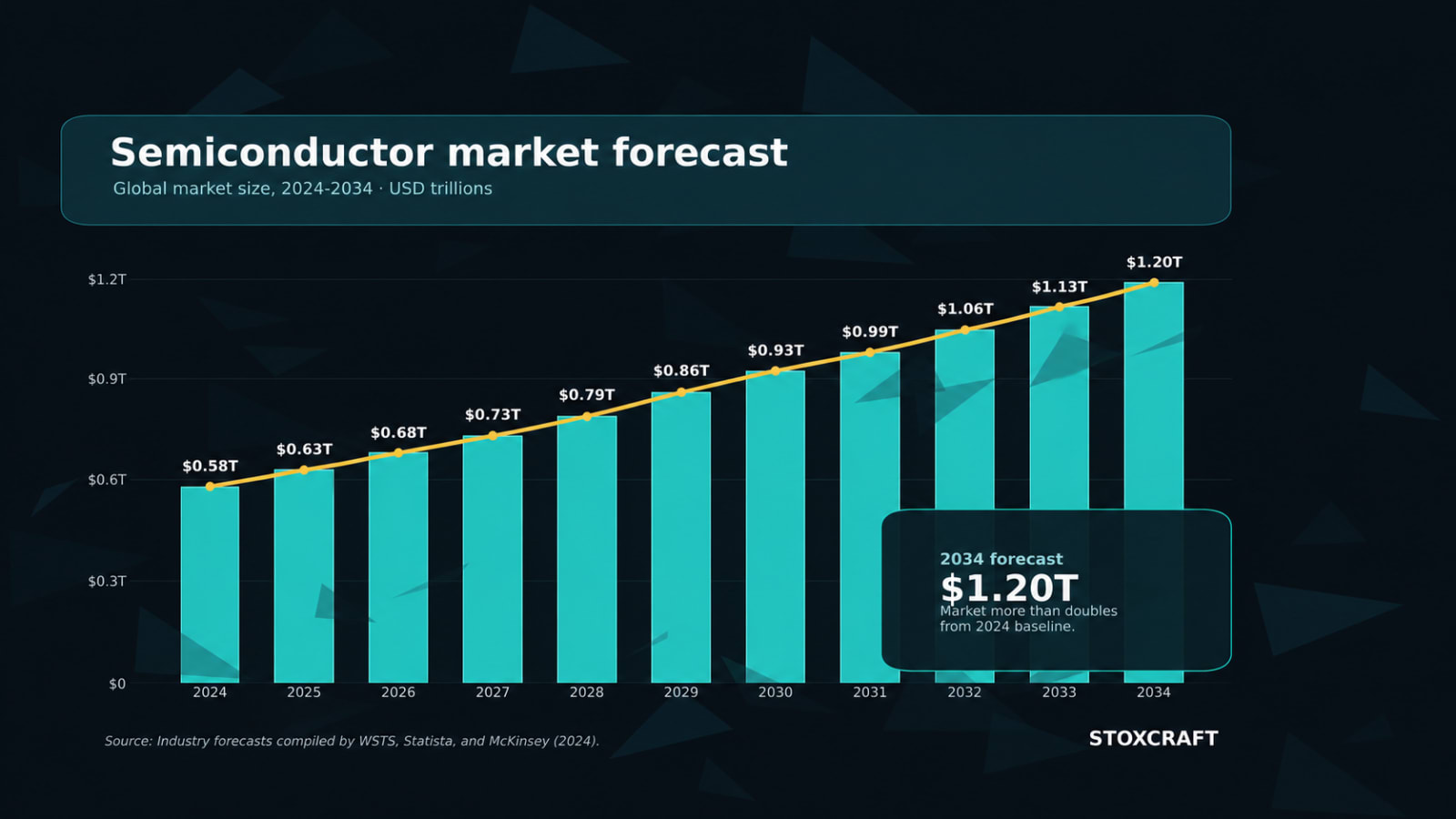
Every major innovation runs on silicon now, from AI and cloud computing to EVs and connected homes. Chips aren't the hidden ingredient of technology anymore. They are technology.
Booms like this create winners. They also expose the classic investing mistakes that surface whenever hype outruns complexity.







From shortage to superpower
The pandemic exposed how fragile the global supply chain really was. When chips stopped shipping, entire industries froze overnight.
Now the race for independence is on. The US and Europe are pouring over $100 billion into chip sovereignty, while China builds its own ecosystem at full speed, and semiconductors have quietly become a matter of strategy rather than commerce.
Whoever leads here decides how the digital world runs. By 2030, more than half of all chip demand will come from computing, data storage, and wireless communication, per McKinsey's sector outlook.

AI data centers, smart cars, and 5G infrastructure are the engines behind that shift. The top ten companies already control around two-thirds of global chip production, led by Nvidia, Samsung, Intel, Broadcom and AMD. Scale, specialization and capital intensity decide who survives in this game.
Semiconductor stocks to watch
Five companies dominate different layers of the chip value chain, and none of them win the same way. Here's the bull case, and the crack in it, for each.
ASML Holding N.V.
ASML builds the machines that make advanced chips possible, and there's genuinely no substitute. It holds a near-monopoly on extreme ultraviolet lithography, the process required for anything below 7 nanometers. Margins are wide, debt is minimal, and growth has stayed steady for over a decade without needing a hype cycle to justify it.
The bear case is geopolitics, not fundamentals. Export controls on advanced tools to China have already cost ASML orders, and any further tightening could stall growth even while the underlying technology moat stays fully intact.
Taiwan Semiconductor Manufacturing Company
TSMC manufactures more than 60% of the world's contract chips, and nearly all advanced nodes under 5 nanometers run through its fabs. Apple, Nvidia and AMD all depend on it, which is either reassuring or unsettling depending on how you read Taiwan's position on the map.
The stock is up over 50% in the past year, backed by high margins and pricing power most manufacturers can only dream of. The risk nobody can fully price in is a Taiwan Strait scenario, which is exactly why TSMC tends to trade at a discount to its own fundamentals.
Nvidia Corporation
Nvidia turned graphics chips into the backbone of AI computing, and the market has rewarded that shift aggressively. Shares are up over 40% year on year, with margins and cash reserves most software companies would envy.
That's also the risk. Nvidia trades on the assumption that AI infrastructure spending keeps accelerating, and any slowdown in hyperscaler capex, or a real competitive breakthrough, would hit this stock harder than anything else on the list. High risk, high reward isn't a hedge here. It's the honest label.
Broadcom Inc.
Broadcom sits underneath the AI story most people actually talk about: the networking chips, the custom silicon, the infrastructure that makes hyperscale data centers work at all. The stock has climbed more than 90% in six months on that positioning.
Two things temper the enthusiasm. Broadcom carries meaningfully more debt than its peers after the VMware acquisition, and a large share of revenue sits concentrated in a handful of enterprise contracts. Diversified, yes. Immune, no.
Rambus Inc.
Rambus is the smallest name on this list, and the one most investors have never heard of. It licenses high-speed memory and chip-security technology rather than manufacturing anything itself, and that model has paid off: rambus stock is up more than 160% over twelve months as AI workloads pushed demand for faster, more secure memory interfaces.
The flip side of a licensing model is customer concentration and lumpy revenue. A single lost contract moves the needle here in a way it never would for TSMC. That volatility has rewarded conviction so far. It cuts both ways, though.
The long game
None of this makes the chip trade risk-free. Bank of America's own bubble risk indicator has already flagged elevated valuation risk across the sector, and a sharp pullback in Nvidia especially tends to drag the whole group down with it.
Semiconductors aren't a trend, though. They're infrastructure. AI, EVs, renewable energy and cloud computing all run through them, and ASML, TSMC, Nvidia, Broadcom and Rambus each hold a different piece of that trillion dollar puzzle.
For anyone building a watchlist, these semiconductor stocks are worth knowing individually, not as one sector bet. The risk profile changes completely from one name to the next.