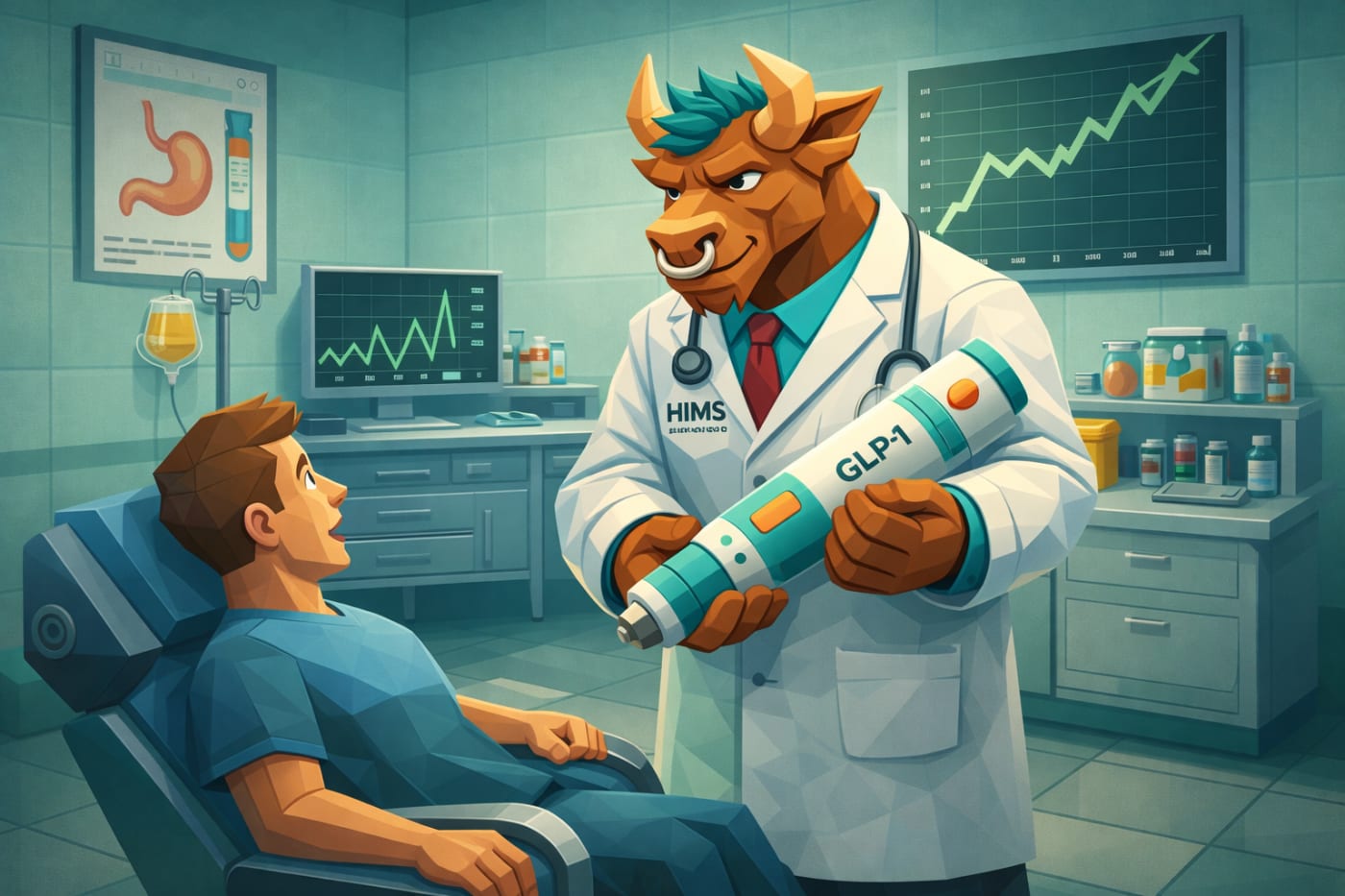
Hims & Hers Health (HIMS) just had the best week in its history as a public company. The stock jumped 57%, and for once, the move wasn't about hype. It was about a single deal that resolved the company's most dangerous legal and strategic threat in one shot.
The deal with Novo Nordisk (NVO) is significant. Not because HIMS gets to sell weight loss drugs now. But because of what the partnership removes: a patent infringement lawsuit that had been hanging over the company like a storm cloud. That cloud is gone. What's left underneath is a $3.1B revenue forecast, a 2.5M+ subscriber base, and a distribution model that legacy pharmacies can't replicate.
Here's what actually happened, what the numbers say, and whether buying in after a 57% run still makes sense.
What the Hims-Novo Nordisk deal is and why the timing matters
To understand why this deal hit so hard, you need to know what HIMS was doing before it, why Novo sued, and what both sides gave up to get here. The deal didn't come out of nowhere.
The lawsuit, the compounded GLP-1s, and why it got messy
GLP-1 drugs are the class of weight loss medications that includes Ozempic and Wegovy. Both are made by Novo Nordisk (NVO). When Ozempic and Wegovy faced supply shortages, the FDA allowed compounding pharmacies to manufacture versions of the active ingredient, semaglutide. HIMS jumped on that opening hard. It started selling compounded semaglutide at prices far below Novo's branded drugs.
Novo did not enjoy this. The company sued HIMS for patent infringement in 2024. The FDA later declared the shortages over, which meant compounding of semaglutide was no longer legally permitted. HIMS was caught in a difficult position: the compounded GLP-1 business that had driven its growth-stock narrative was under legal pressure, and its entire telehealth-plus-weight-loss pitch was at risk.
What HIMS gains and what it gives up in the Novo agreement
The new agreement has two clear sides. On the gain side:
- HIMS becomes an authorized distribution partner for Novo's branded Ozempic and Wegovy
- Patients access them through the HIMS platform at $149–$299/month
- That price is still cheaper than what most uninsured patients pay through traditional channels
- The legal risk disappears entirely, and the supply chain becomes reliable
On the give-up side, HIMS agreed to stop advertising compounded GLP-1 products. That's not a small concession. Compounded semaglutide carried better margins than branded drugs. Authorized versions mean Novo takes its cut. But the company exits the legal risk, gains supply certainty, and replaces a legally fragile business with a legitimate pharma partnership.
The short version: HIMS traded a high-margin, legally risky revenue stream for a cleaner, more scalable one.
The numbers behind HIMS's 57% single-week jump
A 57% single-week move demands scrutiny. The market is telling you something changed. Here's whether the numbers actually justify it.
HIMS revenue forecast, margin targets, and the 2.5M subscriber moat
HIMS reported $617M in Q4 revenue. Analysts are projecting full-year 2026 revenue at $3.1B. That implies 20%+ annual growth, and current estimates project that pace continuing through 2029. On margins, the company is targeting an EBITDA margin of 15% in 2026 and 20% by the end of the decade. EBITDA stands for earnings before interest, taxes, depreciation, and amortization. It's the operating earnings number investors use to compare profitability across companies without accounting noise distorting the picture.
The structural advantage HIMS holds is its subscriber base. Over 2.5 million people are paying cash for HIMS health services. These are real, recurring customers with no insurance middleman sitting between the company and its revenue. When GLP-1 drugs get added to that platform, HIMS shares surged to a record week as the Novo deal fueled fresh optimism across investor sentiment. The market views this subscriber moat as a legitimate distribution asset, not just a list of users.
Amazon (AMZN) runs a competing pharmacy channel. CVS Health (CVS) controls traditional retail dispensing. But neither has a direct-to-consumer telehealth platform with 2.5M active subscribers already paying monthly. That's what makes the HIMS distribution pitch credible in a way that pure pharmacy plays can't match.
Analyst price target upgrades from UBS, Barclays, and Citi
Three major banks raised their price targets on HIMS following the deal announcement. UBS, Barclays, and Citi all moved in the same direction. When three independent research desks simultaneously upgrade a stock after a single catalyst, it signals that institutional money is repricing the risk profile, not just retail sentiment chasing a move.
Analyst ratings from all three banks pointed to the same core thesis: the removal of legal risk combined with an authorized GLP-1 product line materially improves the long-term revenue picture. That's a structural argument, not a short-term trade.
Buy, hold, or sell-the-news: the HIMS case for each side
This is the question every reader who missed the 57% move wants answered. The honest answer requires looking at what both sides of the trade are watching right now.
What the HIMS bears are still focused on
Bears aren't wrong to be cautious here. The risks are real and specific:
- Margin compression is coming. Branded drugs carry lower margins than compounded ones. If HIMS replaces compounded revenue with authorized branded revenue at thinner spreads, earnings per subscriber could drop even as top-line revenue grows.
- Valuation has reset sharply higher. A 57% single-week move means a lot of future growth is already priced in. The stock needs to execute on the $3.1B forecast to justify where it's trading now.
- Eli Lilly (LLY) isn't sitting still. Lilly has its own direct-to-consumer ambitions with Mounjaro and Zepbound. If LLY pursues similar telehealth partnerships, HIMS loses part of its competitive edge.
- Execution risk is real. Scaling a branded drug distribution operation through a telehealth platform is a different challenge than running a subscription skincare business. Patient acquisition costs may rise as the product becomes more mainstream.
What would need to be true for HIMS to hold at $45+
For the current momentum to sustain rather than correct, a few things need to play out. The 2026 revenue forecast of $3.1B needs to be credible. HIMS needs to show that its subscriber base converts to GLP-1 users at meaningful rates. Margins need to hold at or near the 15% EBITDA target, even with lower-margin branded drugs in the mix.
Walmart (WMT) entering health services adds more competitive pressure to the backdrop. Teladoc Health (TDOC) is HIMS's closest telehealth comparison, and its trajectory has diverged sharply from HIMS's. HIMS built a recurring subscription model that drives reliable cash flow. Teladoc hasn't managed that same stickiness.
That difference matters when you're trying to decide whether HIMS's growth-stock premium is deserved or fragile. The bull case is that a 2.5M-subscriber platform selling authorized GLP-1s at $149–$299/month with a path to $3.1B in revenue is genuinely mispriced even after the run. The bear case is that this is a classic sell-the-news setup and the stock corrects toward $30 as margin compression shows up in upcoming quarterly results.










How the Novo deal reshapes GLP-1 market dynamics for HIMS and its rivals
The bigger picture here is market structure, not just one company's stock price. This deal has ripple effects worth tracking across the sector.
Novo Nordisk (NVO) gained roughly 2.1% on the day the deal was announced. That tells you something. Novo benefits by gaining a direct-to-consumer distribution channel that doesn't undercut its pricing in traditional markets. HIMS benefits by gaining legitimacy, supply certainty, and legal clearance. Both sides win, which is why the deal got done.
Eli Lilly (LLY) is watching this closely. If Novo secures HIMS as a distribution partner, Eli Lilly's GLP-1 market share faces new competitive pressure as Mounjaro and Zepbound may need their own telehealth distribution answer. Lilly has the products. What it hasn't done yet is build a 2.5M subscriber direct-to-consumer pipeline like HIMS has.
The incumbents most exposed are the traditional pharmacies. CVS Health (CVS) and legacy retail pharmacy models are being outflanked. A telehealth platform can prescribe, dispense, and ship GLP-1 medications with less friction, lower overhead, and a direct patient relationship. For broader context on the macro forces driving healthcare sector re-ratings right now, the 5 biggest forces shaping the stock market in 2026 is worth reading alongside this one.
Whether HIMS stock is actually worth buying after the 57% run
57% in a week is not a starting point for a position. It's a market re-rating. The fundamental story changed, the legal overhang is gone, and the product lineup is now cleaner. None of that means the entry point is ideal today.
If HIMS executes on the 2026 revenue forecast and holds that subscriber base, the stock has a credible path to further re-rating when quarterly earnings confirm the model is working. If it misses on margins or subscriber conversion, the current price becomes hard to justify.
The risk here isn't that the deal was bad. It wasn't. The risk is that the market may have priced in perfect execution the day the deal closed. That's the tension every investor needs to sit with before making a move on HIMS right now. For a broader look at which stocks have been surprising the market this cycle, stocks with comeback potential in 2026 adds useful context on how re-rating stories have played out recently.
This article is for informational purposes only and does not constitute financial advice. Always do your own research before making any investment decisions.