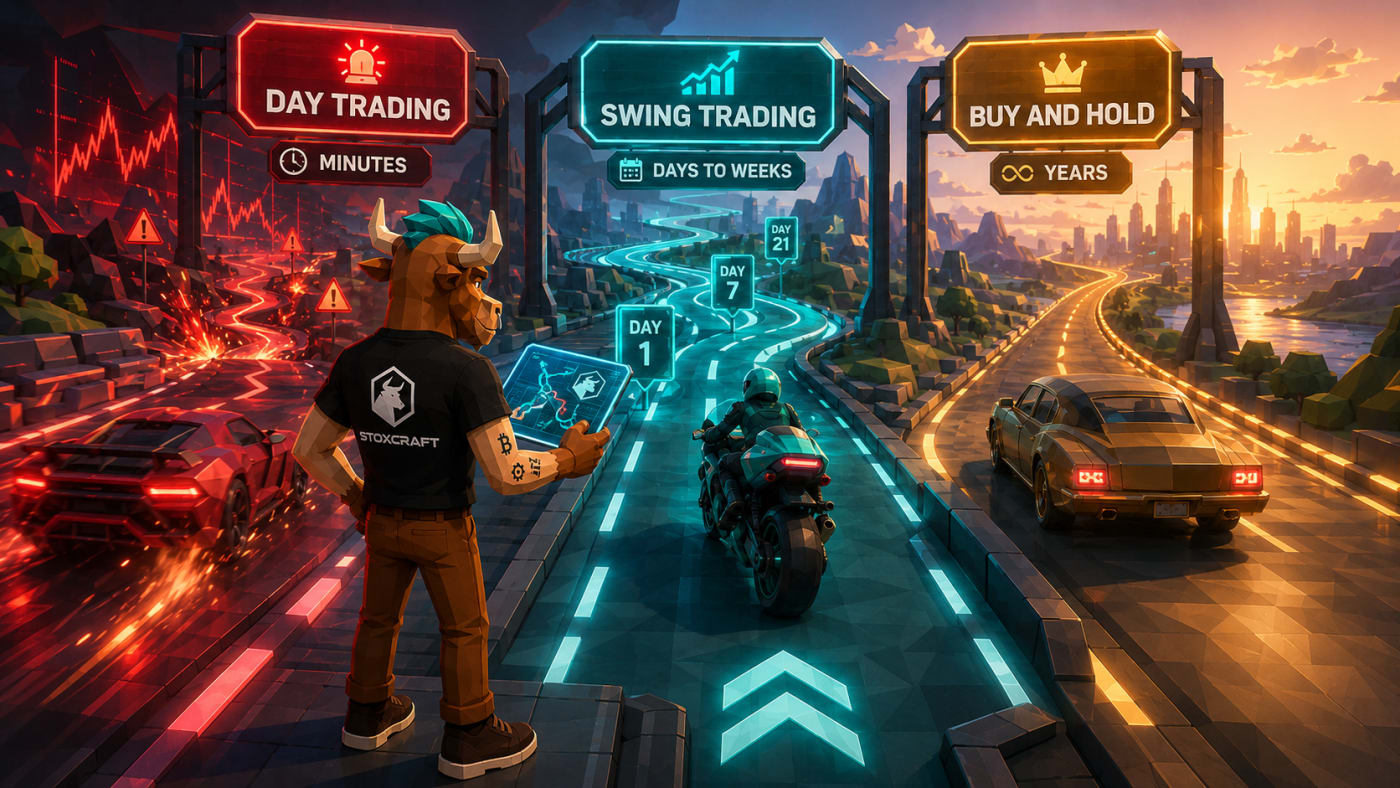
Swing trading sits between day trading and buy and hold investing. It asks you to hold a position for days or weeks, not minutes or decades.
Retail traders keep showing up in bigger numbers. Their share of US equity trading fell to 17% in the first quarter of 2026 before rebounding, and a growing slice of that group now trades on a multi-day timeframe instead of glued to a screen all day.
Swing trading vs day trading is the comparison most people reach for first. It misses half the picture. The real choice runs across three styles, not two, and where you land depends on your schedule, your nerves, and how much you enjoy watching a chart.
What swing trading means in practice
Swing trading targets a single price move, then exits. A trader spots a setup, enters, and holds anywhere from a few days to a few weeks while the move plays out.
The style leans on momentum and structure rather than a company's ten-year outlook. A swing trader wants to know what a stock is likely to do next week, not what it will look like in 2035.
Most swing trades target a move of 5% to 20%. Hit that a handful of times a month and the gains compound fast. Miss your stop and they erase just as fast.
Swing trading vs day trading: the real differences
Day trading and swing trading both live on charts, but the resemblance stops there. Time commitment and capital rules split the two styles apart.
Time and screen time in swing trading vs day trading
Day traders close every position before the market shuts. That means watching price action for hours, often minutes at a time, with no overnight exposure.
Swing traders check in once or twice a day. A position can run through a weekend, an earnings date, or a Fed announcement while the trader sleeps. That gap creates volatility risk overnight, but it also frees up an entire working day.
Capital and rules in swing trading vs day trading
Day trading in the US comes with a hard capital floor. Anyone flagged as a pattern day trader under FINRA's rule must keep at least $25,000 in a margin account before placing a fourth day trade in five business days.
Swing trading carries no such minimum. A trader can build a position with a few hundred dollars and scale up as the account grows, which is the biggest reason the style attracts people who are not ready to commit full-time capital or full-time hours to the market.
Swing trading vs buy and hold: the other end of the spectrum
Buy and hold investors pick a business and stay put through every drawdown. The bet is on the company, not the chart, and the time horizon stretches into years or decades.
Swing traders make the opposite bet. They care far less about a company's five-year plan and far more about what the next two weeks of price action look like.
Neither approach is wrong. They just answer different questions.
Coca-Cola (KO) shows what the patient end of the spectrum looks like. Its beta sits well below 1, and the stock rarely swings more than a few percent in a week, which is exactly why buy and hold investors like it and swing traders tend to skip it. There simply is not enough movement to trade.
How swing traders find their setups
Every swing trade starts with a read on structure. Where has the stock struggled to break higher, and where has it found buyers on the way down?
Support, resistance, and trend in swing trading
Traders watch support levels for entries and resistance levels for exits, then layer a moving average on top to confirm the direction of the broader trend. A stock bouncing off support inside an uptrend is a far cleaner setup than the same bounce inside a downtrend.
The Chart and Technical Analysis island's lesson on timeframes and trading styles covers how the same chart reads differently depending on whether you are day trading, swing trading, or investing for years.
Trend following and the momentum approach
A lot of swing setups are really momentum trades wearing a different name. The trader follows an established trend and rides it until the structure breaks.
The Strategy Codex's momentum investor skill goes deeper into how to follow a trend with rules instead of emotion, which is the same discipline a swing trader needs on a shorter clock.
Picking swing trade candidates without picking losers
Not every stock swings. A name needs enough daily range to make the trade worth the risk, and that range shows up in beta and standard deviation before it shows up on a chart.
Tesla (TSLA) carries a beta near 1.8 and has moved more than 20% in a single month this year. Coinbase (COIN) runs even hotter, with a beta above 3 and a 1-year price swing topping 50% in both directions. Nvidia (NVDA) sits in between, volatile enough to swing but anchored by a business investors track closely.
Volatility, side by side:
Four names, four risk profiles. TSLA and COIN carry a Risk Score well above the database median, meaning higher risk: sharper drawdowns and bigger daily ranges. KO sits at the other end, with a Risk Score low enough to mean the opposite, which is exactly why buy and hold investors favor it and swing traders mostly ignore it.
High beta names like TSLA and COIN offer bigger potential swings, but they punish bad entries just as fast. A swing trader who wants exposure to that kind of range should size positions smaller, not bigger, to keep any single trade from wrecking the account.
Screening for candidates by hand is slow. The Stoxcraft Screener lets you filter by volatility and trend strength directly, instead of pulling up one ticker at a time.










Run that screen before every trade idea, not just the ones that already look exciting.
Risk rules that separate swing traders from gamblers
A swing trade without a plan is a bet, not a strategy. The traders who last set their exit before they set their entry.
Skip any one of those steps often enough and the odds catch up. Day trading failure studies consistently point to the same root cause: no plan, chased losses, and position sizes that grew with each attempt to win it back. Swing trading punishes the same habits, just on a slower clock.
Who swing trading fits best
Swing trading suits someone with a job, an evening, and enough patience to let a setup develop over days instead of demanding an answer by 4pm. It doesn't suit someone who checks their portfolio every ten minutes out of anxiety, since that habit will wreck a multi-day hold just as fast as it wrecks a long-term one.
It also doesn't suit someone using the 74% to 97% day trading failure rates widely cited across FINRA and academic studies as a reason to avoid market timing altogether. Swing trading sits in the middle precisely because it demands less obsessive monitoring than day trading while still rewarding active decision-making that buy and hold doesn't ask for.
Most swing trading blowups trace back to skipping one of those four steps, not to bad luck.
Swing trading is the pace, not the shortcut
Swing trading vs day trading vs buy and hold is not really a competition. Day trading is built for speed. Buy and hold rewards patience, and swing trading suits people who want to stay active without living on a screen all day.
Pick the pace that matches your schedule and your temperament, not the one with the best stories attached to it. Plenty of accounts get wiped out chasing a pace they were never built for in the first place.