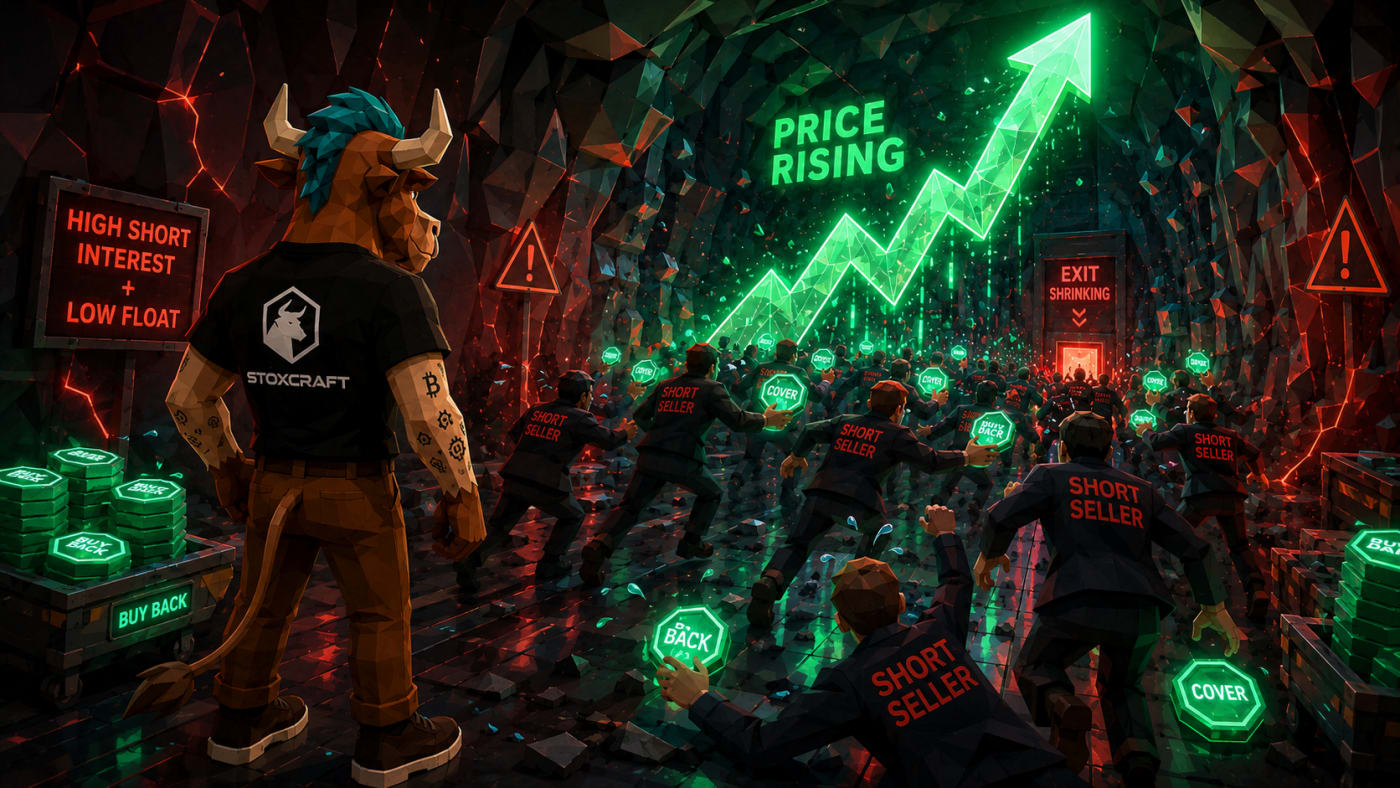
A short squeeze is what happens when a heavily shorted stock spikes instead of dropping. Short sellers get trapped. Their scramble to exit sends the price even higher.
You have seen the headlines. GameStop, AMC, a stock jumping 100% in a day for no clear reason. That's usually a squeeze at work.
This guide breaks down the mechanics. No hype. Just the numbers that move the price.
What a short squeeze really means
A short squeeze happens when a stock with heavy short interest suddenly rises instead of falling. Short sellers get trapped. The panic to escape drives the price even higher.
That interest comes from short selling, a bet that a stock's price will drop. Short sellers borrow shares, sell them right away, and plan to buy them back later for less.
If the stock falls, they profit from the gap. If it rises, they lose money every minute they hold the position open.
Eventually every short seller has to buy back the shares they borrowed. That's called covering. When enough of them cover at the same time, their own buying pushes the price higher.
That forces even more shorts to cover. The cycle feeds itself until it runs out of fuel.
The three numbers that flag a squeeze before it happens
Not every heavily shorted stock turns into a squeeze. Traders watch a few numbers to spot the setup before it blows up.
Short interest as a percentage of float
Float is the number of shares actually available to trade. Short interest measures how many of those shares are currently sold short.
When short interest passes 20% of the float, a stock is considered a squeeze candidate. GameStop's short interest hit 140% in January 2021. That only happens when shares get re-borrowed and shorted more than once.
Days to cover
Days to cover shows how many trading days shorts need to buy back every borrowed share. It uses average trading volume as the baseline.
A high number means shorts cannot exit quietly. No room to hide. Any spike in buying forces them into a bidding war for the same shares.
GameStop: the short squeeze that broke Wall Street
GameStop (GME) is the short squeeze that put the term in every headline. In January 2021, retail traders on Reddit noticed the stock's short interest was absurd.
GameStop traded near $17 at the start of January 2021. By January 28, it touched an intraday high near $483. Weeks earlier, short interest on GameStop had already hit 138% of its float, an extreme setup.
Hedge funds like Melvin Capital had bet heavily against GameStop. When the price started climbing, they had to buy back shares fast, and that panic buying added fuel to a fire retail traders had already lit.
GameStop was not the only name in that story. Stocks like BlackBerry (BB) and Tesla (TSLA) rode similar waves too. Short covering swept through the same basket of heavily shorted names.







Three names, one squeeze pattern:
GameStop, BlackBerry, and Tesla have all seen sharp moves tied to short covering. Watching how they trade side by side shows how fast sentiment can swing a heavily shorted name.
Volkswagen 2008: the squeeze that beat GameStop for size
GameStop was not the biggest short squeeze in history. That record still belongs to Volkswagen.
In October 2008, Porsche revealed it quietly controlled about 74% of Volkswagen's voting shares through options.
Add in a stake held by the German state of Lower Saxony. Only about 6% of the stock was left to trade.
Short sellers holding roughly 12% to 13% of Volkswagen's shares had nowhere to go, and the stock rocketed from about 210 euros to past 1,000 euros in two days. For a few hours, Volkswagen ruled the planet.
Hedge funds lost an estimated $30 billion. The lesson has not changed since 2008. A tight float plus heavy short interest is a loaded spring.
How social media turns a squeeze into a spectator sport
Short squeezes existed long before Reddit. What changed with GameStop was speed. A meme stock can go from obscure to overrun in hours, not weeks.
Social platforms compress the hype cycle that used to take months into a single afternoon. A viral post can pull thousands of traders into the same trade at once. That's exactly what a squeeze needs.
Stoxcraft's Academy breaks down how that amplification works. It covers the pump patterns that show up before a stock goes viral for bad reasons. Read how social media moves stocks for the full picture.
Why chasing a squeeze after the headline breaks rarely pays off
By the time a short squeeze hits the news, most of the move is already behind it. FOMO pulls in a fresh wave of buyers late. That's right when the squeeze runs out of shorts to force out.
That's exactly what happened with Opendoor in 2025. The stock jumped 300% in a single month. Late buyers who chased the headline became exit liquidity for the traders who got in early.
The pattern shows up in psychology as much as in price. Anyone prone to chasing a hot story might see themselves in Stoxcraft's breakdown of investor biases.
Spotting when hype is topping out is worth more than trying to catch the exact peak. Stoxcraft's Academy skill on signals that hype is peaking covers the warning signs worth watching.
Short squeezes end the same way they start: fast
A short squeeze is not a strategy. It's a mechanical reaction. Extreme short interest meets a stubborn supply of shares that refuses to sell.
The setups are rare and the endings are brutal for whoever is on the wrong side. GameStop fell more than 80% from its peak within days. Volkswagen dropped 58% in four days.
Float and short interest tell you more than any headline. Watch both, not the noise.