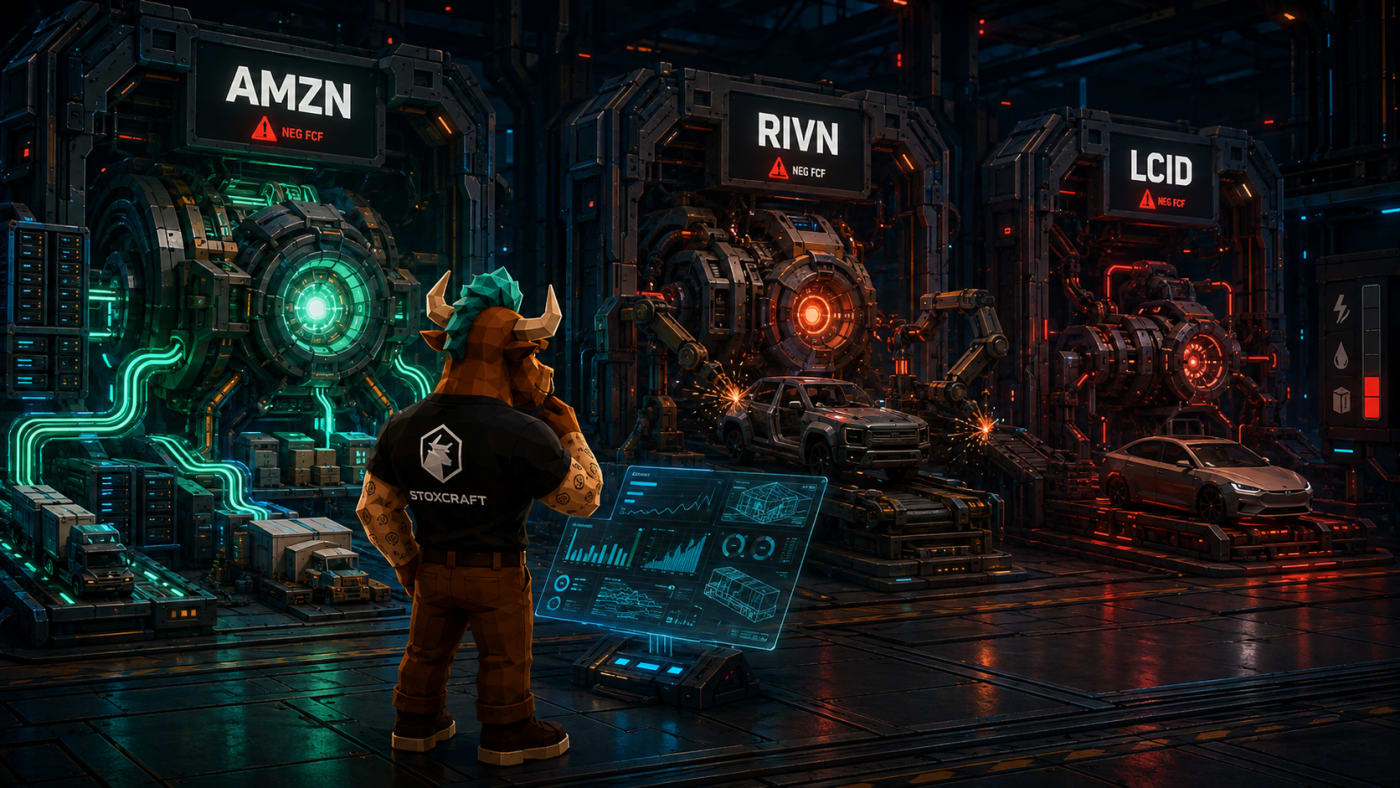
Negative free cash flow shows up in a company's numbers and the instinct is to run. The business is spending more cash than it brings in. That instinct is right more often than it's wrong.
It just isn't right every time. Amazon's free cash flow per share is negative right now, and its entry signal on Stoxcraft still reads Buy. The difference between a red flag and a growth phase comes down to what's actually driving the number.
This piece breaks down what free cash flow really measures, why it can dip below zero for very different reasons, and how to tell which reason you're looking at before you write a company off.
What free cash flow actually measures
Free cash flow is the cash a company has left after running the business and paying for the equipment, infrastructure, or property it needs to keep operating. It comes from the cash flow statement, not the income statement. That's exactly why it can tell a different story than net income.
Net income can look healthy while cash quietly drains out the back door, through unpaid invoices piling up, inventory nobody's buying, or a factory under construction that hasn't shipped a single product yet. Free cash flow strips that accounting distance away. It shows what actually moved in and out of the bank account.
When operating cash flow can't cover that spending, free cash flow goes negative. The number itself doesn't say why. That's the part most investors skip.
Why free cash flow turns negative
A company burns more cash than it generates for a few very different reasons, and only some of them should worry you.
The first reason is decline. Revenue is shrinking, margins are getting squeezed, and the business can't cover its own costs anymore. The second reason is investment. The company is spending heavily on capacity it doesn't need yet, betting that spending pays off later.
There's a third, quieter reason: a single large, one-time project. A new factory, a big acquisition, or a major facility upgrade can push free cash flow negative for a year or two even at an otherwise stable company, then disappear from the numbers once the project wraps.
All three show up as the exact same negative number. Only one of them is a warning.
Amazon's free cash flow just went negative, and the market didn't blink
Amazon's free cash flow per share currently sits at -0.23, according to Stoxcraft's own data. Operating cash flow per share is still a healthy 13.83.
That gap is capital expenditure, mostly AWS infrastructure and logistics buildout, not a shrinking business. Amazon's revenue for the year sits at 716.9 billion dollars, and its Health Score is 7.4 out of 10, still a solid fundamental profile even with the cash flow dip. The cashflow, profit and what matters most skill in the Academy goes deeper into why these two numbers can point in opposite directions.
Its Performance Score sits at 6.7, driven largely by a 99% three-year return and a 24% gain over the past year. Stoxcraft's entry signal on Amazon currently reads Buy, and the stock carries a four-star Overall Rating. A negative free cash flow number alone didn't move any of that.
Rivian and Lucid show what negative free cash flow looks like without the safety net
Rivian's free cash flow per share sits at -1.99. Lucid's sits at -14.24, more than 14 dollars burned for every share outstanding.
Both companies are also spending to build capacity, new factories, new vehicle platforms, the same story Amazon tells on paper. The difference is what surrounds the number.
Rivian's Health Score is 0.9 out of 10. Lucid's is 0.5. Stoxcraft's entry signal reads Strong Sell on both, and each currently carries an Overall Rating of just half a star.
Same red flag, three different stories:
Amazon, Rivian, and Lucid all show negative free cash flow right now. Only one of them backs that number with strong margins, real revenue, and a business that already works. The chart below tracks how the market has actually priced all three.
Price alone won't tell you which story you're looking at. The scores underneath it will.





Questions that separate a growth phase from a warning sign
A negative free cash flow number is a prompt to look closer, not a verdict. A few questions do most of the work.
Run Amazon through that list and most boxes check. Run Rivian or Lucid through it and they don't. The how to spot red flags in financials skill covers this exact pattern in more depth, spending that looks identical on the surface but means something completely different underneath.
How to read negative free cash flow before you buy
Never judge free cash flow alone. Pair it with operating cash flow, revenue direction, and the balance sheet before deciding anything.
Check more than one quarter. A single bad quarter driven by a large purchase can look identical to the start of a real decline until you pull the trend out over two or three years. If free cash flow keeps recovering after each capital push, that's the investment pattern. If it never recovers and just keeps sliding, that's the decline pattern.
Watch operating cash flow closely while you do this. It's the cleanest signal of the two. A company with strongly positive and growing operating cash flow that's investing heavily is telling a very different story than one where operating cash flow itself is negative or shrinking.
A company can post negative free cash flow and remain a legitimate long-term holding, or a shrinking business quietly running out of runway. The number by itself can't tell the two apart. The Stoxcraft Screener lets you filter for Health Score alongside cash flow trends, so you don't have to check both by hand every time.
Negative free cash flow is a question, not a verdict
The number by itself never tells you why a company is burning cash. Growth and decline can produce the exact same negative sign.
Amazon's free cash flow is negative right now, and it still carries one of the stronger rated profiles on Stoxcraft. Rivian and Lucid post negative free cash flow too, and their scores tell a very different story.
Check the number. Then check what's actually behind it.