Quick Start
How bonds work and support portfolios


In every match, the spotlight is on the forwards scoring goals, but the defense often decide who wins. Investing works the same way. Stocks get the glory, but bonds quietly hold the team together.
They do not skyrocket overnight, and they rarely trend on social media, but when the market shakes, they keep your portfolio standing. To see why bonds are underrated, we need to unpack what they really are, how they differ from stocks, and why every serious portfolio leans on them for stability.

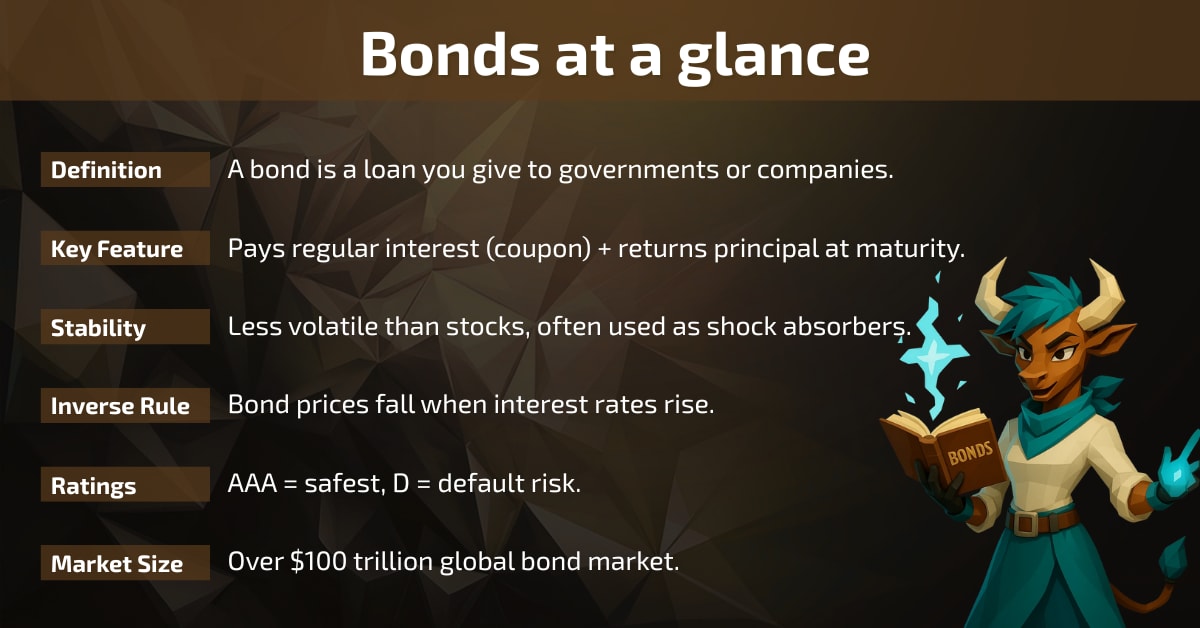
A bond is a loan, plain and simple. When you buy one, you lend money to a government or a company.
In return they promise two things:
Regular interest payments and the return of your original investment at maturity.
Think of it like giving a friend cash with the deal that they pay you back plus extra for the trouble.
Unlike stocks, where value swings daily based on expectations, bonds are structured deals.
That makes them more predictable, easier to plan with, and useful when you need steady income. This predictability is why bonds play such a key role in managing risk without losing sleep.
Stocks represent ownership, bonds represent lending. That difference changes everything.
Stocks rise and fall with company performance, hype, and growth potential.
Bonds, by contrast, move with interest rates and credit quality.
A simple rule: when interest rates rise, bond prices fall, and vice versa.
It feels counterintuitive at first, but it is the math of lending.
Imagine buying a console for $400, then a new bundle comes out for the same price but with
two free games. Suddenly, resale value for your original console drops.
That is exactly how bonds and rates interact.
When markets turn ugly, bonds often act as shock absorbers.
While stock prices can drop sharply during a market crash or bear market, bonds may hold steady or even rise as investors look for a safe haven.
Even in rough stretches, coupon payments keep flowing, providing income when
stock dividends may be cut. It is like having a backup generator when the main power goes out.
Not perfect, not glamorous, but enough to keep things running.
Bonds are not risk-free, but their stability makes them a reliable tool for balancing turbulence.
The art of investing is not just chasing gains, it is about balancing offense and defense.
Bonds are the defensive side. A portfolio heavy in stocks may deliver big wins, but it can also crash hard.
Adding bonds smooths the ride. Younger investors might only need a small share for balance, while those nearing retirement rely more on bonds for stability. Think of building a gaming squad: you need damage dealers, but without a healer or a tank, the team wipes quickly.
Bonds keep the squad alive.
Understanding bonds in theory is one thing, but seeing how they behave in real portfolios makes it click.
Next, let’s follow an example where bonds prove why they matter when stocks stumble.
