Quick Start
How property fits a balanced portfolio


Owning property sounds powerful until you add the headaches.
Listed real estate lets you skip leaking roofs and late tenant calls.
When you buy a Real Estate Investment Trust (REIT) you buy tiny slices of many buildings that collect rent and share it with you as dividends. Think of it like owning part of a city’s infrastructure through one ticker. Returns come from two streams: steady income and growth in rents over time.
This Deep Dive keeps it simple: what you own, how it pays, how it behaves, and how it fits into a portfolio.

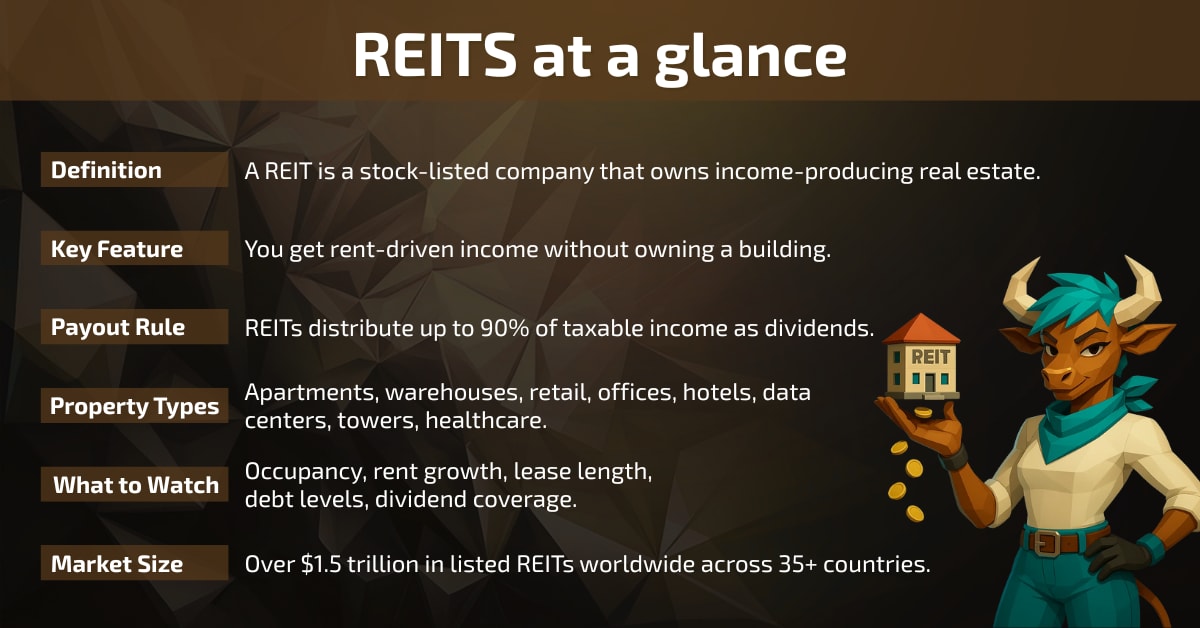
A REIT is a company that owns income producing real estate and trades like a stock.
Instead of one mortgage and one address you get a basket of properties across cities and tenants.
That basket can be apartments, warehouses, offices, shopping centers, hotels, data centers, or cell towers. It is like buying a team roster, not a single star player. Professional managers handle leases, maintenance, and financing. You get daily liquidity, broad diversification, and a clear rule set for how much cash is paid out.
Real estate pays in two simple ways.
First, rent checks come in and a large share is paid to you as dividends.
Second, rents can grow, which can lift the value of the properties over time.
Interest rates still matter because they change borrowing costs and what yield investors demand.
Picture it like a game economy. Your base generates steady coins per tick.
Upgrades increase the coin rate, but higher difficulty settings can slow progress.
The goal is dependable cash flow with room to grow, not perfect market timing.
Different buildings follow different mini economies. Apartments react to local jobs and supply.
Warehouses ride e commerce and trade routes. Hotels change quickly with travel demand.
Offices depend on corporate space needs. Data centers and towers serve the digital world.
Different property types don’t move together.
Apartments follow local jobs, warehouses follow trade and e-commerce, hotels follow travel demand, offices depend on companies. One can be strong while another is weak.
That’s why mixing them matters. It’s less like betting on one player and more like building a balanced team.
Keep it simple.
Use a broad REIT fund as your core so you cover many property types in one step.
If you want flavor, add a small tilt to a theme you believe in, like logistics or residential.
Do not overload one lane or one country. Rebalance so real estate stays a supporting actor, not the whole cast.
As a rough guide for education only, many long term investors consider between five and fifteen percent of a portfolio for listed real estate. Pick a level that fits your risk and income needs.
Real estate is not a magic yield machine.
It is a set of cash flow engines tied to real world tenants and local supply.
Use it for income, mix property types to reduce bumps, and size it so it steadies your other holdings.
Ready to see how it works in practice with a clean portfolio mix and a few simple rules?
