Quick Start
How different order types shape your trades


Order types look simple on the surface, but in practice they can make or break a trade.
Bullma’s journey shows how the same tool can help or hurt depending on timing, liquidity, and context.
Let’s follow her through situations where market, limit, and stop orders reveal their strengths and weaknesses.
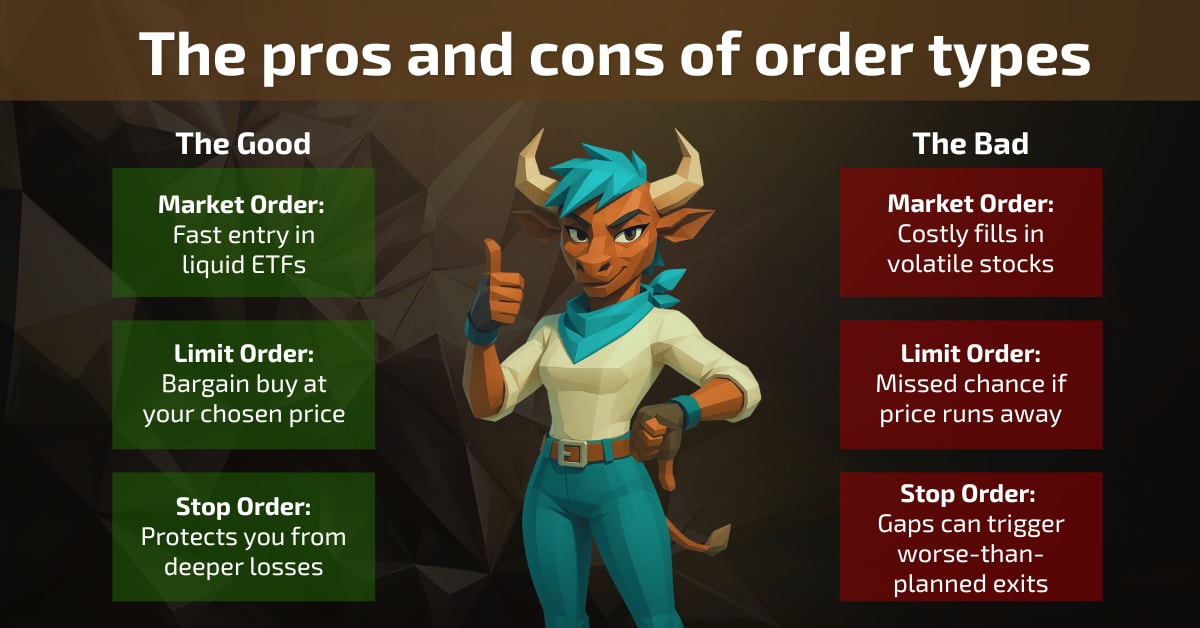
Bullma scrolls her app during lunch break. She wants quick exposure to the S&P 500 ETF, taps buy with a market order, and it fills instantly. Just like ordering a coffee to go, she gets exactly what she asked for, at nearly the same price she saw.
Later that week she sees a meme stock exploding on social media. Same move, same market order. But this time it is like jumping on a bus that is already leaving the station. The fill lands at the peak, and by the time she checks again, she is already in the red.
Bullma has her eye on a tech stock, but she does not want to chase.
She sets a limit order a few dollars below the current price.
Days later, the stock dips, her order fills, and she feels like she scored a bargain.
It is the investing version of waiting for a sale instead of paying full price.
But not every story ends so well. Another stock she liked kept climbing without ever touching her limit.
It is like holding out for a flight deal that never comes, while prices climb higher.
She was right about the stock, but her order never executed, and the rally passed her by.
Bullma finally builds a decent position and wants protection.
She sets a stop-loss 10 % below her entry.
Weeks later the stock slides, her stop triggers, and she is out before the losses get ugly.
It feels like having an emergency brake, not fun to use but it keeps the crash contained.
Then comes earnings season. Overnight, a company she owns gaps down far below her stop.
The next morning her shares sell at a much worse price than planned.
The stop worked, but not how she imagined.
Just like pulling the brake on ice, it slowed the damage, but it could not stop her completely.
No single order type is perfect. Mix them based on context. Use market orders for speed in liquid assets, limits for precision, and stops for protection. The smart move is knowing when each one earns its place.
Now test your execution instincts in the quiz. Then move on to meet the quiet support class of investing and learn how bonds stabilize portfolios when markets turn rough.
