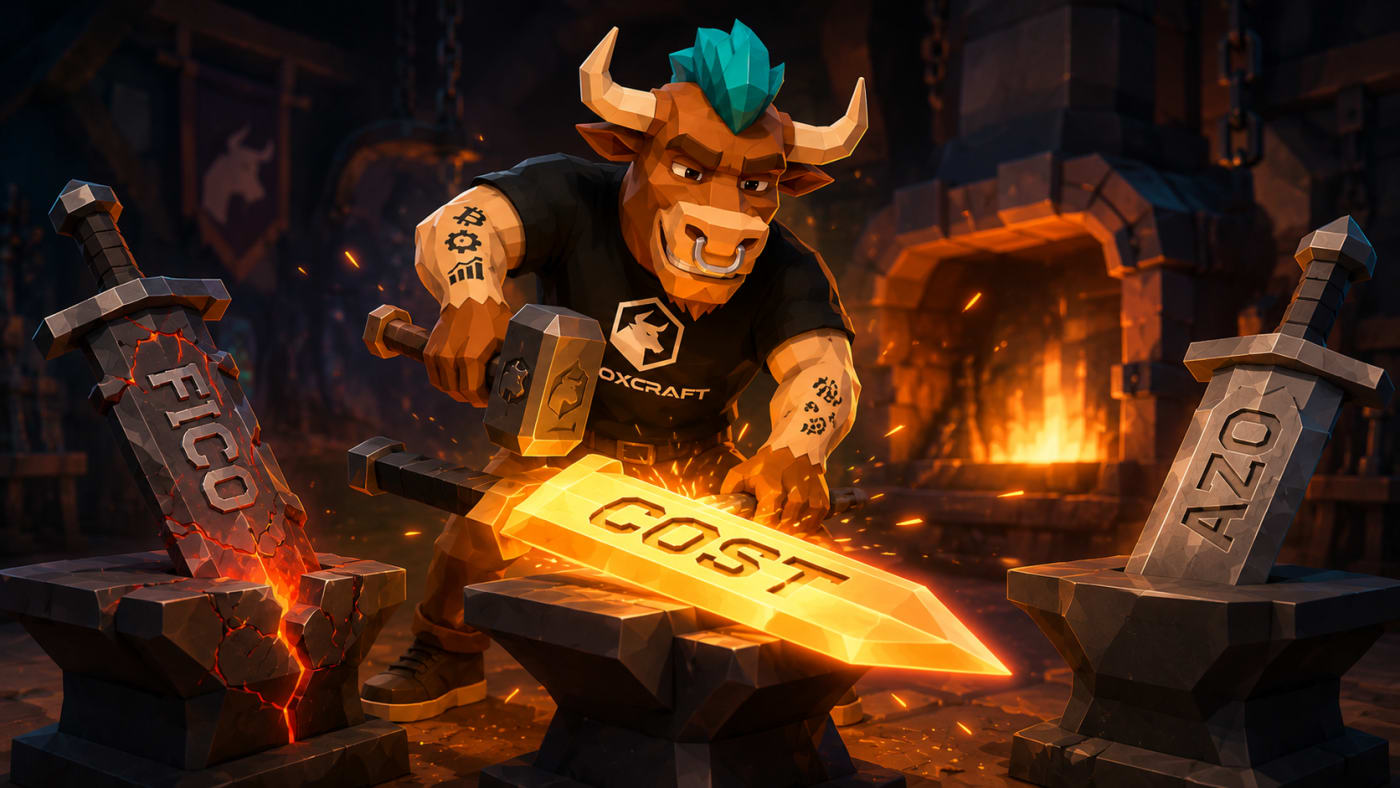
Three stocks keep showing up in every stock split conversation this year. Fair Isaac (FICO) trades above $1,200. Costco (COST) sits near $950. AutoZone (AZO) trades above $3,000.
That price alone gets people talking about a split. But a split doesn't fix a weak business, and it doesn't break a strong one. It's just math.
The real question isn't whether these three stocks look expensive. It's whether their fundamentals can back up the price tag. Stoxcraft's scoring system exists exactly for this. It cuts through the split hype and tells you what's actually happening under the hood.
Metrics feed into the three Core Scores: Health, Performance, and Risk
Why a stock split gets investors excited
A split is one of the easiest stories in the market to get hyped about. The price drops, the share count goes up, and suddenly a stock that felt out of reach looks buyable again.
That reaction isn't irrational. Lower prices can pull in more retail buyers and add liquidity to a stock. But none of that touches the company's free cash flow, debt load, or growth rate.
A split is packaging. It doesn't change what's inside.
Three stocks, one long-running rumor
FICO, COST, and AZO share one thing. Each has a share price that's turned into a talking point on its own.
None of the three companies has confirmed anything. This is speculation, not an announcement, and the gap between "high price" and "confirmed split" matters.








The score verdict: FICO, Costco, and AutoZone
Split hype treats these three stocks the same. Stoxcraft's data doesn't.
Fair Isaac (FICO): great fundamentals, real risk
FICO's Health Score of 8.3 ranks it #98 out of every stock Stoxcraft tracks. That's the top 3% for balance sheet quality. Within Software - Application, it ranks #4 out of 136, driven by a huge profit margin and strong free cash flow.
Performance is where it gets messier. At 5.4, FICO ranks #1,210 of 3,484, almost dead center. A five-year return north of 140% is real. But the past year has wiped out a big chunk of it.
Here's the number that matters most. FICO's Risk Score sits at 9.1, meaning very high risk, placing it in the riskiest 6% of stocks tracked. The stock has dropped by roughly half from its 2025 peak as new competition threatens its mortgage scoring business.
Entry timing doesn't look great right now either. The RSI is sitting in the high 30s, and the trend has been weak for months. FICO's Overall Rating: 3 stars.
Costco (COST): the strongest scorecard of the three
COST's Health Score of 8.2 ranks #122 globally, but the sharper stat is its industry rank: #1 out of 11 Discount Stores. Nobody in that category scores higher.
Performance backs it up. A 7.4 Performance Score puts COST in the top 18% of the entire universe, powered by a 196% five-year return and a 99% three-year return. Both numbers crush the S&P 500 over the same stretch.
Risk is where COST separates itself completely. Its Risk Score of 2.5 means low risk, and it lands in the safest 9% of all stocks tracked. Max drawdown over the past year sits under 5%. Costco's fiscal Q2 profit beat expectations on $1.36B in membership fees, which is exactly the kind of steady cash engine that Health Score is built to catch.
COST's Overall Rating: 4.5 stars, just short of the exclusive 5-star tier.
AutoZone (AZO): steady, but nowhere near cheap
AZO's Health Score of 7.3 ranks #349 globally and #5 out of 40 within Auto - Parts. Strong margins drive the score, even with a debt load typical of buyback-heavy retailers.
Performance sits almost exactly at the market's midpoint, ranked #1,350 overall with a 4.9 score. The three-year return is solid, up nearly 40%. The past six months haven't been, down close to 19%.
Risk is genuinely low here. AZO's Risk Score of 2.9 means low risk, and a beta of just 0.36 makes it one of the calmest names in this whole comparison.
Timing is the weak spot. The trend has been falling for three straight months. AZO's Overall Rating: 3.5 stars.
Which of these three actually earns its price tag
Line up all three scorecards and one stock separates from the pack. COST combines a top-tier Health Score with a top-20% Performance Score and one of the lowest Risk Scores on this list. That's rare.
AZO shares COST's low-risk profile and solid fundamentals, but its performance and entry timing are both weaker right now. Call it the steadier, less exciting version of the same story.
FICO is the outlier. Elite fundamentals sit next to the highest risk profile of the three, and the entry signal is unattractive. Strong balance sheet, weak trend, bad timing. That combination looks more like a value trap than a split story.
What history says about stocks after they split
Split hype isn't pure fiction. Companies that have split their stock since 1980 have averaged a 25.4% return in the 12 months after the announcement. That's more than double the S&P 500's 11.9% average over the same stretch.
But the causation runs backward. Companies tend to split only after their stock has already climbed hard. Strong fundamentals come first. The split comes later.
The split doesn't cause the outperformance. Strong scores usually do, and the split just tends to show up next to them.
Forget the split date. Watch the fundamentals instead
None of these three companies has announced a split. Nobody knows exactly when, or if, one's coming. What Stoxcraft's data can tell you is which stock is actually built to handle it.
COST's scorecard leads this group by a wide margin. AZO is close behind on safety and fundamentals, but weaker on timing. FICO's balance sheet is excellent, but its risk profile and entry timing both argue for caution.
A split can make a stock more accessible. It can't fix a weak trend or lower a Risk Score. That work is already done, or not done, long before any board announces a split date.