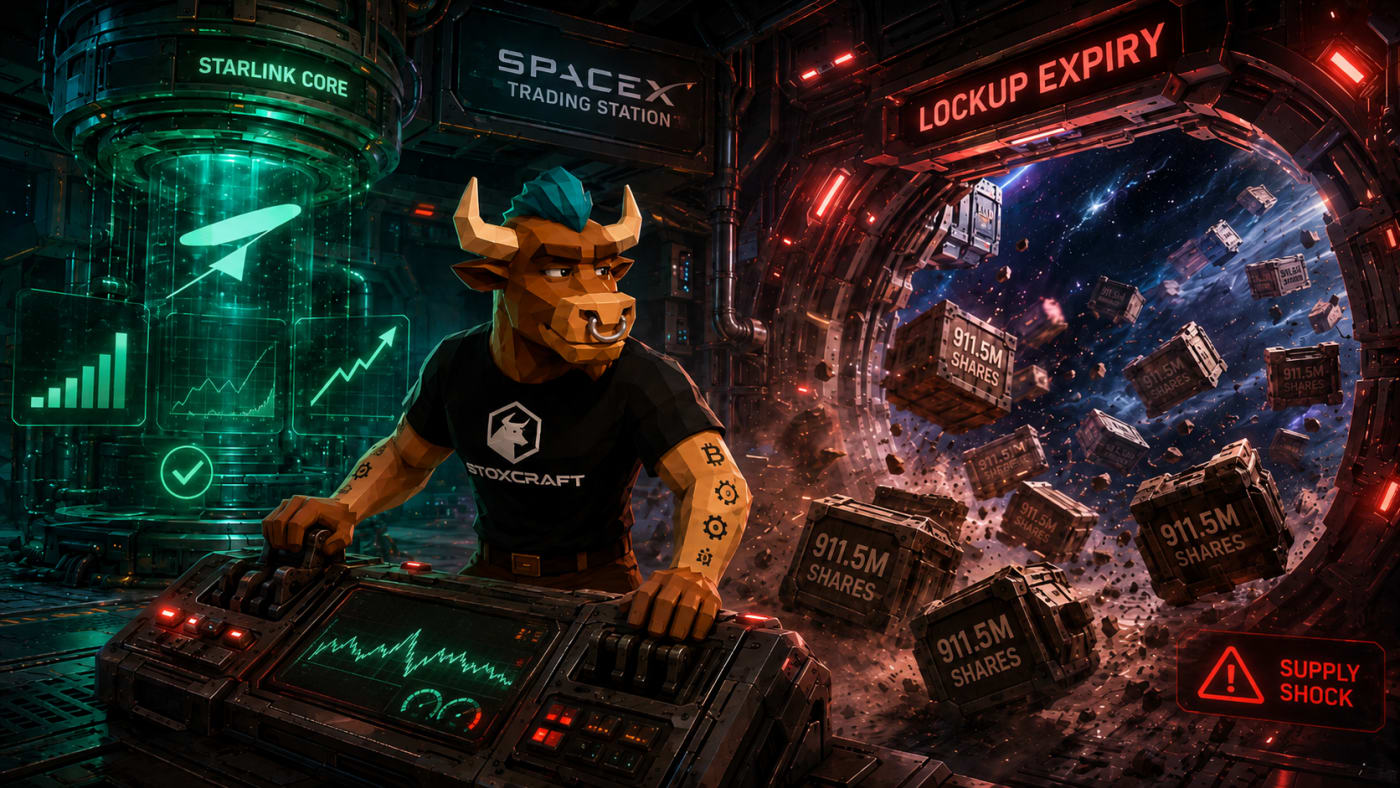
SpaceX just proved its business is scaling. Today it's proving something else: what happens when a record-breaking IPO's lockup period starts to unwind.
The beat: growth that's actually accelerating
SpaceX's first earnings report as a public company, released Tuesday after the close, showed revenue of $7.81 billion for the second quarter, up 92% year over year and roughly $1 billion ahead of the $6.8 billion analysts had modeled, according to Quartz's earnings coverage. Every segment beat, led by Starlink connectivity revenue, which rose 66% to $4.3 billion against a $3.83 billion estimate.
The bottom line improved just as sharply. Net loss narrowed to $541 million from $1 billion in the year-ago quarter, and adjusted EBITDA jumped 191% to $3.5 billion, even as average revenue per Starlink subscriber fell 22% on the company's push into cheaper international plans. On paper, this is exactly the trajectory an $85.7 billion IPO is supposed to deliver: faster growth, shrinking losses, expanding margins.
The catch: capex nobody modeled for
Capital expenditures came in at $18.4 billion for the quarter, well above the roughly $13 billion analysts had penciled in, per a detailed breakdown of the print. That single number did more to move the stock than the revenue beat did. Shares fell as much as 8% in after-hours trading once the capex figure hit the tape, even after climbing nearly 10% during the regular session on optimism heading into the print.
Heavy spending isn't new for SpaceX. Starship development, Starlink satellite production, and expanding launch cadence all eat cash long before they show up as revenue. The market's concern isn't that the spending is happening, it's the pace: a jump this far above consensus raises the question of how much further capex guidance could climb before 2026 is out.
The bigger story: today's lockup
Here's what actually makes today different from a normal earnings reaction. SpaceX's IPO in June priced shares at $135, raising $85.7 billion in the largest public offering in history, but only around 4 to 5% of total shares actually floated at listing. The rest sat under a staggered lockup schedule, with the first tranche tied directly to this earnings date.
That first tranche opens today, freeing up to 911.5 million shares, about 20% of the restricted pool, for insiders and early holders to sell, per a breakdown of the unlock mechanics. To put that in perspective: it's more than double the stock's entire tradable float since the IPO. A further 10% could unlock if the stock manages to close 30% above its IPO price on enough sessions beforehand, a bar SpaceX is nowhere near right now given shares have already fallen more than 20% below the $135 issue price.
Stoxcraft's own data shows SPCX down over 13% today, with a Risk Score of 6.6, elevated but not the maximum on the scale, and a Health Score of just 1.5, both consistent with a young, capital-intensive, still-loss-making company navigating its first real supply test as a public stock. The Performance Score reads 0, unsurprising for a name with only weeks of trading history and no multi-year track record to measure against. Put together, that's an Overall Rating of just 0.5 stars, the lowest of any name in Stoxcraft's coverage of the sector right now.
This isn't the last unlock either
Under the staggered schedule, another 7% tranche unlocks roughly every 15 days through the fall, with a larger 28% slice tied to SpaceX's third-quarter results later this year. The full 180-day lockup, covering Elon Musk's stake and the remaining early investors, doesn't clear until December 8. That means today's reaction, however it plays out, is really just the first data point in a supply story that runs through the rest of 2026.
What this means for the rest of the sector
SpaceX isn't trading in isolation. Rocket Lab and AST SpaceMobile, two of the more speculative space names Stoxcraft tracks, both carry similarly steep risk profiles: RKLB's Risk Score sits at the maximum 10 with a Health Score of 1.7, while ASTS shows the same maxed-out Risk Score alongside a Health Score of 1.5. Both stocks have posted enormous multi-year gains, RKLB up over 1,000% across three years, ASTS up over 1,450%, built on the same kind of story SpaceX is now telling as a public company: rapid growth, heavy losses, and a market willing to pay up for the narrative. Both also carry a 2-star Overall Rating, still well ahead of SpaceX's 0.5 stars, mostly on the strength of a longer trading history that smooths out the swings a two-month-old stock hasn't had time to work through.
Lockup expirations aren't unique to SpaceX, and market history offers a mixed verdict on how much they actually matter, as a deep dive into SpaceX's lockup schedule lays out. Facebook's 2012 lockup expiry triggered a sharp selloff as employees rushed for the exits. Rivian and Beyond Meat saw similar single-session drops around their own unlock dates. But in each case, the stock recovered its footing within weeks once the initial supply was absorbed. The size of SpaceX's tranche, over $100 billion at current prices, dwarfs any of those precedents, which is exactly why analysts are treating today as a real test rather than a formality.






None of that means today's unlock is destiny. Eligible to sell doesn't mean everyone sells; taxes, lockup preferences, and long-term conviction all cut against a full dump. But with short interest already elevated and a supply shock this large hitting a stock that's already underwater against its IPO price, the next few sessions matter more for SpaceX's near-term direction than the earnings beat that preceded them.
See how SPCX, RKLB, and ASTS stack up against the rest of the Industrials sector on the Stoxcraft Screener, and track the rest of this week's reports on the Stoxcraft earnings calendar.
Disclaimer: This article reflects data as of publication and is for informational purposes only. It is not financial advice. Stoxcraft Scores are quantitative indicators, not buy or sell recommendations.