AI is everywhere right now, and nobody fully agrees on what it actually does. That confusion follows it straight into every "AI stock screener" pitch you see today. One week AI is replacing jobs. The next it is just autocomplete with better marketing.
Stock screeners caught the same wave of hype. Every platform claims AI now, the Stoxcraft Screener included. Real data and real math sit behind that label, not magic. The mystery only shows up when nobody explains what happens in between.
This piece breaks down what actually feeds an AI stock screener, one part at a time. It covers how the scoring works. It shows where "AI" earns its label instead of just decorating a filter list. Then it covers how to use one without treating the score as gospel. None of this needs a finance degree to follow.
What data feeds an AI stock screener
Every screener starts with data. The real question is which data, and how much of it moves the needle.
Fundamental numbers set the baseline
Fundamentals still carry the most weight in almost every model. They tell you if a business actually makes money before anything else gets weighed. A few numbers matter more than the rest.
- Revenue growth over the last few years, not just one good quarter.
- Profit margins, since a company can grow sales and still lose money.
- Free cash flow, the cash left over after real bills get paid.
- Debt levels, which decide how much trouble a bad year could cause.
Nvidia (NVDA) shows how these fundamentals stack up in practice. Its revenue growth alone would push almost any model's score higher. Strong profit margins and heavy free cash flow add even more weight on top. High debt would drag that score back down, but Nvidia barely carries any. The P/E ratio alone rarely decides anything on its own. It is one input among dozens, not the whole verdict.
Price and momentum data add context
Fundamentals tell you if a company is healthy. Price data tells you if the market has noticed yet. Think of it like a game. Fundamentals are the stat sheet. Price action is the live scoreboard everyone else is already watching. Screeners track momentum, moving averages, and trading volume. That combination catches shifts before they show up in a quarterly report. A breakout pattern or a volume spike often moves first. A stock can look cheap on paper and still keep falling. The fundamentals just have not caught up to the story yet.
Sentiment data is the newest, noisiest input
Some screeners now scan news headlines and analyst rating changes. Others track social chatter for market sentiment too. This is the newest layer, and the noisiest one. Sentiment shifts fast and reverses just as fast. Most serious models treat it as a small adjustment. It rarely drives a score on its own.
How AI scoring models turn data into a rank
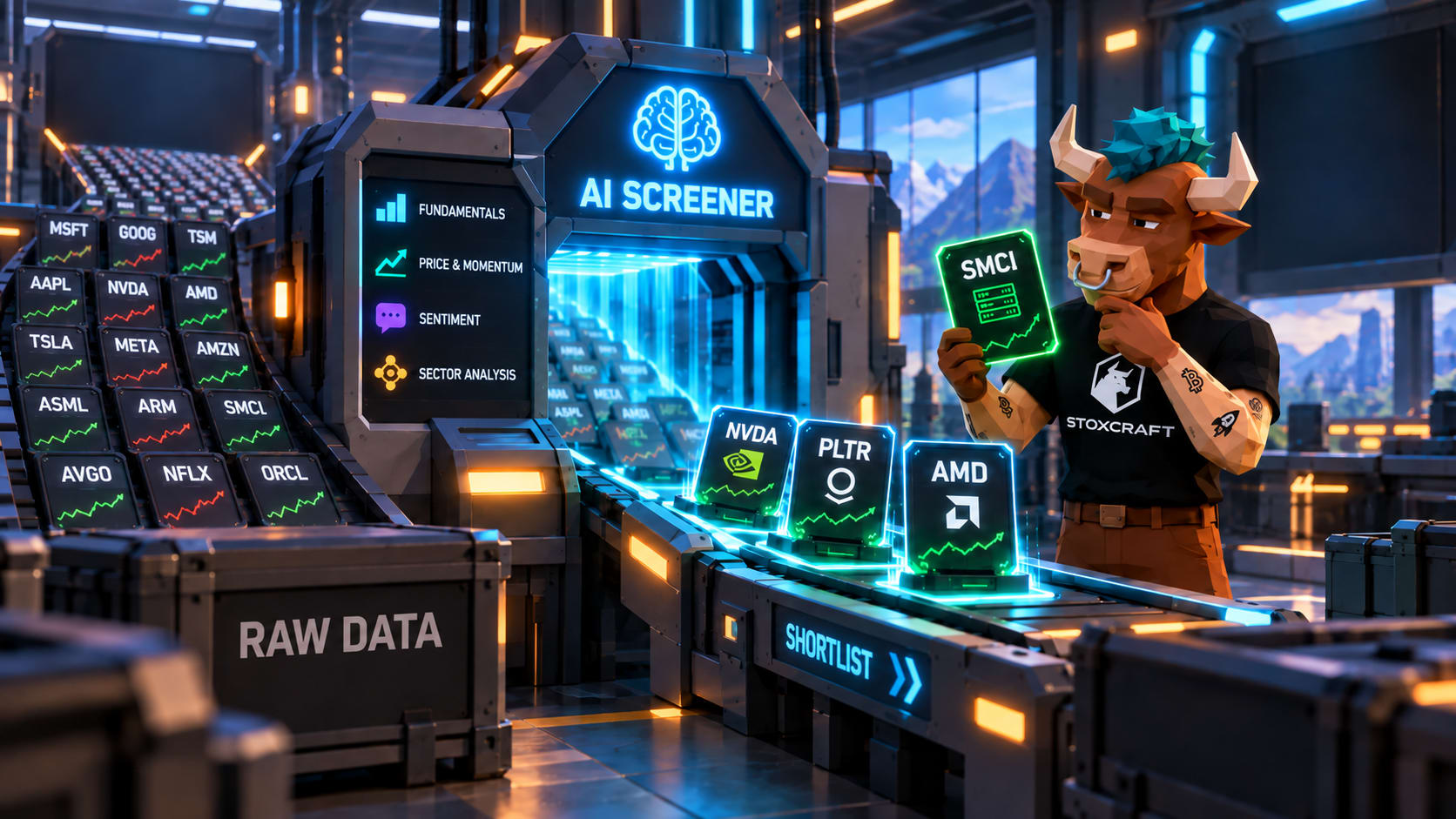
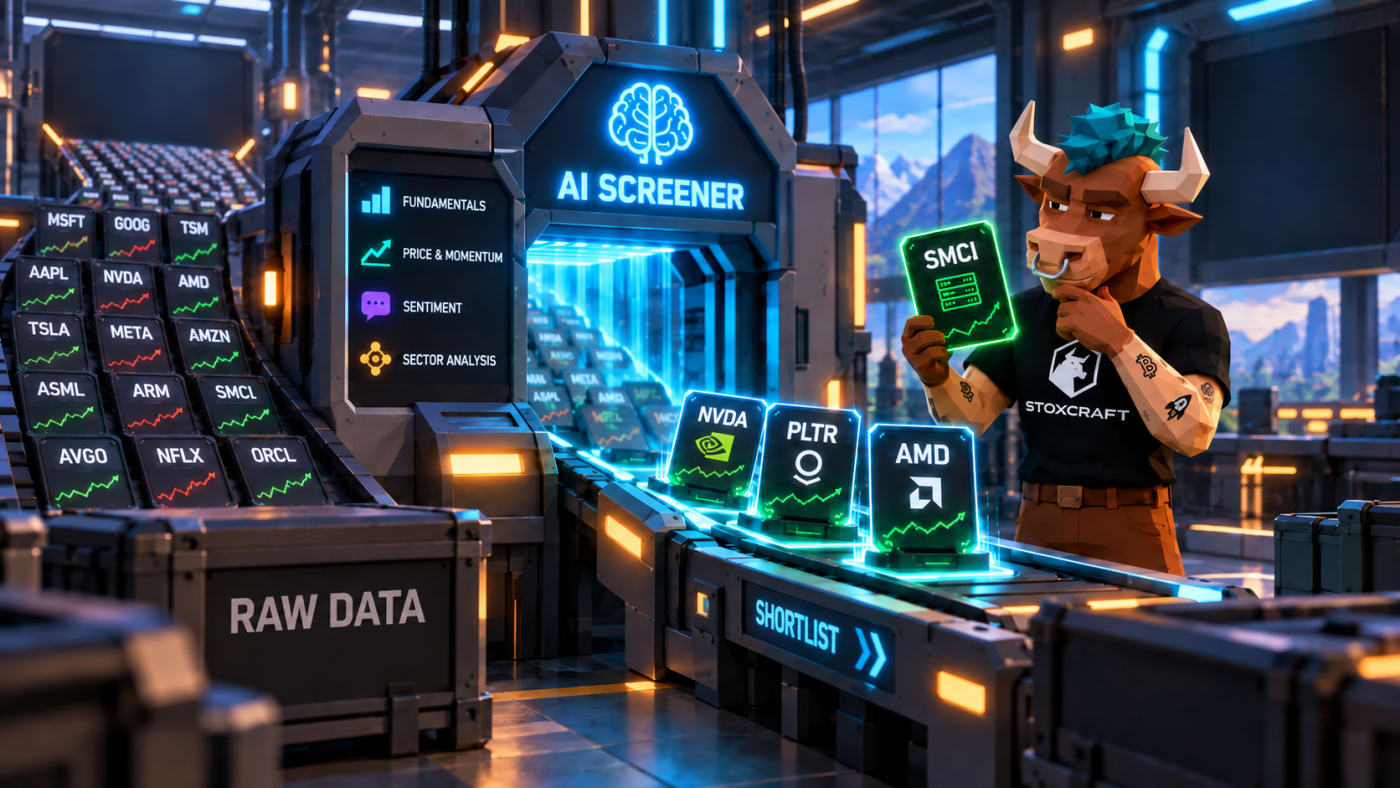
Once the data is in, a model has real work to do. It has to make sectors comparable to each other first. A biotech company and a bank cannot share one scale. Most models run through the same basic pipeline.
- Normalize every metric against sector peers, not the whole market.
- Weight each factor by how well it has predicted returns before.
- Run the weighted inputs through a model trained on years of data.
- Output a single score investors can scan in seconds.
Most stock-screening AI is not a black box making judgment calls. It is a statistical model. It finds which mix of metrics lined up with strong returns before. It scores new stocks against that same pattern.
That gap is the part most marketing pages skip entirely. A model is not reasoning about a company like an analyst would. It is pattern matching at a large scale instead. It scans thousands of names at once, something no analyst could do alone.
Where the Stoxcraft Screener's AI adds real signal
The honest case for AI here is speed and coverage, not genius. The Stoxcraft Screener currently tracks 3,537 stocks across the market. No human research team checks that many balance sheets daily.
Human stock pickers do not have a great track record either. 79% of U.S. large-cap fund managers underperformed the S&P 500 in 2025, per Yahoo Finance. In plain terms, four out of five paid experts lost to a plain index fund. That is the real bar an AI model has to clear, not perfection. Forbes has pointed out something else too. Retail investors used to need a Bloomberg terminal and a six-figure budget for this kind of research. Broad access to institutional-grade tools is closing a gap that used to favor big trading desks only. That is exactly the gap a free screener like Stoxcraft's is built to close.
Where AI genuinely earns its place:
- Scanning thousands of names against the same criteria at once.
- Flagging a change in fundamentals the same day it happens.
- Comparing a stock's own history against its sector, not just a headline number.
Nvidia (NVDA) and Palantir (PLTR) get flagged often by these models. So does AMD (AMD). They sit inside the same AI trade, so the same headline can move all three at once. A big chip order or a hyperscaler earnings call ripples across every name in that group instantly.





Some of this is just marketing, not real AI. A platform slaps the word "AI" on a basic filter to sound impressive. Running an old checklist on a server does not make it smart. It is still just a checklist, no matter what you call it. If a platform will not explain which numbers drive its score, that is a warning sign. It is not something to brag about.
How to use the Stoxcraft Screener without overtrusting the score
A high score is a starting point. It is never a finish line on its own. Two habits keep a screener useful instead of dangerous.
Treat the score as a shortlist, not a verdict
Use a screener the way you would use a search engine. It narrows millions of options down to a short list. That short list is still worth reading closely before you act. The reading part is still yours to do. No model has read this quarter's earnings call with real judgment.
Check the raw numbers behind the score before you buy
Open the actual financials before acting on any single score. Pair the screener with your own numbers every time. Never trust the headline rating on its own. Want the full breakdown of how Stoxcraft weighs its own factors? The Stoxcraft scoring system post walks through every piece of the model. The Stoxcraft Screener is where you run those filters next.
The AI hype around investing has only grown louder this year. Stoxcraft's own look at the rise of AI in global markets covers that shift. A screener is one tool inside it. It is never a replacement for reading the numbers yourself.
Quick gut check before the wrap. See if the mechanics above actually stuck.
A screener finds candidates. You still make the call.
An AI stock screener does one job well. It narrows thousands of names down to a short list worth your time. It does not replace due diligence, and it never will. A good screener's model runs on real fundamentals and real price data. It adds a growing sentiment layer on top. All of it gets scored consistently across thousands of stocks. That means you do not have to check every one by hand.
Use the score to build the short list. Use your own reading to make the final call. The model does the sorting. You still do the deciding.