Quick Start
Match your mindset with tools built for your strategy


Every investor has a blueprint. It's a mix of psychology, goals, risk tolerance, and the stories you tell yourself about money. Your style isn't something you choose overnight. It's shaped by how you react to uncertainty, how you define success, and what you value more: freedom, stability, or control.
Understanding your investing personality helps you make smarter choices when markets test your emotions. It turns guesswork into self-awareness and random trades into a strategy that actually fits you.
Your investing style is built from three main elements: mindset, goals, and risk tolerance.
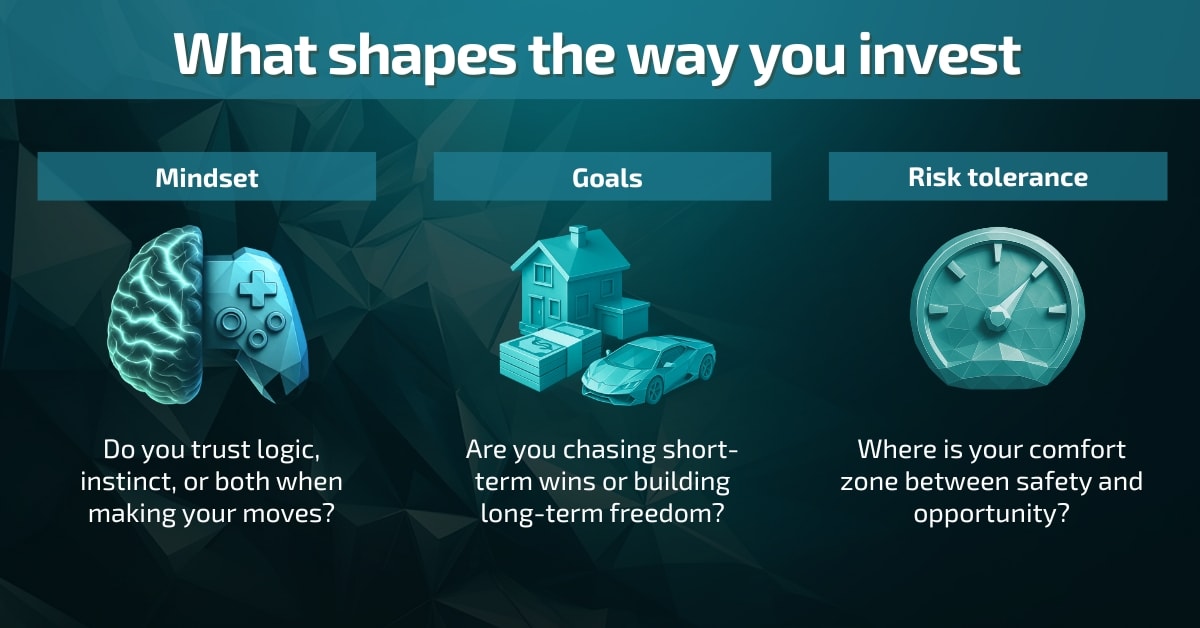
Your mindset decides how patient you are.
Your goals define what you're aiming for.
And your risk tolerance reveals how much volatility you can stand before losing sleep.
The balance between these three elements determines your approach.
A long-term builder accepts short-term dips because the goal is future growth.
A momentum trader accepts chaos because the excitement of timing the market feels worth the ride.
Several theories try to describe investor behavior.
One is the Barnewall Two-Way Model, which separates passive and active investors.
Another is the Bailard, Biehl and Kaiser Model, which identifies five types: adventurer, celebrity, guardian, individualist, and straight arrow.
You don't have to fit perfectly into one box.
These frameworks simply help you recognize patterns in how you think.
Are you more analytical or intuitive?
Do you prefer control or delegation?
The answers point toward your natural rhythm as an investor.
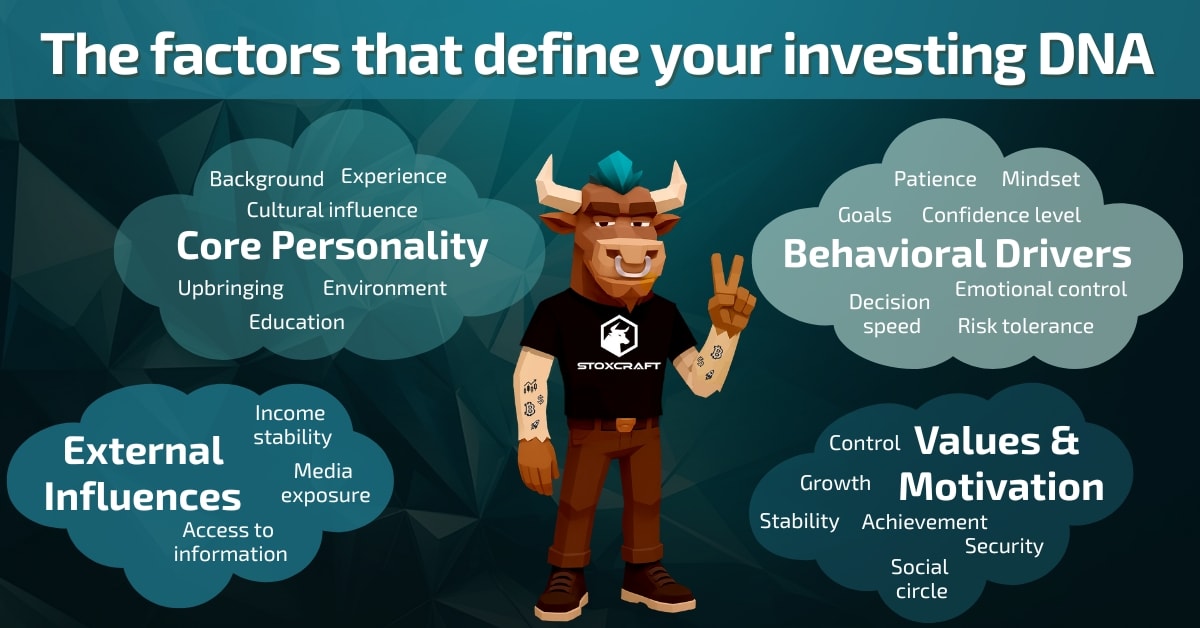
Your background, education, and experience all influence how you invest.
Someone who grew up during a market crash may always stay cautious.
Someone who witnessed early tech booms may forever chase growth.
Even your profession and social circle matter.
Engineers often value structure and precision.
Entrepreneurs tend to see volatility as part of the process.
And gamers? They think in systems.
They understand progression, probabilities, and adapting to new environments faster than most.
Stoxcraft is built with that mindset. It transforms gaming instincts like pattern recognition, timing, and risk assessment into real investing skills.
The goal isn't to label yourself but to understand how your experiences shape your view of the market.
Finding your investing style starts with honest reflection.
Ask yourself:
Do I feel more comfortable planning or reacting?
What would make me quit an investment: emotion or logic?
Am I investing to build wealth, to prove something, or to feel secure?
How much loss can I tolerate before I change my plan?
These questions help uncover what truly drives your behavior. Once you know that, your strategy becomes natural and sustainable.
Knowing your investor type gives you clarity and direction. You stop copying strategies that don't fit and start focusing on those that match your instincts.
In Stoxcraft, this awareness becomes your advantage. Every score, portfolio, and lesson adapts to your natural style.
Next, you'll see how this knowledge plays out when theory meets real decisions.
Core takeaways:
Next, you will see how this knowledge plays out when theory meets real decisions.
