Quick Start
The hidden shortcuts sabotaging your decisions


Investing feels like a rational, strategic game. Charts, numbers, data.
But under the surface, your brain is running on fast guesses and shortcuts.
You like to think your choices are objective. But often, you’re just filtering reality to fit what you already believe. That’s not bad character. That’s a bug in human cognition.
Biases are mental habits. They save time, reduce friction, and feel right.
But in investing, what feels right is often what costs you.
Like replaying a strategy from your favorite game that once worked, even if the rules have changed.
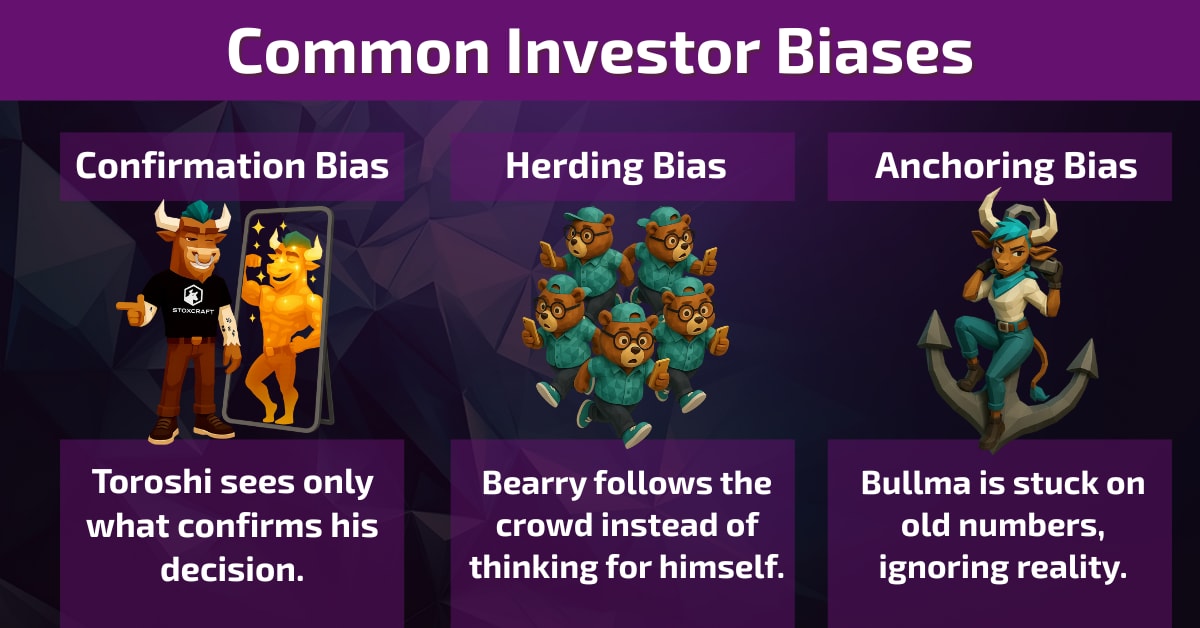
You pick a stock, then look for reasons it’s a smart move.
You ignore the red flags. You downplay criticism. You read bullish headlines and skip the bearish ones.
That’s confirmation bias.
It’s comforting. But it kills objectivity.
And the worst part? It doesn’t feel like bias. It feels like doing research.
Like rewatching a review video just to feel better about a purchase you already made.
You see everyone buying something. It’s all over Reddit. Twitter. TikTok.
You feel behind. You act fast.
Herding is your brain outsourcing thinking.
If others are doing it, it must be safe. Must be right.
But in markets, the crowd is usually early or late. Rarely right on time.
Like buying that cool Fortnite skin you saw everywhere, only to log in and realize the whole lobby’s wearing it ....and now it just feels mid.
You remember when a stock was $120.
Now it’s $75. You think, it has to go back.
That number becomes your anchor.
But anchors don’t care about fundamentals, trends, or reality. They just feel familiar.
So you hold longer than you should. Or you buy based on old prices, not current value.
Core takeaways:
You don’t need to become perfectly objective.
You just need to catch yourself in the act.
Let’s walk through a real-world situation where these biases quietly take control.
