Quick Start
What real investing means and why it actually works

Imagine you're dropped into a new open-world game. No tutorial. No map. Just chaos. You wander around, pick up coins, open random loot, maybe level up a bit, but you’re not really sure what the goal is.
That’s how most people approach investing. And it’s a problem.
Because investing isn’t reserved for suits, boomers, or crypto bros. It’s not a bet. It’s not a trend. It’s a system that rewards people who understand how it works and commit to it long-term. No special background required. Just the ability to think ahead and take small steps consistently.
This Deep Dive is your first real step. It won’t make you rich overnight, but it will show you what game you’re actually playing.

Let’s start with the biggest myth. Investing is risky. Saving is safe.
Feels right. But let’s test that logic.
Say you stash 10,000 dollars under your metaphorical mattress or in a basic savings account. With inflation averaging around two to three percent per year, that money quietly loses value. Ten years later, it still says 10,000 dollars, but it buys you far less.
Meanwhile, investing that same amount gives your money the chance to grow. Not guaranteed, but statistically likely. Historically, broad markets like the S&P 500 have returned around seven to ten percent annually after inflation. That’s not luck. That’s math.
So what is investing, really?
At its core, investing means using your money to buy things that create more value over time. Stocks, ETFs or real estate. You put capital into something productive and let time do the heavy lifting.
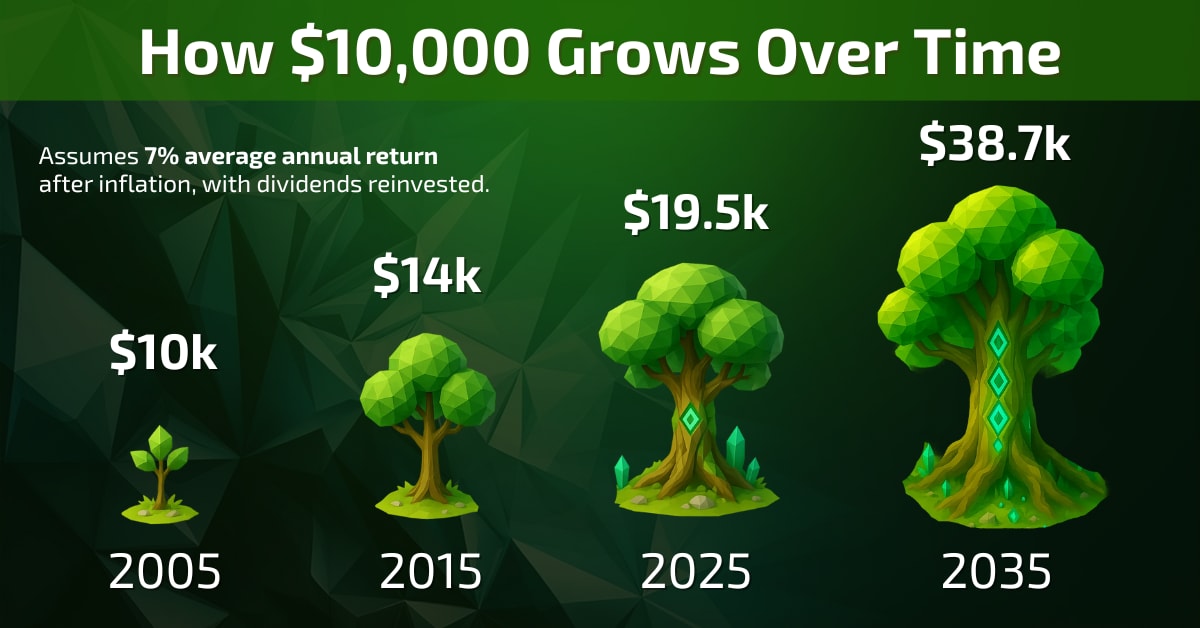
Think of it like planting a tree in your backyard. At first, it looks like nothing’s happening. You water it, protect it, maybe even forget about it for a while. But season by season, it takes root. It grows. And one day, it provides shade, fruit, or firewood without you doing much at all.
It’s the same with investing. At first, it feels slow. Then compounding kicks in. Reinvested gains feed future gains. And suddenly, your momentum takes on a life of its own.
You might think, how can I trust markets when the world feels like it’s on fire?
Valid question. But zoom out.
Markets reflect companies, and companies grow because people solve problems. New tech. Better systems. Smarter logistics. Sure, there are crashes. But over the long run, progress tends to win.
Look at the last hundred years. From telegrams to TikTok. From bikes to spaceflight. Through wars, recessions, pandemics, markets kept climbing. Not in a straight line, but on a long-term trend.
Investing in markets means you’re not betting on one moment. You’re backing the entire engine of human innovation.
Standing still feels safe. But it’s not.
Every year you wait, you lose time and momentum. Compounding works best when it starts early.
Small steps today outperform big efforts later.
And here’s the twist. Even if you avoid investing, you’re still affected by it. Your job, your rent, your favorite brands, your pension. All of it moves with the markets. Learning how it works doesn’t just protect you. It empowers you.
Core takeaways:
If theory alone doesn’t do it for you, we’ve got a real-world use case coming up that makes all of this even easier to grasp.
