Quick Start
Get the basics on stocks, bonds, crypto and more


In every game, some characters deal massive damage, others tank hits, and a few quietly support from the backline. Your portfolio works the same way.
Asset classes are the building blocks of every investment portfolio. Each one behaves differently, reacts to different environments, and serves a different purpose. And when you combine them strategically, they can cover each other’s weaknesses and boost your overall stability.
Let’s break them down.

Stocks - The high-voltage growth engine of your portfolio
Type: Shares in public companies
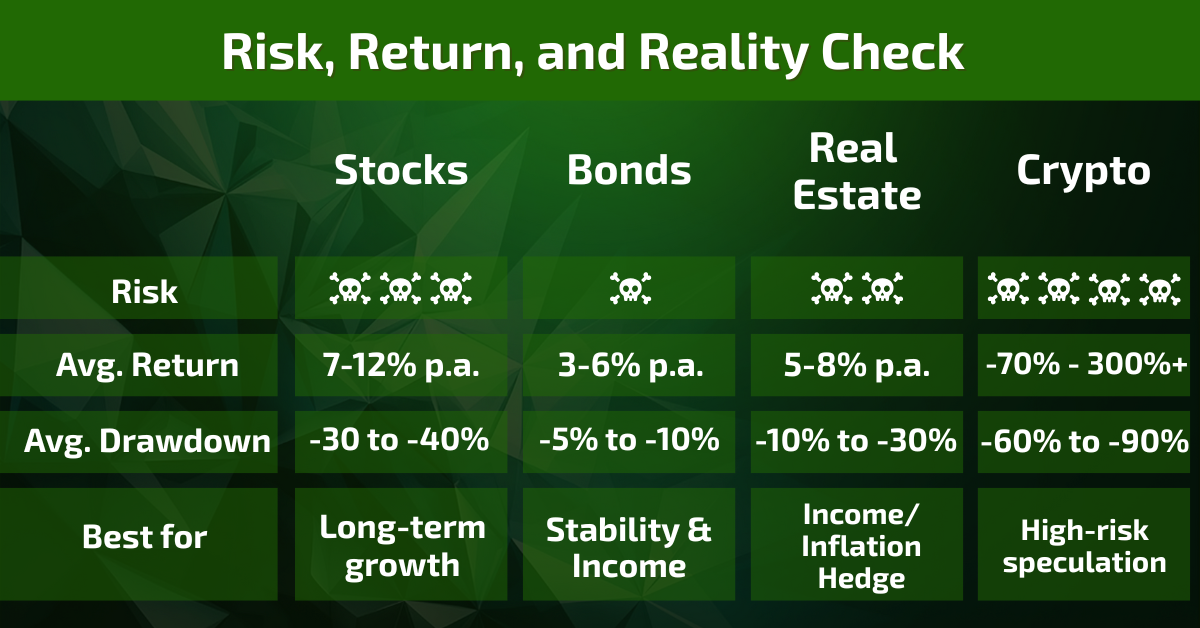
Risk: ☠️☠️☠️
Performance: ????
Stocks represent partial ownership in a publicly traded company. When you buy a stock, you're buying a claim on the company’s future profits and performance. Their prices move based on earnings, news, market sentiment, and broader economic trends. They’re liquid, accessible, and a cornerstone of most long-term portfolios.
They’re volatile, but historically deliver strong long-term returns. Great for growth, not ideal if you panic easily.
Bonds - The steady hand when markets get shaky
Type: Loans to companies or governments
Risk: ☠️
Performance: ??
Bonds are debt instruments issued by companies or governments. When you buy a bond, you're lending money in exchange for regular interest payments and the return of your principal after a set period. They're typically less volatile than stocks, and often act as a stabilizer during market downturns.
More stable and predictable. Lower returns, but a solid base when markets are shaky or you're closer to retirement.
Real Estate - The slow tank that pays rent and holds the line
Type: Physical or listed property
Risk: ☠️☠️
Performance: ???
Real estate investing involves purchasing physical properties (like rental housing or commercial buildings) or financial products tied to them (like REITs). Real estate can provide both capital appreciation and income through rent. It’s less liquid than stocks or bonds, but often seen as a hedge against inflation.
Tangible and income-generating. Slower to grow, harder to sell, but inflation-resistant and useful for diversification.
Crypto - The chaos card that can print or vanish wealth
Type: Digital assets and tokens
Risk: ☠️☠️☠️☠️
Performance: ?????
Cryptocurrencies are digital assets built on blockchain technology. Unlike stocks or bonds, they aren’t backed by cash flows or physical assets. Instead, their value is driven by supply, demand, utility and speculation. Bitcoin, Ethereum and others have grown popular as alternative stores of value, but they remain highly volatile and unregulated.
Massive upside potential, massive volatility. Highly speculative. Use it sparingly and never bet what you can’t lose.
If you’re young and hungry for growth, stocks and a dash of crypto might be your playground.
If you value stability and sleep at night, bonds or real estate play the defense role.
If you want income, real estate and dividend stocks might carry more weight.
And if you hate sudden swings, diversification is your best friend.
You don’t have to go all in on any one type. The magic happens in the mix when offense, defense and utility all work together.
Core takeaways:
Next up: A real-world breakdown of how different mixes perform and what that means for you.
