Quick Start
How trades actually move through the market system


You tap buy, a confetti pop appears, and it feels instant.
Under the hood a chain reaction starts.
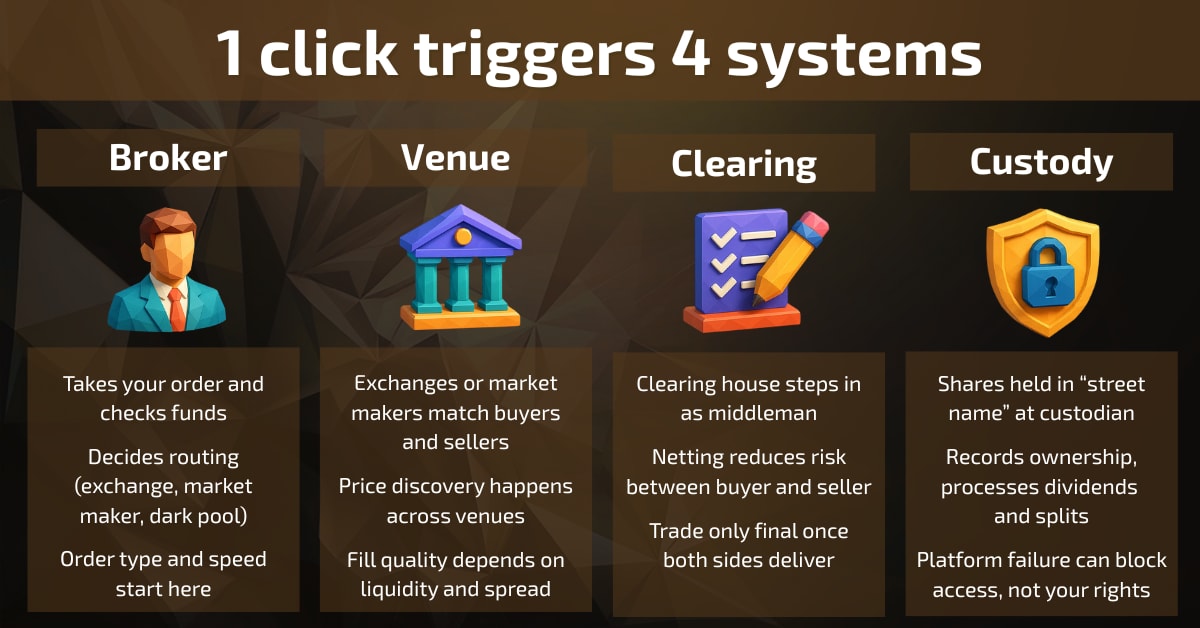
Your broker receives the order, checks funding and account flags, then decides where to send it.
Liquidity, speed, fees, and business incentives all shape that choice. On the receiving side, venues compete to fill you at the best available price. After the fill, other firms step in to make the trade final and store your assets safely. Knowing this path helps you judge cost, reliability, and what ownership really means.

Your broker is the gatekeeper. It validates cash or margin, applies risk checks, and picks a route.
Some orders go to exchanges, others to market makers for rapid fills. Smart order routers weigh price, fill probability, and rebates. Business models matter. Payment for order flow can align with fast execution, but may also shape routing choices.
You can often choose order type and venue preferences.
Limit order versus market order, time-in-force, and odd lots all affect outcomes.
The first decision point already influences your price and speed.
Exchanges list the order book, but much activity also happens with market makers who post continuous quotes and commit capital to fill retail flow. They earn the spread and manage inventory risk while competing on execution quality. Price discovery aggregates across venues through the national best price or similar constructs.
During volatile moments, halts or wide spreads can appear and slippage grows.
Dark pools match orders away from the lit book to reduce impact.
Where your order meets liquidity determines whether you save basis points or give them up.
A matched trade is only a promise until it settles.
Clearing houses step between buyer and seller to manage counterparty risk and net obligations.
On settlement date, cash moves and shares are delivered. Afterward, custodians safeguard the assets, record entitlements, and process dividends and corporate actions. Most retail holdings sit in street name, giving you beneficial ownership while the custodian handles the plumbing.
Outages, broker distress, or corporate events test this system.
Understanding who holds what, and under which protections, clarifies your real risk and rights.
Core takeaways:
One tap sets brokers, venues, clearers, and custodians in motion. Each step can help you or quietly tax you through spreads, routing, and delays. Pick brokers for transparency and protections, use order types with intention, and know who actually holds your assets. If a link fails, speed, price, or access can suffer.
That takes us to the next step.
What happens to you when part of this chain breaks in the real world?
