Quick Start
Why benchmarks and ETFs are not the same


Picture flipping through a recipe book.
You see the ingredient list for a pasta dish: pasta, tomatoes, olive oil, artichokes.
But when two different chefs cook it, one leaves out the artichokes because no one likes them, and the other adds extra chili flakes to spice it up. The list is the same, but the end product you eat can taste very different.
That is the split between an index and an ETF.
The index is just the list.
The ETF is the cooked meal, shaped by whoever prepares it and the rules they follow.

An index is a list. Nothing more, nothing less.
The S&P 500, for example, is a collection of the 500 largest US companies.
It tracks their combined performance but does not let you buy them directly.
Think of it like a shopping list. Until you actually buy the items, the list itself has no function.
This is where ETFs come in.
An ETF takes the blueprint and builds it into something real.
It is a tradable fund that mirrors the index and puts it into a form you can buy like any stock.
In everyday terms, the index is like a playlist someone curates on Spotify, while the ETF is the album you download and play on repeat. Both are linked, but only one is tangible and usable.
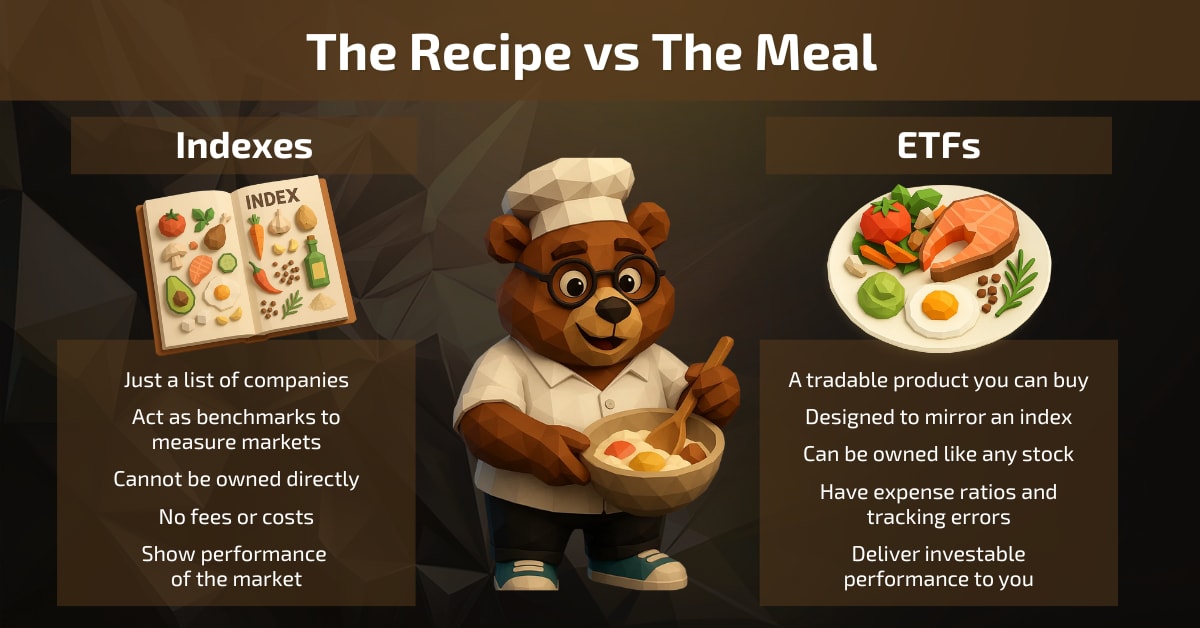
Here is where nuance comes in. ETFs are products created by providers, which means rules and costs.
Expense ratios, replication methods and tracking errors decide how closely the ETF follows the index.
Think about gaming. Two developers might use the same engine to build a game, but one makes it Free to Play while the other turns it into a Pay to Win grind. Same core, completely different experience. Likewise, two ETFs can follow the same index but deliver very different outcomes for investors.
The key is knowing when to use which perspective.
Use indexes as benchmarks: did your portfolio beat the S&P 500?
Use ETFs as products: am I paying fair fees for this exposure, and is the structure sound?
Indexes are not investable, they are references.
ETFs are the products that make those references usable.
The difference seems small, but it changes how you measure results, manage costs and set strategy.
The real question is how this choice plays out in practice. That is where our next step comes in.
