Quick Start
Discover the hidden engine that moves stock prices


When you picture the stock market, you might imagine flashing tickers, shouting traders, and Wall Street chaos. The reality today looks very different.
Modern exchanges are quiet, high-speed networks where machines do the heavy lifting.
Every trade you see on a chart has already passed through a matching engine, an invisible referee connecting buyers with sellers in milliseconds. This engine is the real market. Understanding how it works explains why prices change constantly, why liquidity matters more than hype, and why your trade executes at the price it does.

When you place a buy or sell, your broker does not go looking for someone manually.
The order is transmitted electronically to an exchange.
There, it joins thousands of others in what is called the order book.
This book is a live list of offers to buy or sell at different prices.
Some are from retail investors like you, many from institutions or algorithmic traders.
The exchange does not care who sent them. It just queues them up and prepares to match.
The heart of the market is the matching engine. Think of it as Tinder for trades.
Every buy order is swiping right on the best available sell order, and the engine makes the match in milliseconds.
Prices shift because these matches happen continuously.
If buyers get more aggressive, they push prices higher. If sellers crowd in, prices slide.
Even when you are not trading, someone else is still swiping, and that constant activity keeps the price moving.
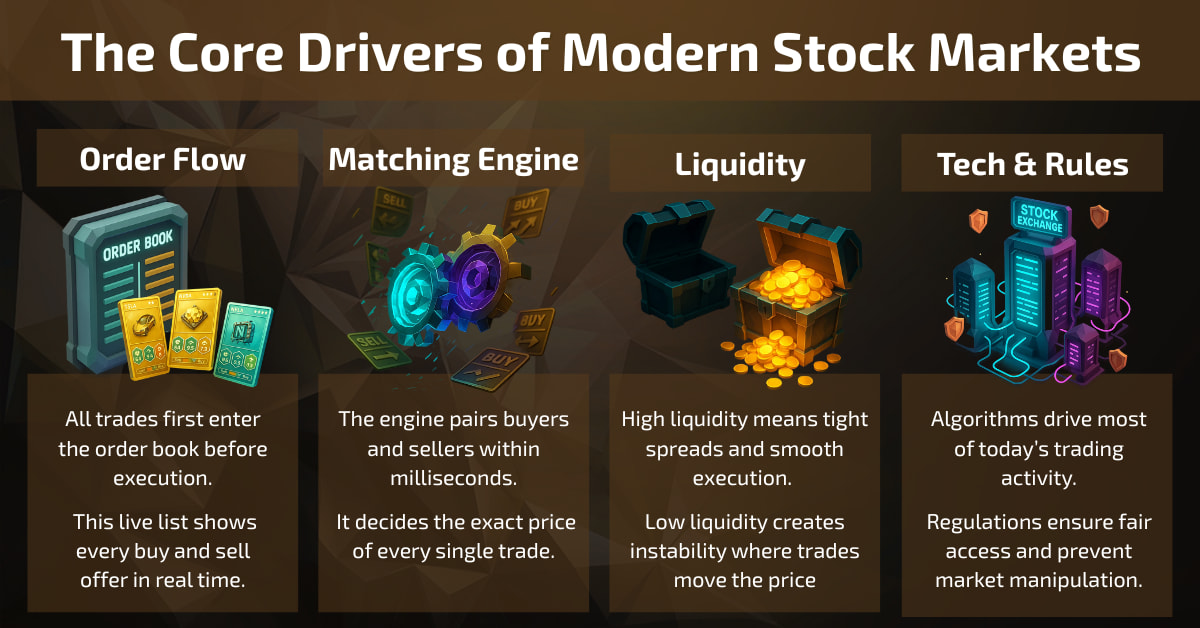
Liquidity is the availability of willing buyers and sellers at every price point.
High liquidity means tight spreads, fast trades, and stable pricing.
Low liquidity means wider spreads and bigger jumps between trades.
Imagine trying to sell your concert ticket in a packed arena versus in an empty parking lot.
The difference in speed and price reliability is massive.
Stocks with high liquidity trade smoothly. Those with thin liquidity can turn every order into turbulence.
Exchanges today are tech ecosystems.
Matching engines run on specialized hardware inside data centers, often colocated with trading firms for extra speed. Algorithms dominate most order flow, competing in microseconds.
At the same time, regulations ensure fair access, preventing any single player from gaming the system completely. What looks chaotic on a chart is in fact a highly structured system where rules and code determine who gets matched and at what price every second of the day.
Once you see the stock market as a machine instead of a crowd, the noise starts making sense.
Every tick, spike, or dip you see is the outcome of supply and demand being paired in real time by invisible engines. It is not about luck or chaos. It is about liquidity and order flow.
Understanding this prepares you for the next step: using that knowledge to trade smarter and interpret price action with clarity.
