Quick Start
Discover how currencies trade and influence global economies

Think about the last time you checked a currency exchange before traveling.
The rate you saw was not random. It was a tiny reflection of the biggest financial market in the world: Forex.
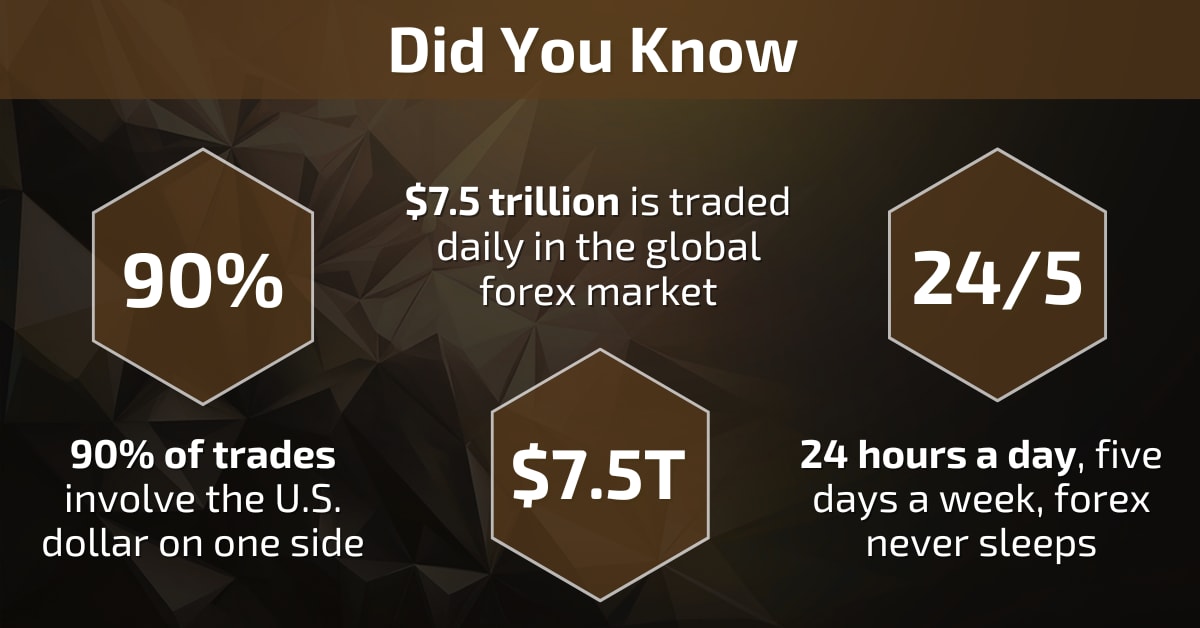
Every day, trillions of dollars move across borders in a nonstop cycle of buying and selling currencies. Unlike the stock market, Forex never closes, and the price you see on that board connects directly to global trade, central bank decisions, and investment flows.
Understanding how it works means understanding the pulse of the global economy.
At its core, Forex is about pairs. Every transaction involves one currency rising against another.
For example, EUR/USD shows how many dollars one euro can buy.
When the euro strengthens, the dollar weakens in that pair.
These moves are influenced by interest rates, inflation expectations, and investor sentiment.
The pair structure is why traders often talk about “longing one currency and shorting another.”
It is always a relative game, not an absolute one.
Tourists buying holiday cash barely scratch the surface.
The real drivers are central banks, hedge funds, multinational corporations, and commercial banks.
Central banks step in to stabilize or stimulate their economies.
Corporations hedge currency risk from global trade.
Hedge funds chase profits through speculation.
These players operate at scales that dwarf retail traders.
That’s why understanding how news moves markets is critical in Forex, where a single policy signal can shift prices worldwide within minutes.
Exchange rates are not just abstract numbers.
They affect daily life in ways most people overlook.
A weak local currency makes imports more expensive, driving up inflation.
A strong currency can hurt exports but make foreign travel cheaper.
Investors holding international assets see returns shift with currency movements, sometimes amplifying or erasing gains. Forex moves shape the cost of living, industry competitiveness, and even government policy.

Unlike stock exchanges with opening bells and closing times, Forex never sleeps.
Sydney kicks things off, then Tokyo, London, and New York take turns leading the flow.
This rolling cycle makes it the most liquid market in existence.
News from one continent spills into the next, so exchange rates can shift in seconds, day or night.
Forex is more than just background noise for travelers. It is the backbone of international trade and finance, a market where shifts in one corner of the world can ripple everywhere else.
Seeing exchange rates as signals, not trivia, is the first step to grasping how money shapes the global game. Next, we explore a scenario that shows how personal these shifts can get.
