Quick Start
What dividends, splits and dilution really mean


Imagine you’re watching a game scoreboard. The numbers don’t change, but somehow your ranking shifts.
That’s what happens in investing when dividends, splits or dilution come into play.
Your stock price might sit still, yet the value of what you hold quietly transforms.
These moves can boost your gains, thin out your ownership, or simply make a stock feel more affordable.
Understanding them is the difference between reading the flashy score and knowing how the game is scored.

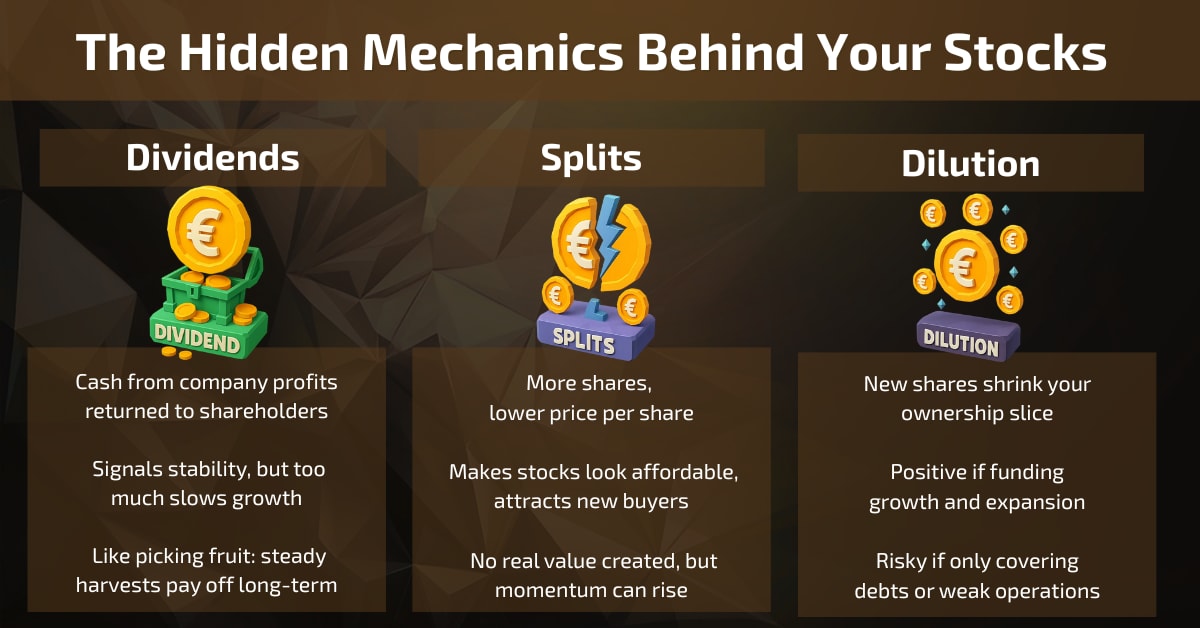
When companies earn money, they can reinvest it or pay part of it back to shareholders as dividends.
A dividend looks like free cash, but it’s your share of the profit being returned.
Reliable dividends often signal stability and confidence, especially in mature businesses.
But high payouts can also mean less reinvestment for growth.
It’s like picking fruit from a tree. Take too much too often and growth slows, but steady harvests can be both rewarding and sustainable.
A stock split is like cutting a pizza into more slices.
You suddenly own more shares, but each is worth less, so the total value is unchanged.
The trick is in psychology: a $100 share feels more approachable than a $1,000 one.
Splits make stocks look affordable, drawing in new investors and sometimes pushing prices higher.
It’s not real value creation, but it can spark momentum.
Dilution occurs when companies issue new shares, reducing your ownership percentage.
This isn’t bad. If new capital funds expansion, innovation or strategic deals, everyone can benefit.
But if shares are printed just to cover debts or finance weak operations, your slice shrinks without added value. The key is context: fresh capital can be rocket fuel, or just a way to keep the lights on.
These mechanics don’t scream for attention like daily price moves, but they accumulate over time.
Dividends often make up a large chunk of total returns.
Splits expand accessibility and can influence demand.
Dilution, if unchecked, erodes your stake quietly.
It’s like booking a flight and ignoring the extra fees. The base price looks fine, but the final cost is very different.
Price charts tell only half the story.
The other half is written in the quiet adjustments that shape your real outcome.
Mastering these mechanics means understanding who really benefits from each move before it reshapes your long-term returns.
Now you’re ready to dive into a Use Case and see how two investors experience these changes differently.
